Mirach is your guide star to finding 3 galaxies
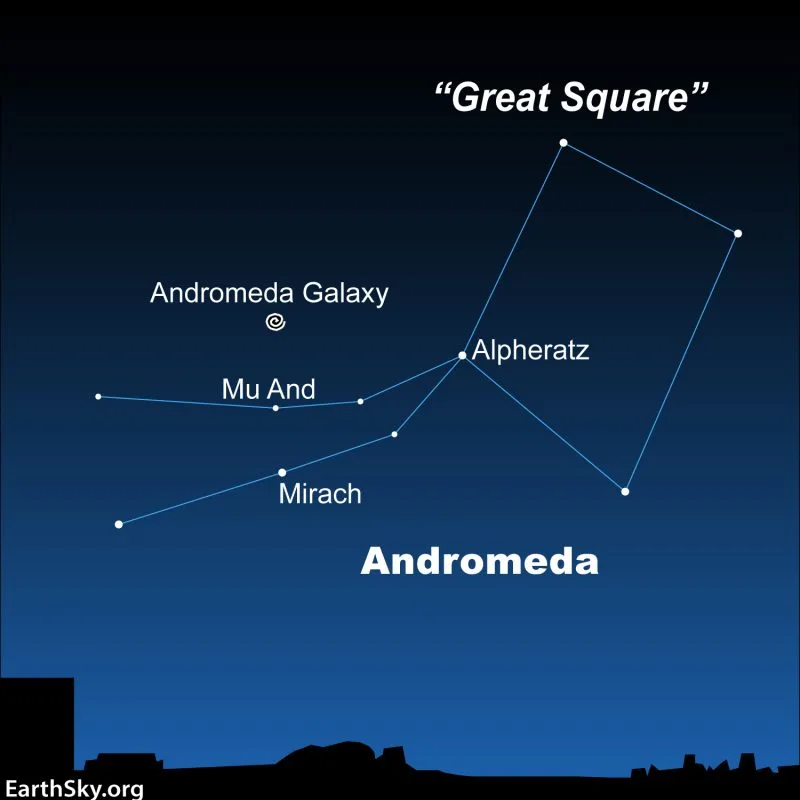
Mirach, also known as Beta Andromedae, is a star in the constellation Andromeda. It’s only moderately bright. But it’s an important star to stargazers, as it can act as a signpost to three galaxies: the Andromeda galaxy (M31), the Triangulum galaxy (M33) and a galaxy known as Mirach’s Ghost (NGC 404).
Mirach is what’s known as a red giant star, a star in the final stages of its evolution whose outer layers have expanded. It has about three to four times the sun’s mass and 100 times the sun’s diameter. It shines with about 1,900 times our sun’s total brightness. But Mirach is rather far away, at 200 light-years. That’s why it shines in our sky at only 2nd magnitude, a respectable brightness but not as bright as many other stars.
But it’s bright enough to be a useful signpost to three galaxies. Read on to find out how to spot them.
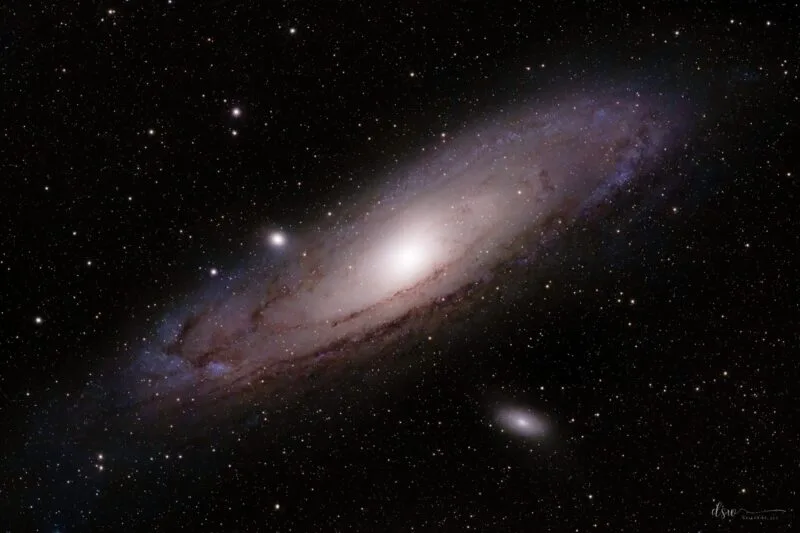
Finding the Andromeda galaxy with Mirach
Draw an imaginary line from Mirach to the star Mu (µ) Andromedae (see below). Then, continue extending that line for about the same distance between those two stars to reach the Andromeda Galaxy.
Under dark, moonless skies, the Andromeda galaxy appears as a smudge in the sky to the unaided eye. Even if the moon is out or under skies with moderate light pollution (like the suburbs), you can see it through binoculars. At about 2.5 million light-years away, the Andromeda galaxy is the nearest large spiral galaxy to our Milky Way. And it’s the most distant thing you can easily see with your eye alone.
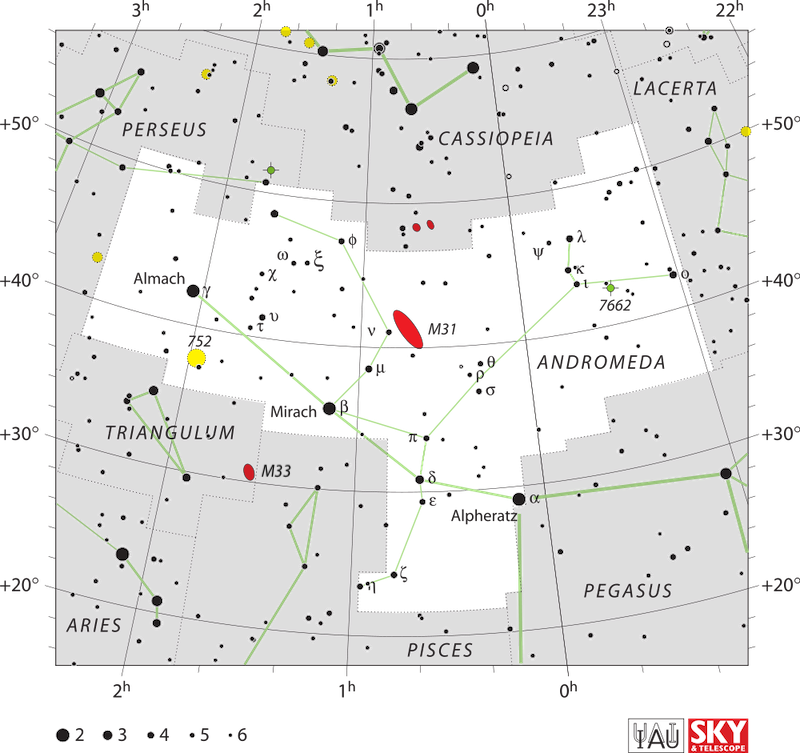
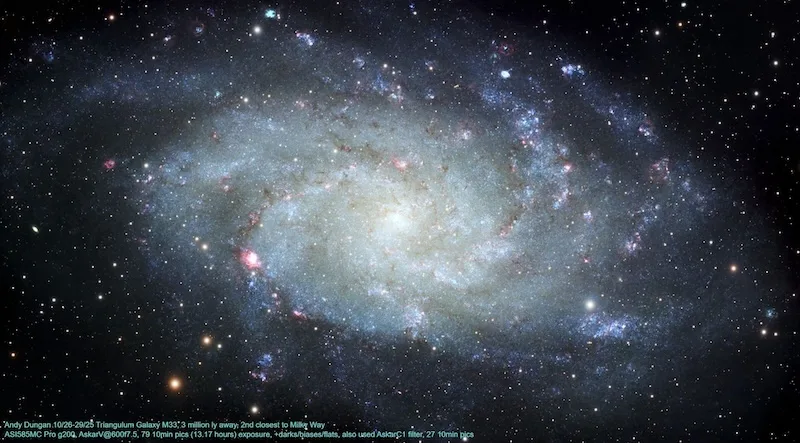
Finding the Triangulum galaxy (M33)
The Triangulum Galaxy (M33), in the constellation Triangulum, is much fainter than the Andromeda Galaxy. Some people with excellent eyesight have been able to see it unaided by telescopes or binoculars, in extraordinarily good viewing conditions. Even so, it can still be a challenge to find M33 with binoculars and small telescopes.
To find Triangulum, you’ll use the same two stars as above, but star-hop in the opposite direction. Follow an imaginary line from the star Mu (µ) Andromedae to Mirach, then continue to draw that line past Mirach, for twice the distance between Mu Andromedae and Mirach, to reach the Triangulum Galaxy.
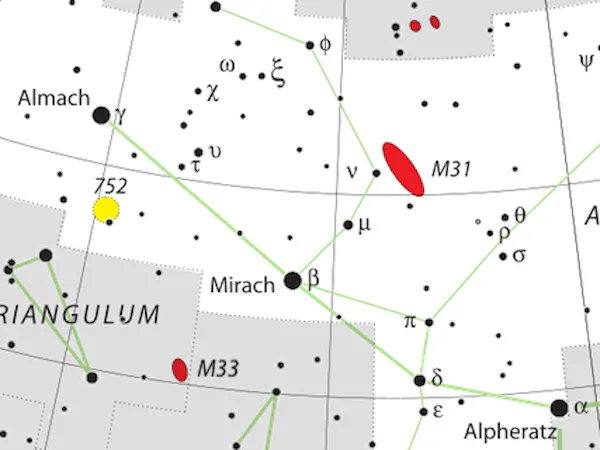
Finding Mirach’s Ghost (NGC 404)
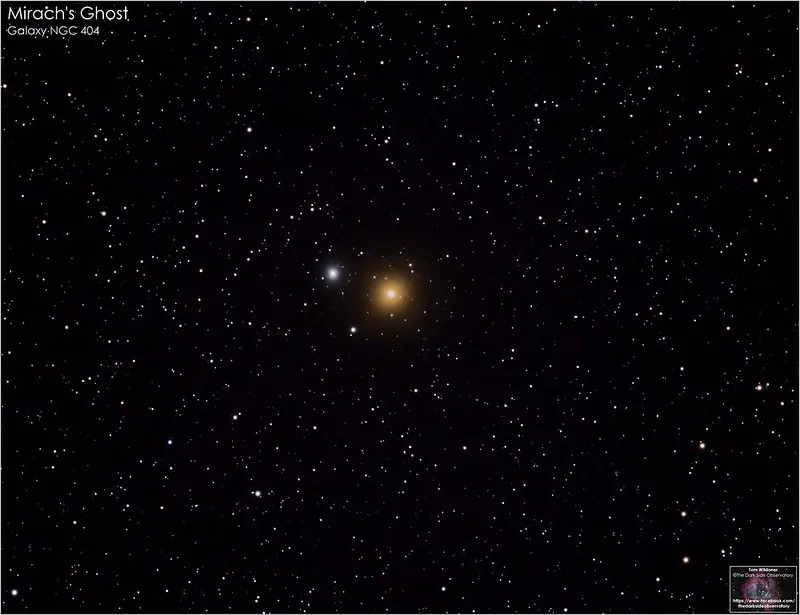
When you look at Mirach, you’re looking almost exactly in the direction of the galaxy labeled NGC 404 but known affectionately among astronomers as Mirach’s Ghost. That’s because the remote, fuzzy galaxy lies right next to the moderately bright star, just 1/10 degree from Mirach. A full moon is 1/2 degree wide, so you can see that’s very close.
Mirach’s Ghost is faint, just magnitude 11 in brightness. Many amateur astronomers try to spot it with their small telescopes, but due to its proximity to the brighter 2nd-magnitude Mirach, seeing the galaxy is not easy.
NGC 404 is located about 10 million light-years away, just beyond our Local Group of galaxies. The Local Group is a cluster of galaxies that includes the Milky Way, Andromeda and Triangulum galaxies. NGC 404 does not appear gravitationally bound to our Local Group.
Bottom line: Stargazers use Mirach, a moderately bright star in the constellation Andromeda, to locate three galaxies. It can help you find the Andromeda Galaxy, the Triangulum Galaxy and a galaxy known as Mirach’s Ghost (NGC 404).
The post Mirach is your guide star to finding 3 galaxies first appeared on EarthSky.