← Technology, Science & Infrastructure
▣ Distilled locally
Inside the Design of Hack the North's Custom ESP32 Badge
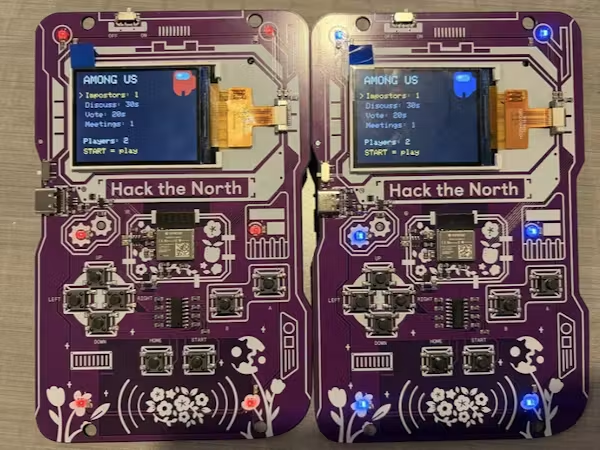
At most conferences, attendees receive a name tag printed on a piece of paper or cardstock. It's a simple, inexpensive way to identify them, but it doesn't do anything beyond that. Maker conferences are usually different, and that includes Hack the North 2026, Canada's largest hackathon. Instead of handing out ordinary name tags, Nicholas Ficara and a team of organizers designed and manufactured 1,750 programmable electronic badges that attendees could customize with their own software. The project began in January, when Ficara proposed bringing electronic badge culture to Hack the North. The original plan called for a custom PCB equipped with a display, buttons, LEDs, audio, wireless connectivity, and a battery. The team also wanted to keep costs around $5 per attendee, a target that ultimately proved unrealistic. The first prototype included a hexagonal PCB with an ESP32 microcontroller, a small color display, addressable LEDs, and NFC capabilities. Unfortunately, several hardware problems appeared almost immediately. A component selection mistake resulted in a capacitor being installed where an inductor belonged, and an attempt to solder the display's flexible ribbon cable directly to the PCB proved impractical for manufacturing. The team corrected these issues in subsequent revisions, replacing the direct display connection with an FPC connector and redesigning the PCB to resemble a miniature handheld game console. The NFC hardware also required changes after Ficara discovered that the original chip could function as a tag but not a reader. On the software side, the ESP32 ran custom firmware that turned the badge into a programmable platform. A Lua runtime allowed attendees to develop their own applications, while a browser-based code editor simplified programming. An onboard shell provided access to files and settings. The badge also supported wireless interactions, including exchanging contact information using Bluetooth and an accelerometer. The team soon learned that building a single prototype and mass-producing boards are two entirely different things. During a 50-unit validation run, two incorrectly oriented ICs prevented many badges from operating. Even worse, inserting the batteries backward could cause the boards to produce smoke. The team eventually added a FET for reverse-polarity protection and worked with the manufacturer to resolve the assembly problems. Production began in late June, with 1,750 populated badges and another 750 unpopulated boards ordered for volunteers. The assembled badges ultimately cost approximately $11.60 each, excluding development expenses and accessories. After additional manufacturing delays and defective displays, the shipment arrived on August 20, nearly a month before the event. When Hack the North finally opened in September, attendees quickly began finding creative uses for their badges. Projects included multiplayer games, a rhythm game, a remote-control vehicle interface, and even a mesh-networked version of Among Us running on four badges. For anyone interested in building something similar, the team has released the hardware designs, firmware, and a browser-based emulator as open source projects . The badges may have been intended to identify attendees, but they ultimately became one of the hackathon's most interesting development platforms.The Hack the North 2026 conference badge (📷: Nicholas Ficara) An early prototype (📷: Nicholas Ficara) A first-person shooter developed for the badge (📷: Nicholas Ficara) A slick way to share personal info (📷: Nicholas Ficara)
↑ Back to top
Originally published by Hackster News ↗
· rebuilt here from its own full-text RSS feed · all rights
remain with the publisher, please read and support them there.