← Technology, Science & Infrastructure
▣ Distilled locally
This Tiny Flying Robot Can Take a Beating
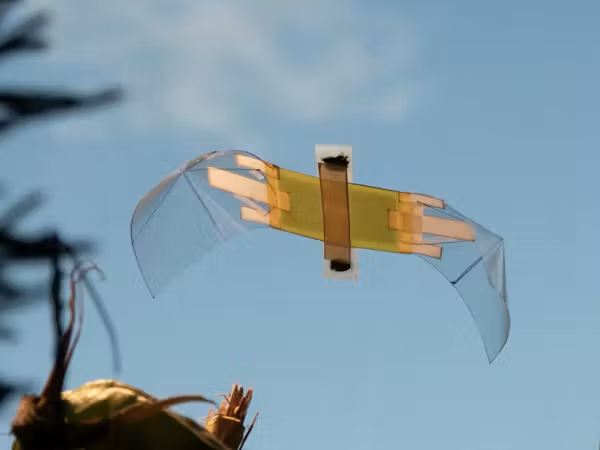
Flying insects are incredibly resilient creatures. A fruit fly or bee can slam into a window, bounce off, and continue flying as though nothing happened. But don't try that with a tiny flying robot unless you want to spend some time in the workshop making repairs. Researchers at the University of California, Los Angeles and the University of California, Davis have developed a new robot that takes inspiration from these insects, using flexible polymer materials to survive impacts that would destroy more traditional designs. The robot, described in a paper published in Science Robotics , weighs just 185 milligrams — less than one-fifth of a gram. Despite its tiny size, it can generate enough lift to support three times its own weight. It's resilient as well — the robot can continue flying after being struck with a flyswatter or crushed under a load approximately 11,000 times its own weight. The secret to that durability is an all-polymer construction that eliminates the rigid mechanical components commonly found in miniature flying robots. Instead of using a conventional motor and mechanical transmission to flap its wings, the robot relies on an electrically driven artificial muscle made from a thin film of a relaxor ferroelectric polymer. When an electric field is applied, the polymer expands through a process known as electrostriction. This deformation causes the actuator to bend, directly driving a pair of flexible, cone-shaped wings. The actuator can achieve a bending angle of 136 degrees at 110 Hz, with a power density of 1,600 watts per kilogram. The wings themselves also contribute to the robot's performance. Their asymmetric geometry and ability to deform during each wingbeat generate upward lift, while their flexibility allows them to bend when they encounter obstacles. Because the wings are resistant to permanent creasing, they can recover their original shape after an impact. During testing, the researchers demonstrated that the robot could take off without assistance and climb at an average speed of 40 centimeters per second. At a wingbeat frequency of 30 Hz, it achieved a lift-to-weight ratio of 3.0 and a lift-to-power ratio of 8.3 millinewtons per watt. This robot isn't ready to take flight in real-world applications, however. The current prototype receives power through external wires, so it isn't yet capable of independent flight. It also lacks the onboard electronics and sensors needed for autonomous navigation. The researchers plan to address those shortcomings by improving flight control, increasing payload capacity, and integrating onboard power and sensing systems. Eventually, they envision tiny flying robots that could navigate confined spaces during search-and-rescue operations, inspect hazardous environments, monitor ecosystems, or assist with agricultural pollination. There's plenty of work left before this little robot can venture beyond the laboratory on its own. But its ability to survive being swatted or crushed suggests that the researchers have already solved one of the biggest problems facing insect-sized flying robots: keeping them in one piece.A flying robot modeled after insects (📷: Wenzhong Yan) The robot can fit in the palm of your hand (📷: Mario Rodriguez) Wings are directly attached to the actuator (📷: UC Davis)
↑ Back to top
Originally published by Hackster News ↗
· rebuilt here from its own full-text RSS feed · all rights
remain with the publisher, please read and support them there.