← Technology, Science & Infrastructure
▣ Distilled locally
A $4 Robot With a Mind of Its Own
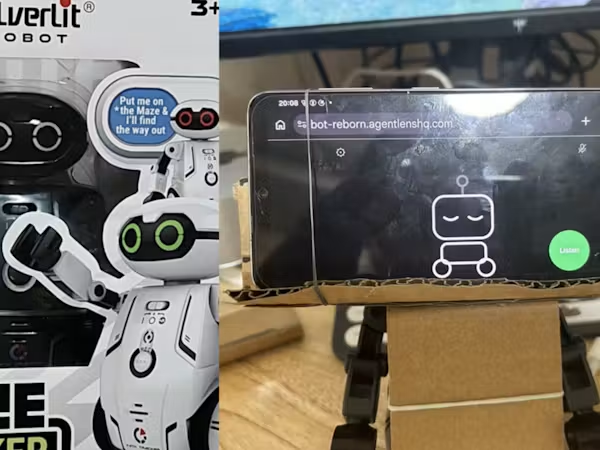
A cheap toy robot might not keep your attention for long, but with a little hardware hacking and some AI, it has potential. Maker Asten has demonstrated this with Bot Reborn , an open source project that transforms a toy into a voice-controlled robot that can hold conversations, answer questions, and respond to commands. It even has a personality, thanks to a specialized AI model that gives it fast reflexes without waiting for a large language model to respond. The project started with a Silverlit Maze Breaker, a toy robot originally designed to follow lines and navigate simple mazes. Asten purchased one for about $4, then got to work hacking it into something far more interesting. The stock robot operates using a very simple mechanism. A single electric motor drives its tracks, while an electromagnet controls steering by moving an armature left or right. Two driver chips handle these functions, each requiring just two control signals. That means only four wires are needed to take complete control of the robot's movements. Asten bypassed the original controller by cutting a PCB trace and soldering wires to the motor and steering driver inputs. These connect to an FT232H USB-to-GPIO breakout board, which allows an Android smartphone to control the robot through Chrome's WebUSB interface. The smartphone was mounted on the robot using cardboard and rubber bands, with its screen serving as an animated face. It also provides the microphone and speaker needed for voice interactions. A computer on the same Wi-Fi network runs the AI services, with a small Node.js server coordinating speech recognition, conversational responses, and motor commands. One problem with using a conventional large language model to control a robot is latency. Asking the robot to stop shouldn't require waiting several seconds for an AI model to process the request, especially when it's heading toward an obstacle. To solve this issue, Asten fine-tuned a Qwen3.5-0.8B model specifically for recognizing movement commands. Rather than generating conversational responses, this smaller model classifies incoming speech into actions such as forward, backward, left, right, stop, or keep going. Requests that don't correspond to simple movements are passed along to a larger conversational model. The specialized model was trained using 490 examples in approximately 30 minutes on a free Google Colab GPU. It achieved 86.6% accuracy on a separate test set of 164 examples. Running on a Mac mini M4, it can classify a command in approximately 200 milliseconds. To reduce accidental movements, commands are executed only when the model's confidence exceeds 80%. The system works, but it has one notable hardware problem: the smartphone is heavy enough to tip the little robot over when it reverses. Asten is therefore developing a replacement based on an ESP32-S3 microcontroller, an INMP441 I2S microphone, and a MAX98357A audio amplifier. The new hardware can already stream audio over Wi-Fi and play responses, although it hasn't yet been integrated with the robot's motors. The AI processing will remain on the computer. Bot Reborn's source code, training dataset, and fine-tuned model are publicly available , making it possible for other makers to build their own AI-powered companions without starting from scratch. The robot, before and after (📷: Asten) The original hardware had to be modified (📷: Asten) A web interface was developed (📷: Asten)
↑ Back to top
Originally published by Hackster News ↗
· rebuilt here from its own full-text RSS feed · all rights
remain with the publisher, please read and support them there.