← Technology, Science & Infrastructure
▣ Distilled locally
Researchers Want to Turn Your TV Into a Speaker Matrix to Put Every Sound Exactly Where It Belongs
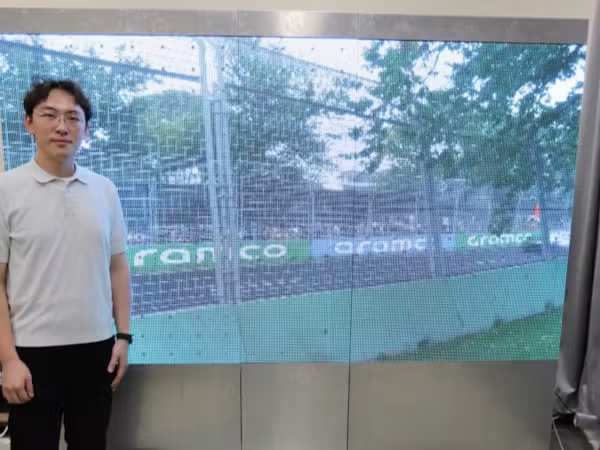
Researchers from the AX Convergence Research Center at the Korea Institute of Machinery and Materials (KIMM) have developed a way to take the audiovisual experience into a new dimension — by turning a display into a sectional speaker matrix, so the location of sounds matches the image. "[Our] modular-grid technology aligns the position of a sound source on the screen with the direction from which the actual sound is heard, creating an immersive audiovisual experience that has been difficult to achieve with conventional displays," says senior researcher Dongjoon Kim of the team's creation. "We plan to expand the technology to modular LED tile displays and further develop it into a next-generation core technology that can be applied across a wide range of display applications." In a typical TV, sound comes from a pair of stereo speakers with, if you're lucky, a third low-frequency subwoofer in the mix. Even in surround-sound systems, you usually only get one additional center channel plus stereo rear channels — though systems with ceiling-mounted speakers are available to those with deep enough pockets. In all cases, though, the direction of a sound has to be created by mixing between speakers: something located slap-bang in the left third of the screen will have its audio played roughly equally between left and center channels. The system developed at KIMM, based on a patented technology for a "Modular Acoustic Radiation System," goes further: 80 voice-coil motors were installed behind a 100" display made by placing an LED display film over an aluminum panel, in a matrix layout. Any given voice coil can be triggered to vibrate the panel, turning that part of the display into a speaker — and allowing the sound to be located to any one of 80 sections of the display, rather than just the left-center-right options available in a traditional sound system. The resulting display-speaker is modular, its creators say, and could be scaled from a living-room TV all the way up to a cinema screen or electronic billboard. Combining multiple voice coils at once, meanwhile, provides a way to reproduce lower-frequency tones without the need for an external subwoofer. Efficacy of the prototype was confirmed with an acoustic camera, though source files do require special processing through a machine learning system in order to position each sound source. A paper detailing the team's work has been published in the Journal of Mechanical Science and Technology under closed-access terms. Dongjoon Kim (pictured) and colleagues are looking to turn TVs and cinema screens into position-specific speaker matrices. (📷: Korea Institute of Machinery and Materials) The matrix, with real-time processing on the video and audio source, provides a way to position audio in the video. (📷: Korea Institute of Machinery and Materials)
↑ Back to top
Originally published by Hackster News ↗
· rebuilt here from its own full-text RSS feed · all rights
remain with the publisher, please read and support them there.