← Technology, Science & Infrastructure
▣ Distilled locally
Wake Electronics Opens Crowdfunding for the Raspberry Pi Pico-Powered Tinta ePaper Display Range
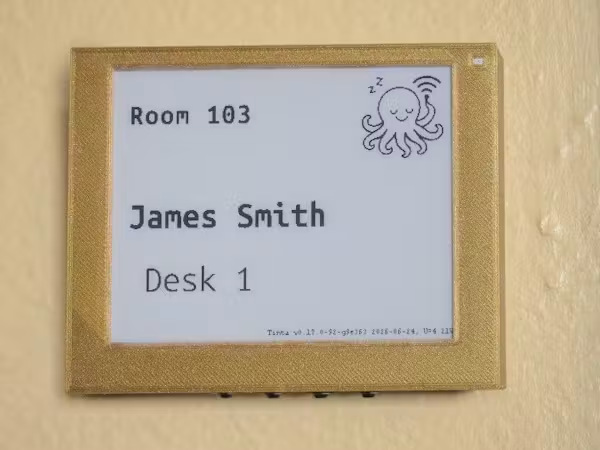
Wake Electronics' Nicolas Spethmann has opened crowdfunding for the Tinta, a family of smart ePaper displays designed tgo run for over a year on standard disposable alkaline batteries — powered by a Raspberry Pi Pico W or Raspberry Pi Pico 2 W microcontroller board. "Tinta is an open-source ePaper sign that runs for more than a year on ordinary alkaline batteries. It connects over Wi-Fi and requires no gateway, no cable, and no vendor cloud," Spethmann explains. "Tinta works in any building, as it requires only the existing Wi-Fi: no power outlet, no cable, and no gateway. You can use it with your own self-hosted platforms, so no cloud account, vendor server, or proprietary software is necessary. It runs on three standard alkaline batteries, so there is no rechargeable cell to lose capacity over time or complicate shipping and storage. It lifts off its baseplate on a dovetail, so a battery change takes seconds, and the baseplate stays on the wall." The Tinta hardware itself is built as a carrier board for either the Raspberry Pi Pico W or Raspberry Pi Pico 2 W, with their RP2040 and RP2350 microcontrollers respectively — Spethmann says a final decision on which to use has not yet been made. This drives either a 4.2" or a 7.5" monochrome ePaper display, which draws power only when changing states. Coupled with smart power management capabilities for the microcontroller and its radio, that means up to a year of operation per set of three AAA (4.2" model) or AA (7.5" model) alkaline batteries — or between 6,000 and 10,000 update cycles, by Spethmann's reckoning. That extra-long battery life comes, Spethmann says, from a power management system that uses MOSFET switching to completely power the control circuitry, including the microcontroller and its radio, off between updates. The hardware only wakes up when needed, triggered either by a physical push-button switch, an on-board real-time clock (RTC) that stays running at all times, or a near-field communication (NFC) tap. Spethmann is funding production of the displays, which will ship with 3D-printed housings, on Crowd Supply priced at $299 and $449 for the 4.2" and 7.5" models respectively — making them an expensive proposition compared to mass-market alternatives from companies like Pimoroni or Seeed Studio. Their designs, however, are open source, with firmware and hardware files available on GitHub under the permissive Apache License 2.0 and strongly reciprocal variant of the CERN Open Hardware License 2 respectively.Wake Electronics is funding production of the Tinta ePaper smart displays — or you can build your own from source files provided. (📹: Wake Electronics)
↑ Back to top
Originally published by Hackster News ↗
· rebuilt here from its own full-text RSS feed · all rights
remain with the publisher, please read and support them there.