The Silent Ambassador to the Galaxy: Voyager at One Light-Day
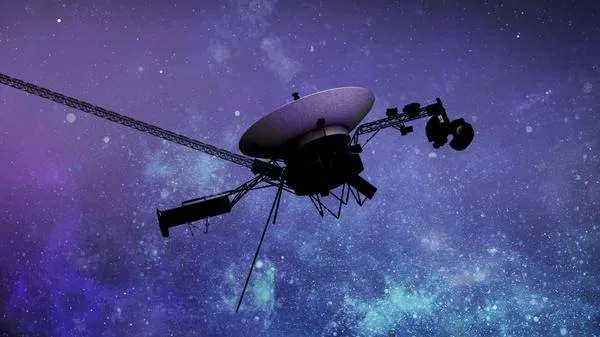
On a sunny day in August 1977, the Voyager 2 spacecraft was strapped to a rocket on a launchpad in Cape Canaveral, Florida, awaiting the start of its journey to explore where no probe—and certainly no human—had ever been before. Caltech scientist Alan Cummings (PhD '73) wanted to perform some final checks before its flight. He was escorted up to the top of the spacecraft and peered through a hatch in the nose cone at the spacecraft's four delicate low-energy cosmic ray telescopes. Each telescope, about the size of a salt shaker, was designed to catch and characterize particles as they hurtled through space at up to a few tenths the speed of light. Cummings reached in with a gloved hand to gently tighten the protective covers on each telescope—the last human touch that Voyager 2 would experience before it set off on its lonely journey.
Some 49 years later, both Voyager 2 and its mission partner, Voyager 1, which launched 16 days after its twin, are far beyond even the farthest reaches of our solar system, in interstellar space. They are the first—and, so far, the only—human-made objects to leave the neighborhood where every human has ever lived.
By November 18, Voyager 1 will have traveled a staggering 16,090,000,000 miles from Earth. That's one "light-day": the distance that a photon of light can travel in one full Earth day, or 24 hours. Voyager 2 is not far from the same milestone, expected to occur in 2035, and both will only ever move farther away from home.
The Voyager mission was dreamed up starting in the 1960s by a small group of scientists and engineers at Caltech and NASA's Jet Propulsion Laboratory, which Caltech manages for NASA; Caltech's JPL designed and built the probes and has managed the mission ever since for NASA.
"What really gives me chills is the fact that they're going to go on forever, even long after they've stopped sending data and go dark," says Cummings, now a senior research scientist at Caltech's Space Radiation Laboratory, who has been a member of the Voyager science team since before the launches. "They're going to orbit around the center of the galaxy for billions of years."
The Voyager missions were each equipped with 10 scientific instruments with the ambitious goals of observing the outer planets and characterizing the environment of space beyond. Even now, nearly 50 years after launch, the spacecraft continue to send back data about the previously unexplored dark expanse of space beyond our solar system.
The Grand Tour: The Once in a Lifetime Opportunity
The Voyager spacecraft have been able to travel so far because of a meticulously planned trajectory that gave them boosts of speed by taking advantage of the gravity of the four giant outer planets: Jupiter, Saturn, Uranus, and Neptune.
In 1964, Gary Flandro (PhD '67) was a Caltech aeronautics graduate student working at JPL over the summer examining the geometry of the outer planets as part of a relatively new idea called a slingshot gravity assist. It turns out that a spacecraft can pick up speed if it "slingshots" around a planet. At the time, researchers had been looking at how the technique could help them more efficiently send spacecraft to the inner planets like Mercury, but no one, recalls Flandro in an oral history interview in 2022, was thinking about the outer planets.
Through a complex series of calculations, Flandro, who was named a Caltech Distinguished Alumnus in 2018, discovered that all four of the outer planets would be on the same side of the Sun during a window of time from 1976 through 1977, enabling a visit to all four with a single mission. This planetary alignment would not happen again for another 176 years.
That once-in-several-lifetimes planetary alignment was just 10 years off, so the race was on to get a mission approved and built in time. Flandro and his collaborators called this mission The Grand Tour.
Making It Happen
Scientists and engineers from Caltech, JPL, NASA, and other institutions assembled to turn Voyager from an idea into reality. The team's task was to deliver a mission that NASA could afford, while maximizing its scientific payoff. The hope was that the mission would extend far beyond its proposed timeline of four years to Jupiter and Saturn, and that at least one probe would perhaps visit all of the giant planets. And, with luck, go farther still.
John Casani, Voyager's second project manager and an engineer, had extensive experience with JPL's Ranger and Mariner spacecraft programs, which traveled to the Moon and the inner planets, respectively. He led the project through its final development and ultimate launch. His team's key design choices were instrumental to the probes' longevity; they decided, for example, to add an amplifier to the spacecraft's Sun sensors, allowing them to function in the dim outer solar system and increasing the odds of a successful Grand Tour.
Casani also worked with famed astronomer and science communicator Carl Sagan to equip each Voyager with a cosmic time capsule: The "Golden Record," a 12-inch gold-plated copper phonograph disk containing images and sounds reflecting the diversity of life on Earth, for the benefit of potential extraterrestrial civilizations that may someday encounter the spacecraft.
Caltech's Edward C. Stone, a cosmic ray physicist, was initially a co-investigator of the Voyagers' cosmic ray detectors. He became the mission's project scientist in 1972, when he was tasked with coordinating 11 instrument teams—a role he would go on to carry out diligently for 50 years until his retirement in 2022. Caltech professor of planetary science, emeritus, Andy Ingersoll remembers Stone as having an uncanny ability to bring people together.
"The flybys of each planet were going to happen very quickly, and every team wanted to maximize the opportunity to do science with their own instruments," recalls Ingersoll, who retired in 2022. "It was sometimes tough and competitive, because the spacecraft couldn't do everything at once. But Ed was remarkable, he could absorb all of the arguments and see the best strategy. And people would listen to him."
In a 2002 interview with The Planetary Society, Stone recalled: "One of the key decisions that I had to make early on was in the selection of the trajectory of Voyager 2." NASA's Pioneer 10 mission, a Jupiter flyby launched in 1972, "told us the radiation environment at Jupiter was a thousand times worse than we expected, so we had to go back and redesign all the circuitry and put shielding in and so on. That also meant we wanted to make sure that at least one of the spacecraft stayed far enough away from Jupiter to minimize risk. Remember, we had to get to Saturn—that was mission success."
"The trade-off was to take some risk with Voyager 1, sending it close to Jupiter and keeping Voyager 2 further out, because we could always finish at Saturn if anything happened with Voyager 1. So we had to decide what to do with Voyager 2 at Jupiter—do we go by Europa and look at it up close, or do we go by Ganymede again?" (Europa and Ganymede are two of Jupiter's four largest moons.)
Unveiling the Outer Planets
Voyager 1, launched on September 5, 1977, flew by Jupiter in March 1979, and then Saturn, about a year and a half later. To properly observe both Saturn and its moon Titan during the flyby, the path of Voyager 1 had to go upward out of the plane of the solar system, on a path toward interstellar space, which it reached in 2012. Voyager 2 arrived at Jupiter in July 1979, Saturn in August 1981, and then also visited Uranus (1986) and Neptune (1989). It crossed into interstellar space in 2018.
These planetary flybys inspired entire generations of researchers. Jonathan Lunine (PhD '85) was an undergraduate at the University of Rochester when Voyager 1 flew by Jupiter; the images inspired him to focus his graduate school applications on planetary science programs, and he landed at Caltech in the fall of 1980, just before Voyager 1 flew by Titan. Now JPL's chief scientist, Lunine has worked on multiple JPL-led missions to Jupiter, Saturn, and their moons, including the NASA and European Space Agency mission Cassini-Huygens to Saturn.
"The Voyager missions played a seminal role in my career," Lunine says. "Voyager 1's flyby of Jupiter inspired me to do planetary science, and its close pass by Titan in 1980 provided much of the data for my dissertation at Caltech, which, in turn, opened the door to my participation in the Cassini-Huygens mission to Saturn. I am only one of so many scientists working today who have been inspired by, and benefited from, the Voyager spacecraft and the astounding variety of data they returned."
The Voyager spacecraft took the most detailed images that had ever been seen of the outer planets and their moons, including time-lapse views of evolving turbulent storms in Jupiter's atmosphere and detailed profiles of the atmospheres of Saturn, Uranus, and Neptune. The missions found hints of an ocean beneath Europa's fractured icy surface, unexpected complexity in Saturn's rings, and noted a hazy nitrogen atmosphere on Titan. Voyager 2 discovered Uranus's strange magnetic field, and Neptune's dynamic atmosphere, among many other discoveries.
Both Ingersoll and Cummings were particularly mesmerized by Voyager 1's images of Jupiter's moon Io. Its yellowish surface was dotted with dark circular blobs: signs of active volcanism on its surface.
"They had set up a feed from JPL to campus to stream images in real time," Cummings recalls. "When I saw Io, I was certain the Caltech students had pulled a prank and put up a picture of a pizza or something. It was spectacular."
Along with discoveries, the Voyager mission raised new questions that would inspire decades of future missions. At a press conference following the Uranus flyby, a reporter asked Stone why it seemed the scientists now had more questions than answers.
Ingersoll recalls Stone's reply: "He said, 'With pure discovery, you don't know what you're going to find. If you think you already know what the right questions are, you're probably missing the point.'"
From Planets to Particles: Measuring Cosmic Rays
Ed Stone first came to Caltech in 1964 at the behest of physicist Rochus (Robbie) Vogt—then an assistant professor and now the R. Stanton Avery Distinguished Service Professor and professor of physics, emeritus—to develop the budding field of space physics, including studies of cosmic rays. The two founded Caltech's Space Radiation Laboratory (SRL) to further this work.
Though the Voyagers' initial missions were focused on the alluring giant planets, many members of the science team, including Stone, harbored an additional goal: to measure cosmic rays. Cosmic rays are the nuclei of atoms of hydrogen, helium, and other elements, that race through space at up to nearly the speed of light. They can obtain such high speeds from shock waves generated by exploding stars in the galaxy and also from our own Sun, where they are called solar energetic particles (SEPs) and which are often associated with coronal mass ejections (CMEs). CMEs, giant bubbles of superheated plasma and magnetic field lines erupting from the Sun, are accompanied by solar flares, powerful flashes of light across the electromagnetic spectrum. These SEPs stream outward from the Sun, guided by invisible magnetic fields through the vacuum of space between planets.
Both Voyager 1 and 2 contain three types of cosmic ray telescopes that together comprise the Cosmic Ray Subsystem (CRS), which catch cosmic particles as they hurtle through space. "Measuring the composition and the energy spectra of galactic cosmic rays in interstellar space at the energies measured by CRS was the holy grail of low-energy cosmic ray physics," Cummings says.
During the Voyagers' travels, the detectors measured the composition of cosmic rays in the vast expanses between the planets as well as the interaction of the particles with planetary magnetic fields. The instruments characterized new types of low-energy cosmic particles called anomalous cosmic rays originating from within the heliospheric bubble, among other findings.
Understanding the behavior of cosmic rays and SEPs is crucial for building resilient infrastructure for future space missions. "It's really important to understand space weather, because if a flare or a CME hits Earth, it can cause a lot of problems," says space physicist Christina Cohen. Cohen started at Caltech in the 1990s as a postdoc in Stone's Space Radiation Laboratory and stayed on as a staff scientist, an instrument lead on several NASA missions to study the Sun's activity. "Space weather can affect the electrical grid and GPS navigation, and SEPs and cosmic rays are a real radiation hazard for astronauts. We need to track and understand space weather, and we need to be able to predict it so that we can protect all these assets."
The Pale Blue Dot and the Heliopause
On Valentine's Day in 1990, after successfully touring the giant planets, measuring their magnetic influence, and snapping photographs, Voyager 1 turned its camera back toward Earth. In the photo it captured, our planet appears as a faint speck, dubbed the Pale Blue Dot.
"Consider again that dot," wrote Carl Sagan in his 1994 book Pale Blue Dot. "That's here. That's home. That's us. On it everyone you love, everyone you know, everyone you ever heard of, every human being who ever was, lived out their lives."
Shortly after that photo, Voyager 1 turned its cameras off. But its mission was far from over.
One major question the science team sought to answer was: Where is the boundary of our solar system? In other words, where does our Sun's influence—a vast bubble called the heliosphere—dwindle away?
The Voyager missions provided some insight. As they moved toward interstellar space, the probes observed several transitions in the solar environment. In 2004, at a distance of 94 astronomical units (AU; 1 AU is the distance from Earth to the Sun), Voyager 1 found an invisible boundary, the termination shock, where the solar wind begins to slow below the speed of sound; Voyager 2 reached this point in 2007, at 84 AU. Past that boundary, each spacecraft traveled for years within a region called the heliosheath, where the flow of material from the Sun both slows and turns to flow down the tail of the heliosphere. Finally, in 2012 and 2018, Voyager 1 and 2, respectively, measured a sharp drop in heliospheric particles, an increase in galactic cosmic rays originating from the galaxy, and a sudden increase in the density of the surrounding plasma. They had crossed the heliopause and entered interstellar space.
Nearly 50 years in, some of the spacecraft's instruments have been shut down, but they continue to collect and transmit data about magnetic fields and particle densities in the expanse of space, and to measure the effects and influence of our Sun's magnetic field. The spacecraft provide the only in situ data from interstellar space, information that is important for models of the heliosphere, which shields us from harmful cosmic radiation—and that may have provided a safe environment for life to evolve.
One Light-Day Away
In an era where remote work is common, Suzanne Dodd's job may be humankind's most remote. Dodd, the current project manager for Voyager, oversees the operations of both spacecraft. Commands sent by Dodd's team to Voyager 1 now take a full 24 hours to reach it. One light-day.
The Voyager missions have bookended Dodd's career. Dodd received her BS in engineering from Caltech in 1984, and following a chance conversation at the Caltech swimming pool, she took a job at JPL as a sequencing engineer, translating scientific observations into carefully timed spacecraft commands. After Voyager 2's successful 1986 flyby of Uranus, she became a lead sequence engineer for its Neptune encounter in 1989.
"Neptune was one of the highlights of my career," she says. "Our work contributed to the images of the planets that were later in my kids' science books." She then spent several decades working on other planetary and astrophysics missions but returned to Voyager as the project manager in 2010.
It is sadly a job with diminishing returns, as many of the spacecraft's instruments have been turned off, one by one, to conserve power. The magnetometer and the plasma wave subsystem remain operational on both probes; Voyager 2's cosmic ray subsystem is still holding on.
Voyager 1 was predicted to run out of power for doing science in spring 2027, but Dodd's team has been creatively working to make it last as long as possible. Recently, they executed a set of commands—they called it "the Big Bang"—to juggle around its power use and preserve just enough heat to prevent propellant lines from freezing. If all goes to plan, the craft will still have a few more years of power. "We're freezing out there, but we're going to make the maximum use of our time," Cummings says.
After Ed Stone retired in 2022, JPL scientist Linda Spilker became Voyager's project scientist. Spilker, formerly project scientist for NASA's Cassini mission to Saturn—which followed Voyager in studying the giant planet and its rings for 13 years—also started her career with Voyager in the 1970s.
"Voyager was a total paradigm shift for our solar system," she says. "For a long time, our own Moon—cratered, inactive—was all we knew about moons. Then Voyager got to Jupiter and saw these young icy surfaces on Europa, active volcanoes on Io. Voyager was the pathfinder that led to so many new questions and so many new missions—like Galileo, Cassini, Juno, and Europa Clipper. Voyager has been a multigenerational mission. There's nothing like it."
The Voyager mission will end, eventually. "One day we will stop receiving data," Spilker acknowledges. But the spacecraft? They will keep going for thousands, maybe millions, of years. Maybe forever.
"The Voyagers were the first to do a lot of things: first to visit Uranus and Neptune, first to cross the termination shock of the solar wind, and first to interstellar space," Cummings says. "But they will also be one of the last pieces of evidence that humans on Earth ever existed. Long after the Earth has been extinguished by the expanding Sun, billions of years from now, the Voyagers will still be out there carrying the Golden Record with the sights and sounds of the Earth that once was. As Ed Stone said, Voyager is our silent ambassador to the galaxy."
On Tuesday, November 17, NASA invites the world to participate in "Shine Bright for Voyager's Light-Day" by creating a symbolic wave of golden light encircling the planet after sunset. NASA has created a website that enables smart phones and tablets to flash "VGR", Voyager's call sign, in morse code.
Join the Caltech community in participating on Tuesday, November 17 at 5:15pm at Beckman Auditorium.