← Technology, Science & Infrastructure
▣ Distilled locally
3D Printing a Tank Is Both Easier and More Challenging Than You Think
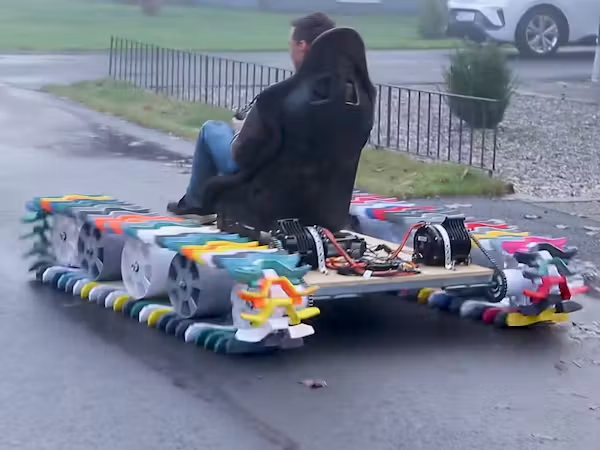
When you think about it, electric cars are kind of just big RC cars, right? In both cases, you just have batteries supplying electricity to electric motors that spin the wheels. If we accept that as true (don’t think too much about it), then the same should apply to tanks. Simon Sörensen is an expert in RC vehicles, so he used that expertise to 3D print a rideable tank that relies on the same concepts . In reality, of course, there are many differences between RC vehicles and their full-scale counterparts. But the drivetrains can truly be essentially the same, just differing in size. That was the case with this tank. Its drivetrain is exactly the same as what you might find in a nice RC tank, just bigger. It has two huge QS138 electric motorcycle motors that receive power from lithium battery packs through VESC Maxim 120V controllers that can pump out a whopping 400A of continuous current. Sörensen even chose to use an RC transmitter for control, instead of building a dedicated set of inputs. There were some issues with the motors Sörensen originally chose, but everything went smoothly after switching to the hardware described above. Other than the size, voltage, and current, putting that all together was just like building an RC vehicle. The part that you might think would be relatively easy — the tank tracks — actually turned out to be the real challenge. Sörensen designed those tracks as a series of identical 3D-printed links. All he had to do was print a bunch of them and screw them together. The wheels inside the tracks were also 3D-printed. Unfortunately, those tracks broke again and again. Part of the problem was material — apparently ultra-cheap PLA filament can be tangibly inferior to the stuff from reputable manufacturers. Whenever a link broke, it was a link printed with that cheap filament. But it didn’t help that Sörensen didn’t bother with suspension or springs, or traditional track geometry. Even so, the tank drives around fairly well, proving the concept. At least until a link breaks. To build something more usable on a practical level, Sörensen will need to go back to the drawing board to come up with a more durable design.
↑ Back to top
Originally published by Hackster News ↗
· rebuilt here from its own full-text RSS feed · all rights
remain with the publisher, please read and support them there.