← Technology, Science & Infrastructure
▣ Distilled locally
This Hexapod Can Transition Between Gaits On the Fly
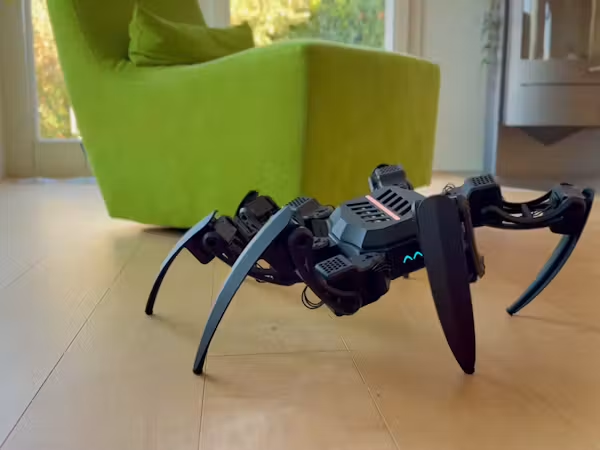
Every robot that walks on legs — not matter how many legs — needs a specific joint movement sequence to achieve stable ambulation. That gait is everything and, generally speaking, you have a greater number of feasible gaits when you have a greater number of legs. Hexapod robots have six legs and there are a few gaits that tend to work well. This hexapod robot, built by ForgeVolt, can seamlessly transition between those gaits on the fly . Hexapod robots aren’t anything new and the basic configuration here isn’t unusual. It is a hexapod robot with 18 actuated joints (three per leg). It is a fairly large hexapod and the joint motors are Dynamixel XC430 servos, which are pretty sophisticated, with several control modes and 4.5Mbps TTL communication. The robot’s eyes are animated on an OLED screen and there are some accent LEDs, too. What makes this hexapod special is the control and the gait. Each leg’s movement implements inverse kinematics, solved at a whopping 200 times per second. That means there isn’t an explicit pre-programmed routine, but rather target positions and real-time movement calculations. An onboard ESP32-S3 performs those calculations as the robot walks, with an MPU6050 gyro for sensing chassis tilt. The cool result of that is the robot’s ability to switch between gaits. Because they’re solved in real-time, it can transition to a new gait at any moment. It can go from a tripod gait to a tetrapod gait between steps, then back again. And because that’s all computed by the onboard ESP32-S3, the control remote doesn’t need to know anything about the gaits. ForgeVolt says their remote is also based on an ESP32 and it communicates with the robot over ESP-NOW. But the remote isn’t telling the robot how to move its legs, it only tells the robot the direction to move and if it should change to a new gait. ForgeVolt’s video is only a few minutes long and we don’t get to see the build process. But the movement demonstrations are very impressive. And, not for nothing, the hexapod looks really awesome, too.
↑ Back to top
Originally published by Hackster News ↗
· rebuilt here from its own full-text RSS feed · all rights
remain with the publisher, please read and support them there.