13 Best Agent Gateways in 2026 for MCP, A2A and LLM Traffic: Kong, Bifrost, AgentCore, Arcade
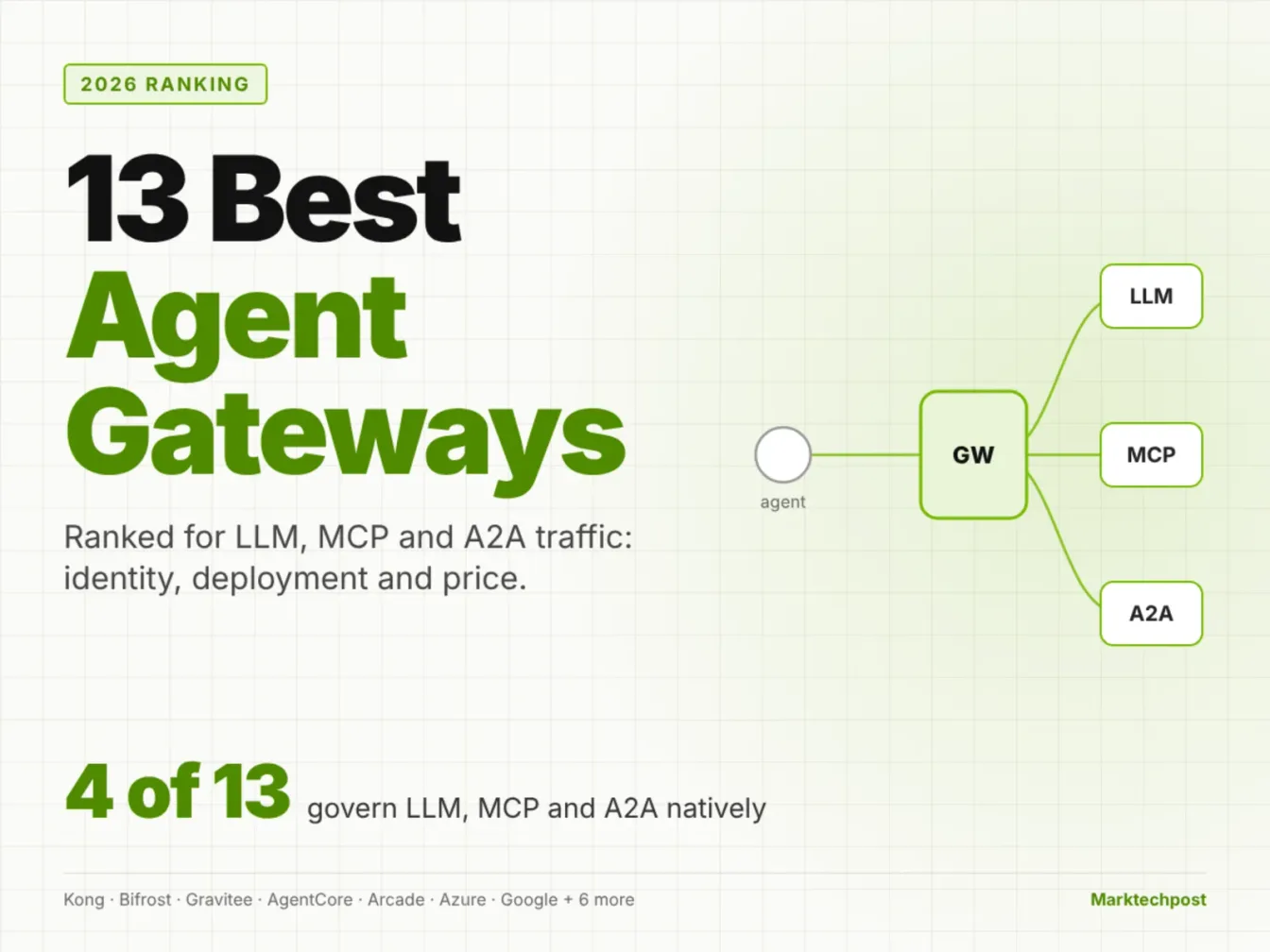
Agents no longer just call a model. They call tools over MCP, delegate to other agents over A2A, and act inside business systems. The best agent gateways sit on that path and decide who can do what. This list compares 13 of them on traffic coverage, identity, deployment and price.
What is an agent gateway?
An agent gateway is a control point that authenticates agents, filters the tools they see, and logs every call. A plain LLM gateway only routes model requests. An agent gateway adds MCP tool governance, agent identity and, increasingly, A2A traffic control.
Our ranking below is editorial and weighs 5 criteria: traffic coverage, identity and authorization, deployment options, maturity, and price transparency.
How the 13 best agent gateways rank
1. Kong AI Gateway
Kong governs LLM, MCP and A2A traffic from 1 control plane. Version 2.0 moved AI features into first-class Providers, Models, MCP Servers and Agents entities.
- Best for: teams already running Kong for API management.
- Watch out: the 2.x architecture needs a Konnect control plane. Arcade notes the MCP OAuth2 plugin is still Tech Preview.
2. Bifrost (Maxim AI)
Bifrost is an Apache 2.0 Go gateway covering models, MCP tools and A2A agents in 1 deployment. Maxim reports 10,000+ models across 25+ providers. Its benchmark claims 11 µs mean overhead at 5,000 RPS.
- Best for: self-hosted, in-VPC or air-gapped teams that want all 3 traffic types.
- Watch out: SSO, SCIM and token exchange are Enterprise-only. An independent review notes the 11 µs figure excludes HTTP handling and JSON marshalling.
3. Gravitee AI Gateway
Gravitee runs an LLM Proxy, MCP Proxy and A2A Proxy on 1 runtime. All 3 share 1 authentication, policy and OpenTelemetry chain. The A2A Proxy supports RFC 8693 token exchange and skill-level authorization.
- Best for: enterprises that want agent identity modeled alongside existing APIs.
- Watch out: Maxim lists Agent Management from $2,500 per month. The A2A Proxy needs Enterprise Edition.
4. Amazon Bedrock AgentCore Gateway
AgentCore Gateway gives agents 1 managed endpoint for tools, models and other agents. It adds semantic tool search, Cedar policies and on-behalf-of token exchange. Pricing starts at $0.005 per 1,000 invocations.
- Best for: AWS-native teams using IAM, CloudWatch and Bedrock Guardrails.
- Watch out: AWS-only. A2A is HTTP passthrough, per Maxim. Search calls cost $0.025 per 1,000, 5x the invoke rate.
5. Arcade.dev
Arcade is an actions runtime, not a model router. Per Arcade, it checks the overlap of user and agent permissions on every action. Credentials never reach the LLM. It lists 8,000+ agent-optimized tools.
- Best for: agents that write to Salesforce, Gmail or Slack on a user’s behalf.
- Watch out: no model routing, so pair it with an LLM gateway. Pricing is $25 per month plus $0.10 per auth event and $0.01 per tool call.
6. Prisma AIRS AI Gateway (formerly Portkey)
Palo Alto Networks completed its Portkey acquisition in May 2026. The gateway reached GA inside Prisma AIRS in July 2026. Palo Alto describes it as a unified LLM, MCP and A2A gateway with 1 enforcement point. It runs in SaaS and hybrid models.
- Best for: security teams that want runtime inspection on every prompt.
- Watch out: pricing is not public. Arcade advises verifying delegated auth and audit depth for agent actions.
7. Azure API Management
Microsoft’s AI gateway extends API Management to model APIs, MCP servers and A2A agent APIs. It can expose REST APIs as MCP servers and front existing MCP servers.
- Best for: Microsoft-centric API teams.
- Watch out: A2A support is preview, JSON-RPC only, and limited to v2 tiers.
8. Google Cloud Agent Gateway
Agent Gateway is the network entry and exit point for Gemini Enterprise Agent Platform. It assigns each agent a SPIFFE ID and can apply Model Armor to prompts and responses. Maxim lists up to 5,000 governed resources per gateway.
- Best for: teams building on Gemini Enterprise Agent Platform.
- Watch out: Maxim reports cross-cloud support as “coming soon.” Model routing and fallback are not documented.
9. IBM ContextForge
ContextForge is an Apache 2.0 registry and proxy that federates MCP, REST, gRPC and A2A. It exposes agents as MCP tools and, per Maxim, deploys via Helm.
- Best for: free, MCP-first, self-hosted Kubernetes setups.
- Watch out: no published commercial support. IBM recommends upgrading to v1.1.1 after security bulletins covering v1.0.0 to v1.1.0.
10. Agent Router (formerly Envoy AI Gateway)
Envoy AI Gateway became Agent Router and joined the Agentic AI Foundation in September 2026. It offers an OpenAI-compatible API plus an MCP gateway on Envoy.
- Best for: Kubernetes teams already on Envoy Gateway.
- Watch out: A2A is preview and JSON-RPC only. Maxim notes no built-in guardrails.
11. Composio
Composio is an MCP gateway and SaaS integration layer with managed OAuth and per-user connected accounts. Arcade lists a free tier of 100,000 tool calls per month and Pro from $29.
- Best for: fast access to a large prebuilt SaaS catalog.
- Watch out: Arcade notes sessions are discoverable by default unless allowlisted.
12. TrueFoundry
TrueFoundry combines an LLM Gateway and centralized MCP access with training and deployment tooling. Pro costs $25 per user per month, with 20,000 requests and tool calls per user.
- Best for: ML teams that want gateway and MLOps in 1 platform.
- Watch out: the client-credentials MCP flow uses a shared identity, not the user’s, Arcade notes.
13. Obot
Obot is an open-source platform bundling an MCP Gateway, LLM Gateway and device monitoring. It supports per-user auth, OAuth token exchange and audit logs.
- Best for: IT teams rolling out MCP servers to employees.
- Watch out: self-hosting alone does not settle downstream authorization, Arcade notes.
Agent gateway comparison table
How to choose an agent gateway
Start with traffic. If agents only call models, an LLM gateway is enough. If they call tools, you need MCP governance. If they delegate to other agents, check A2A support carefully.
Then check identity. Ask whether user and agent permissions are enforced separately at execution time. Finally, check where it must run: single cloud, your VPC, or air-gapped.
Key Takeaways
- Only Kong, Bifrost, Gravitee and Prisma AIRS govern LLM, MCP and A2A natively.
- A2A support is the weakest link: preview, passthrough or JSON-RPC only elsewhere.
- Cloud gateways (AWS, Azure, Google) win on integration but lock you in.
- Arcade solves a different problem: governed actions, not model routing.
- Most identity features (SSO, token exchange) sit behind enterprise licenses.