← Technology, Science & Infrastructure
▣ Distilled locally
Bitmerse Opens Funding for the Romu, Its Tiny Raspberrry Pi RP2354-Based Take on the -omu Craze
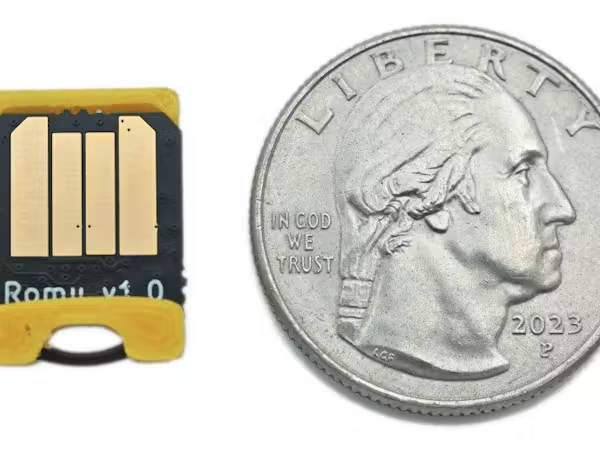
Indian startup Bitmerse has opened crowdfunding for its take on the -omu trend of ultra-compact development boards that near-disappear into a USB Type-A port: the Romu, powered by a Raspberry Pi RP2354A microcontroller. "Romu is an ultra-compact, USB-centric development board built around the Raspberry Pi RP2354A," Bitmerse's Jaydeep Dhrangdhariya and Dhrumil Doshi say of their creation. "It plugs directly inside any USB Type-A port, no cable, no programmer, no breadboard, and gets you writing and running MicroPython code in minutes. Where most dev boards are built to expose GPIO [General-Purpose Input/Output connectivity], Romu is purpose-built for one thing: making USB application development fast, approachable, and fun, whether that's a security key, a macro pad, or a custom HID device you haven't thought of yet." The Romu, which the company unveiled six months back , is the latest in a series of ultra-compact development boards given the "-omu" suffix, which began with Tim Ansell's Tomu nine years ago and has since included SoloKeys' Somu and the QuickLogic Qomu . The Romu joins these with the same core design: a tiny board that slots almost entirely into a USB Type-A port, leaving just enough exposed to pull it free again. The Romu is built around the Raspberry Pi RP2354A, a variant of the RP2350 found on the Raspberry Pi Pico 2 but with 2MB of on-board flash. The chip includes two up-to-150MHz Arm Cortex-M33 cores and two open source Hazard3 RISC-V cores, and can use any two simultaneously. Bitmerse is, however, focusing on the Arm cores with a stock firmware that runs MicroPython — along with an alternative firmware that turns the board into a FIDO2- and Passkey-compatible two-factor authentication dongle. "Plug it into a USB port, open Thonny IDE, and you’re writing and running code immediately, no driver installation, no external programmer, no separate debug cable to track down," its creators promise of the stock MicroPython firmware. "That immediacy matters for two very different audiences. For beginners and educators, it removes nearly every barrier between 'I have an idea' and 'I'm running code,' making Romu a natural fit for classrooms and first embedded projects. For experienced engineers, it means rapid iteration: touch a pad, see the result, tweak the script, touch it again." The trade-off to get the size down is, of course, a lack of expandability. There are no exposed GPIO pins, and only one user-programmable button — a capacitive trace on the exposed edge of the board. That's still enough, its creators argue, for projects from one-touch macro keyboards and security keys to MIDI controllers, status indicators via the on-board LED, and "general USB protocol experimentation." Bitmerse is currently funding production of the Romu on Crowd Supply , priced at $40 plus shipping before volume discounts; an optional programming and debugging jig, accessing pads on the device via pogo pins, is available for a further $65. All hardware is expected to ship in April next year, though as with all crowdfunding campaigns fulfillment is not guaranteed. Bitmerse has also released PCB design files, schematics, a bill of materials, STL files for printing the board's enclosure, and example MicroPython programs on GitHub under the permissive variant of the CERN Open Hardware License Version 2 and the MIT license respectively. An optional debug and programming jig provides easy access to USB, UART, and Serial Wide Debugging (SWD) functionality. (📷: Bitmerse)The latest entry in the -omuverse is here, with a Raspberry Pi RP2354A microcontroller at its heart: the Romu. (📹: Bitmerse)
↑ Back to top
Originally published by Hackster News ↗
· rebuilt here from its own full-text RSS feed · all rights
remain with the publisher, please read and support them there.