IBM Quantum Co-Design Platform With Fermilab and NVIDIA Targets Modular Systems, Plus a 79x Accuracy Gain on Fe4S4
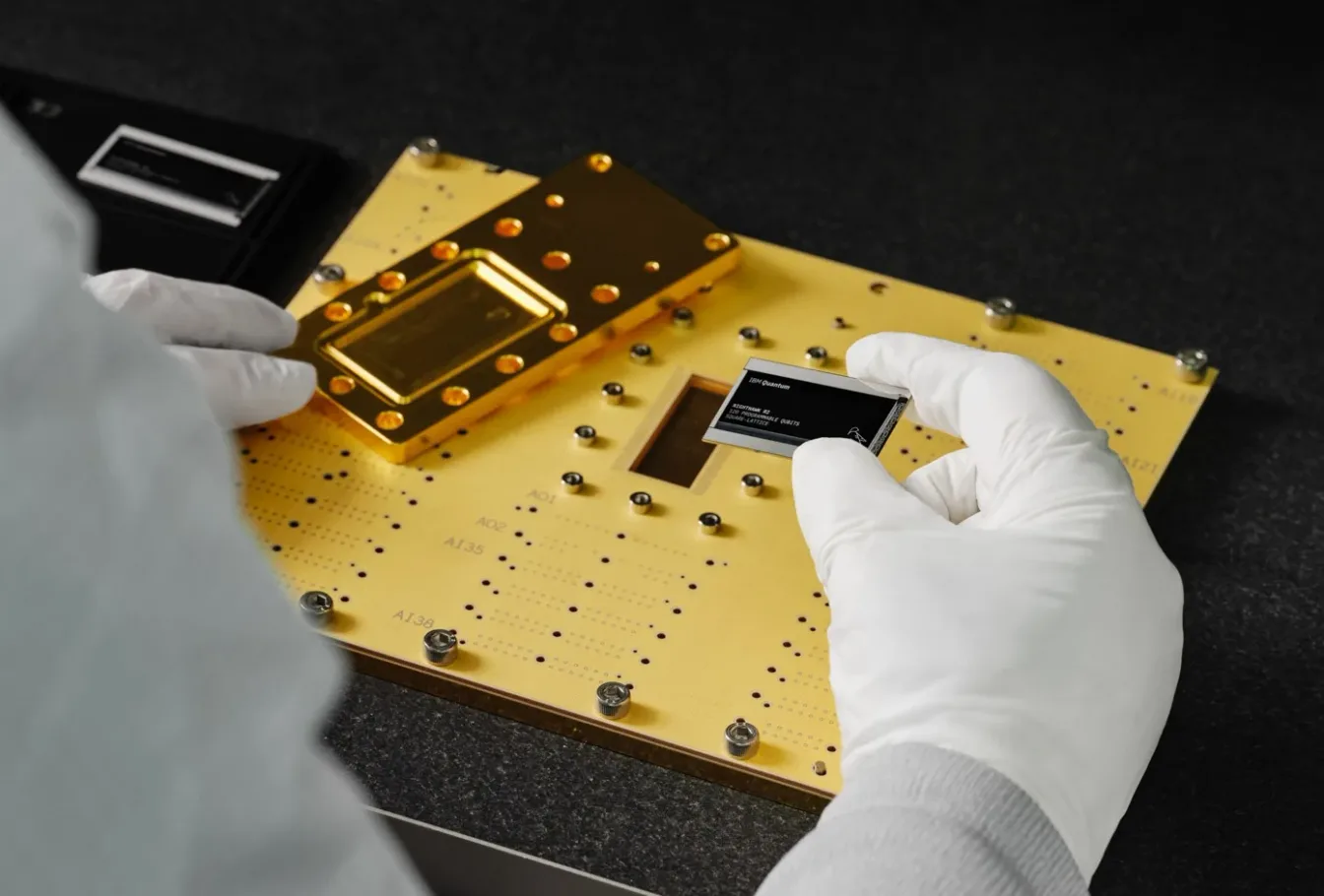
IBM, Fermilab, and NVIDIA plan to build a modular quantum computing co-design platform that puts NVIDIA DGX B200 systems alongside IBM quantum computers, including systems running the IBM Quantum Nighthawk processor. It follows the error correction platform IBM set up with Oak Ridge National Laboratory and AMD, and this one is aimed at the modular architectures IBM expects fault-tolerant machines to use. IBM also detailed a Slurm integration for scheduling quantum processors and a chemistry result with RIKEN that it says is 79 times more accurate than its earlier attempt.

Co-Designing Quantum and Classical Infrastructure
NVIDIA’s side of the collaboration, including a new error-correction decoder, is covered in our NVIDIA SC26 roundup. IBM’s account adds Fermilab’s role: the work draws on the lab’s Superconducting Quantum Materials and Systems (SQMS) Center, which contributes ultracoherent superconducting cavities, prospective interconnects, quantum memories, and bosonic resources. Anna Grassellino, Fermilab chief technology officer and director of the SQMS Center, pointed to “SQMS expertise in ultracoherent quantum hardware” as the lab’s part in the project.
IBM says researchers will use the platform to test what it takes for multiple quantum processors to work together, execute large numbers of samples, and scale classical compute alongside them. The work spans new scientific applications, integration of supercomputing and quantum resources, and components for future quantum computers. Fermilab and IBM also plan to study calculations in high-energy and nuclear physics, including lattice gauge theories, neutrino interactions, and nuclear simulations. IBM gave no site, system counts, or launch date.
On the quantum side, IBM calls Nighthawk the most powerful processor it has built. It runs circuits of up to 7,500 two-qubit operations on 120 qubits at up to 100,000 samples per second, and IBM puts the current Nighthawk r2 at 25 times the throughput of its Heron processor. IBM’s roadmap targets 10,000 operations on 520 qubits with Nighthawk r3, and the company did not say which revision the platform will use.
Slurm Scheduling for Shared Quantum Processors
IBM and NVIDIA, with Pasqal, worked with the open-source community to bring quantum computers into supercomputing workflows through the Quantum Resource Management Interface (QRMI), an open-source, vendor-agnostic layer. QRMI now ties directly into Slurm’s Hierarchical Resources (HRES) scheduling. Slurm previously had no native concept of a quantum processor, so centers attached QPUs through plugins.
A QPU can be shared across multiple nodes, and HRES lets administrators manage it as a shared resource and set limits for each part of a system. Slurm can then allocate, reserve, and account for QPU time under the scheduling policies HPC sites already use, and a researcher can request a QPU in a job script. IBM did not name a Slurm release, while NVIDIA, which acquired Slurm developer SchedMD, says the quantum interface arrives in Slurm 26.11 with support for QRMI and QDMI.
Quantum-Classical Simulation of an Iron-Sulfur Cluster
IBM, RIKEN, and NVIDIA researchers applied sample-based quantum diagonalization (SQD) to Fe4S4, an iron-sulfur cluster whose strongly interacting electrons make it hard to simulate. The team started from an intentionally imperfect but more realistic estimate of the molecule’s state, which steers the quantum computer toward the electron configurations that matter. The classical side ran on NVIDIA GPUs, including RIKEN’s ROQUO supercomputer, which IBM says is built on NVIDIA GB200 NVL4 systems.
The researchers ran circuits of up to 4,000 two-qubit operations on 72 qubits and collected 5 million samples. IBM reports a 79-fold improvement in accuracy over the team’s earlier runs of the same experiment, landing within 4.3 millihartree of the result from the density-matrix renormalization group (DMRG) method, a classical technique used as the reference. These are vendor results, and we did not run or audit them. IBM did not name the quantum processor used.
This is separate from the protein-ligand work by IBM, RIKEN, and Cleveland Clinic that is a finalist for the 2026 ACM Gordon Bell Prize, which NVIDIA highlighted at the show and which also used ROQUO. The Fe4S4 research is supported by Japan’s New Energy and Industrial Technology Development Organization (NEDO) through its project on quantum-supercomputer hybrid platforms.
Decoder and HPC Results at SC26
Among related work IBM is showing at SC26, Pelagos is an open-source decoder project from IBM and AMD that is built on the Triton framework and runs on AMD and NVIDIA GPUs. IBM says its decoder tests ran up to 97 times faster than a single CPU core, and GPU decoding scaled 7.5 times across eight AMD Instinct accelerators against one, on ORNL’s Lux system. The University of Illinois Urbana-Champaign, NCSA, and IBM also connected NCSA’s DeltaAI supercomputer to an IBM quantum computer to model Cu3C6O6, a kagome-lattice metal.
IBM Quantum Hardware
The post IBM Quantum Co-Design Platform With Fermilab and NVIDIA Targets Modular Systems, Plus a 79x Accuracy Gain on Fe4S4 appeared first on StorageReview.com.