← Technology, Science & Infrastructure
▣ Distilled locally
Researchers Unveil the $450 3D Bioprinter, Built Using a Low-Cost FFF 3D Printer and Syringes
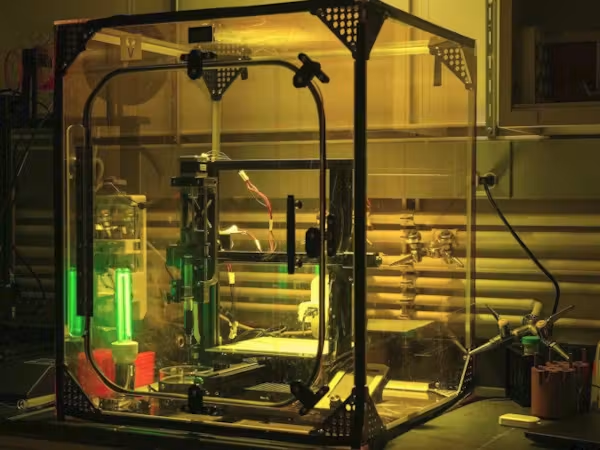
Researchers from the University of Rochester and Cornell University are trying to make 3D bioprinters affordable for anyone who wants one — by modifying low-cost fused filament fabrication (FFF, also known as FDM) printers for the task rather than building them from scratch. "We aim to create DIY bioprinters using inexpensive, easily obtainable parts," explains project lead Anne S. Meyer of the team's focus, "so that they are affordable and easy for other scientists to make in their own labs as well. Our upgraded printer can create living structures that are significantly taller and more complex than was previously possible, and it can even create hollow cavities within the prints." A 3D bioprinter works much like its non-bio FFF equivalent, but rather than extruding molten plastic it builds its objects from living materials. Custom-built bioprinters can cost more than $100,000 each, making them unaffordable for many small-scale research projects — which is where projects to adapt much cheaper FFF printers into bioprinters come in. Earlier efforts had struggled to print objects above around 20 layers, but Meyer and colleagues' design has been able to put together a working 3D bioprinter capable of printing upwards of 100 layers for just $450. "This opens up possibilities to make structures that have a high surface-to-volume ratio," Meyer explains, "so that the embedded bacteria can more efficiently receive signals or nutrients from the environment and can excrete any useful products much more rapidly into their surroundings." Part of that success comes not from the printer itself but the development of secondary materials designed to support the "bioink" as it solidifies — a pair of slurries, one made as a sacrificial support material that can be easily removed from the print once set and one which helps to incubate the bacteria to extend its lifespan. "[We can] create engineered biofilm materials that either have more biofilm characteristics, allowing study of and testing on medically relevant biofilm, or that have stronger mechanical properties, allowing them to be used for applications," Meyer says of the implications of this latter material. The team's work has been published in the journal Applied Polymer Materials under open-access terms; 3D print files for the modifications, which replace the printer's extruder with a syringe and pump system, are available on GitHub under an unspecified license. Main article image courtesy of J. Adam Fenster/University of Rochester. Researchers have come up with an alternative to high-price 3D bioprinters: FFF printers modified for just $450. (📷: J. Adam Fenster/University of Rochester) While modifying FFF printers for bioink isn't a new concept, the team's version can print many more layers than previous attempts. (📷: Gona et al)
↑ Back to top
Originally published by Hackster News ↗
· rebuilt here from its own full-text RSS feed · all rights
remain with the publisher, please read and support them there.