← Technology, Science & Infrastructure
▣ Distilled locally
Don't Let Your Dash Cam Drain Your Battery
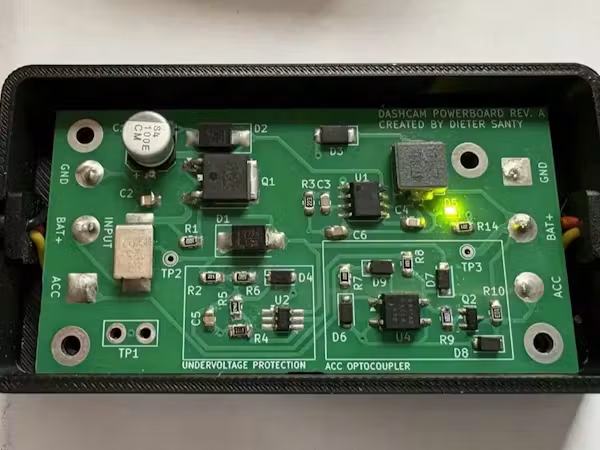
Dash cams can be useful for recording accidents, vandalism, and other incidents, even when a vehicle is parked. But keeping a camera running while the ignition is off comes with a risk: draining the car's 12 V battery. Commercial hardwire kits are supposed to prevent this by automatically disconnecting power when the battery voltage drops too low. Unfortunately, those protections don't always work as advertised. Dieter Santy discovered this problem after purchasing a Vantrue dash cam and its matching hardwire kit. Before installing the hardware in an electric vehicle, Santy connected it to a bench power supply and gradually lowered the voltage to determine when the protection circuit would activate. It never did. The camera continued drawing power even as the voltage dropped below safe levels. Rather than gamble on another commercial kit that may have the same problem, Santy developed VoltGuard, an open source dash cam power board with a configurable low-voltage cutoff, automotive-grade protection circuitry, and ignition detection. VoltGuard consists of five functional circuit blocks designed to regulate power and protect the vehicle's battery. At the center is an Infineon TLE8366EV50 automotive buck converter that steps the vehicle's nominal 12 V supply down to the 5 V required by the dash cam. A resettable fuse, transient voltage suppression diodes, and a P-channel MOSFET provide additional protection against electrical faults and reverse-polarity connections. The most important component, however, is a Texas Instruments TPS3700 voltage detector. This chip monitors the battery through a resistor divider and disconnects the dash cam when the voltage falls below a predetermined threshold. For this particular build, Santy selected a cutoff voltage of 12.2 V, calculated using 294 kΩ and 10 kΩ resistors. When the battery drops below that threshold, the voltage detector chip changes the MOSFET's gate state, shutting off power to the downstream circuitry. An optocoupler monitors the vehicle's ignition-switched accessory line, allowing VoltGuard to keep the camera powered while the vehicle is running. The circuit also generates a separate accessory-status signal so the dash cam can distinguish between driving and parking conditions. VoltGuard's custom PCB was designed in KiCad and assembled entirely by hand. Getting it working, as is so often the case, took quite a bit of troubleshooting, including correcting an incorrectly mapped component footprint, swapped resistors, an improperly specified protection diode, and a nearly invisible solder bridge. After fixing these issues and two solid days of bench testing, the board was operating as intended. The completed electronics were then installed inside a custom 3D-printed enclosure designed in Fusion 360. PETG was chosen over PLA because the power circuitry reached approximately 135 °F during operation, approaching PLA's glass transition temperature. With VoltGuard installed, the dash cam now operates during driving and parking while automatically disconnecting when the battery voltage drops too low. Anyone interested in building their own VoltGuard can find the complete KiCad project, bill of materials, and 3D-printable enclosure files in the project write-up . Everything is released under the CERN-OHL-P open hardware license, making it available for modification and further development.VoltGuard shuts down dash cams to protect car batteries (📷: Dieter Santy) The complete setup (📷: Dieter Santy) Some like it hot, but PLA does not (📷: Dieter Santy)
Originally published by Hackster News ↗
· rebuilt here from its own full-text RSS feed · all rights
remain with the publisher, please read and support them there.
↑ Back to top
© 2026 PaperWeb. Content remains property of respective publishers. · Privacy Policy · Terms