← Technology, Science & Infrastructure
▣ Distilled locally
Sylphide OS Brings Desktop Computing to Microcontrollers
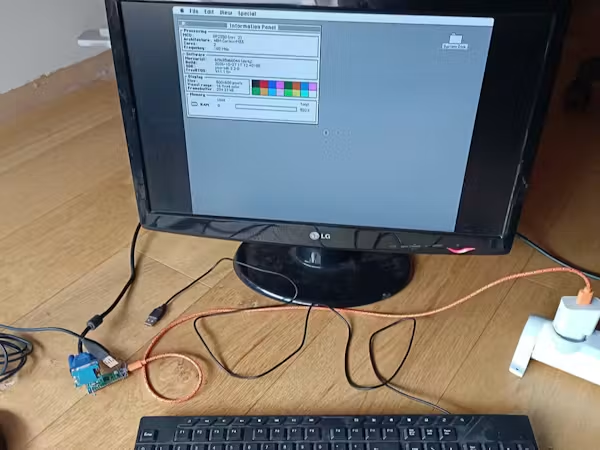
Modern microcontrollers have become very powerful, with many offering processing capabilities that would have been unimaginable in a home computer from the 1980s. Yet most still aren't capable of running a full-fledged operating system like Linux, largely because they lack a memory management unit (MMU) and have relatively limited RAM. That doesn't mean they can't provide a desktop computing experience, however. Developer Thomas Capricelli is demonstrating that with Sylphide OS , an open source operating system designed to turn microcontroller-based hardware into something resembling a vintage home computer. Unlike retrocomputing projects that recreate vintage machines using original components or emulation, Sylphide OS takes a different approach. It uses modern, inexpensive microcontrollers to build entirely new computers that capture the feel of working with hardware from the 1980s and early 1990s. The goal isn't to emulate any particular machine, but rather to recreate the constrained computing environment of that era. For Capricelli, a computer needs more than a processor and a few GPIO pins. It should support a keyboard and mouse, output video through a standard VGA or HDMI connection, and have storage capabilities. A proper framebuffer is also a requirement, rather than on-the-fly video signal generation. Networking is another big plus for Capricelli. Sylphide OS supports all of these features, making microcontrollers look more like single-board computers. Sylphide OS relies on FreeRTOS, a lightweight real-time operating system commonly used in embedded applications. FreeRTOS handles low-level task management, while Sylphide OS provides the hardware drivers, graphics rendering, user interface, and applications needed to create a desktop environment. The software is written primarily in C and C++, with some assembly language used for platform-specific drivers. Resource efficiency is a major consideration, as the operating system is intended to work across hardware with vastly different capabilities, including systems with monochrome displays, small framebuffers, and very little RAM. Sylphide OS currently supports three hardware platforms: the Olimex ESP32-P4-PC, which serves as the flagship target; a minimalist Raspberry Pi Pico 2 configuration using the RP2350 microcontroller with VGA and USB; and FabGL-based hardware with VGA output and PS/2 input. A Linux-hosted emulator is also available to simplify development. The project is still at version 0.1, but it already has a graphical desktop complete with windows, a window manager, menus, and desktop icons. There's also an information panel that displays hardware and software details while demonstrating the system's graphical capabilities. The interface should look familiar to anyone who remembers early graphical operating systems. There's still plenty of work ahead. Storage support, networking, interface widgets, and the ability to load and execute external programs are all planned, but haven't been implemented yet. For now, Capricelli has concentrated on building a stable foundation and getting the hardware drivers working properly. Both the hardware designs and source code are available in the project's repository , giving interested developers an opportunity to experiment with Sylphide OS or help bring it to additional microcontroller platforms.A microcontroller running Sylphide OS (📷: Thomas Capricelli)
↑ Back to top
Originally published by Hackster News ↗
· rebuilt here from its own full-text RSS feed · all rights
remain with the publisher, please read and support them there.