AMD launches EPYC Embedded 9006 CPUs with up to 256 cores
AMD announced the AMD EPYC Embedded 9006 Series SP7 CPUs, expanding its x86 processor portfolio optimized for embedded customer requirements and deployments. Advanced by the high-performance “Zen 6” core architecture, AMD EPYC Embedded 9006 CPUs combine up to 256 cores, scalable PCIe Gen 6 and CXL 3.1 connectivity, and advanced security from secure boot through runtime. With a throughput increase of up to 1.8x compared with the previous generation 5th Gen AMD EPYC 9005 Series processors,1 they provide the leadership compute and high-speed connectivity needed to scale throughput and handle increasingly demanding workloads in semiconductor automated test equipment (ATE), enterprise storage and network firewall applications. Seven-year product longevity, support for post-quantum cryptography for firmware signing, and ongoing security updates simplify maintenance and long-term support for mission-critical embedded applications.
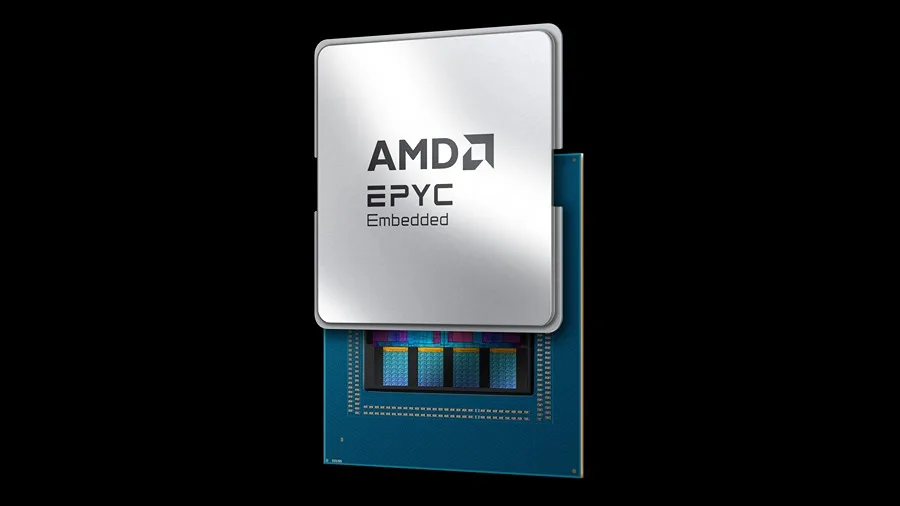
As AI infrastructure expands and data volumes grow, semiconductor ATE needs to validate memory and I/O devices faster, firewalls need to process and secure more network traffic, and storage controllers need to move and process more data. AMD EPYC Embedded 9006 processors deliver the high throughput, memory bandwidth and I/O performance required to meet these growing application demands.
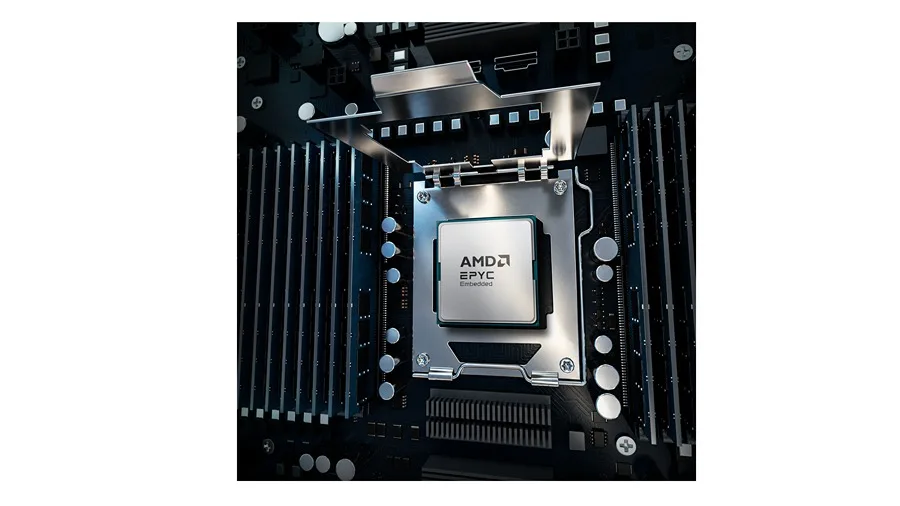
EPYC Embedded 9006 CPUs help power semiconductor-ATE systems that enable production-scale validation of new memory and I/O devices. The CPUs act as the control and orchestration engine, managing memory and storage test workloads and interfaces for high-speed DDR5 RDIMM and emerging MRDIMM technology, as well as switches and devices supporting PCIe Gen 6 and CXL 3.1. They also provide the compute scalability to run more tests in parallel.
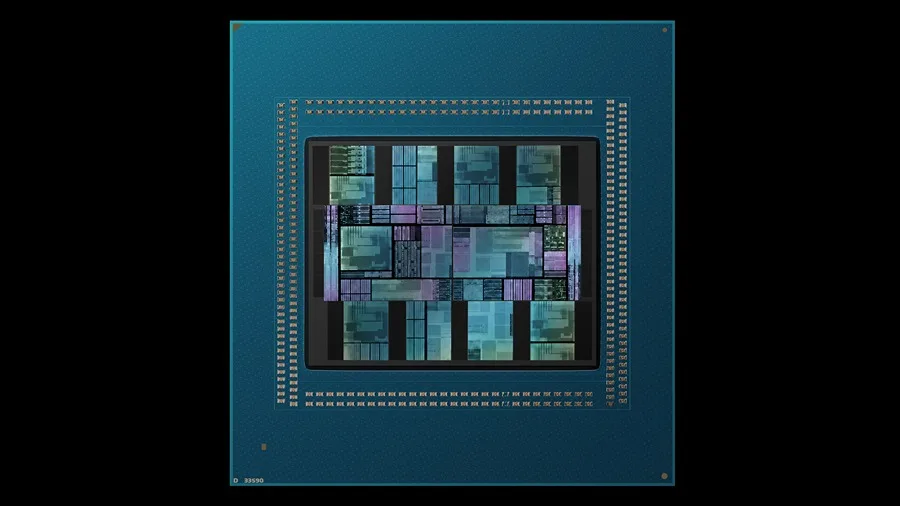
As expanding AI infrastructure increases network traffic, high-end firewalls supporting 400G/800G networks face growing throughput and security-processing requirements. EPYC Embedded 9006 CPUs provide the control-plane engine to manage growing security policies and network sessions, to process new flows and traffic exceptions, and to deliver the throughput for security processing and faster connectivity to data-plane accelerators. They offer customers up to 1.3x higher firewall throughput compared with the previous generation.2
AI data growth is transforming enterprise storage requirements. AMD EPYC Embedded 9006 CPUs power non-volatile memory express (NVM Express) connectivity, data movement and storage processing to manage NVMe devices. They accelerate data-intensive storage services such as compression, caching and RAID systems, delivering an increase over the previous generation of up to 1.5x on the intelligent storage acceleration library (ISA-L) benchmark3 that measures how quickly a processor performs specific functions used in storage services.
he processors offer up to 256 cores and 512 threads and up to a 1.8x throughput improvement compared with the previous generation.1 To help reduce bottlenecks in demanding workloads, they deliver up to 1.5x higher I/O bandwidth4 and up to 2.7x higher memory bandwidth5 compared with the prior generation. Sixteen DDR5 memory channels support RDIMM speeds up to 8,000 megatransfers per second (MT/s) and MRDIMM speeds up to 12,800 MT/s. Up to 96 PCIe Gen 6 lanes operate at 64 gigatransfers per second, while flexible PCIe Gen 6 and CXL 3.1 support high-speed connectivity with compatible networking, storage, accelerators, test equipment and memory expansion.
The processors provide seven-year product longevity for long-term embedded deployments. Ongoing embedded-focused firmware updates and software support help simplify maintenance for mission-critical embedded applications and systems. Building on the EPYC 9006 server CPU architecture, they also provide enterprise-class reliability, availability and serviceability features that help teams maintain embedded infrastructure, with telemetry and predictive failure analysis available through supported platform implementations.
Advanced security is delivered with dedicated security engines that provide complementary layers of protection, from establishing trust at boot to securing runtime operation and verifying platform identity and integrity. Each engine uses separate resources to reduce attack exposure and strengthen resilience:
- AMD root of trust (ART) establishes the initial immutable silicon root of trust and enables secure boot by creating a chain of trust to authenticate firmware components as the system boots. ART also supports post-cryptography for firmware signing, helping to protect the platform against future quantum threats, along with hardware protections against physical and side-channel attacks.
- AMD Security Processor (ASP) acts as the boot orchestrator and provides key security services during operation, including a trusted execution environment. It also provides secure debug capabilities for authorized diagnostics and troubleshooting. For virtualized environments, the ASP also manages the keys used to protect VM memory.
- Caliptra, an open-source vendor-agnostic silicon root of trust, is used for device identity and attestation, and allows a remote entity to verify a device is genuine and that the expected BIOS and firmware are running on the platform.
Customers can choose from a range of SKUs with 64 to 256 core counts for the right combination of performance, power, frequency and cache to efficiently meet specific workload and application requirements. The 128-core SKU processor will be available starting Nov. 15, with the remaining SKUs expected to begin shipping by end of year.
For more information, visit amd.com.
- SPECrate2017_int_base comparison based on AMD internal estimates for a 2P 6th Generation EPYC Embedded processor as of 11/26 and 2P 5th Gen EPYC measurements as of 7/26. 2P AMD EPYC 9976, 512C total, 16x64GB 12800 MT/s MRDIMM, AOCC 6.0, SPECrate2017_int_base 4900. 2P AMD EPYC 9965, 384C total, 12x64GB DDR5-6400, AOCC 5.0, performance determinism, SPECrate2017_int_base 2740. SPEC, SPECint, and SPECrate are registered trademarks of Standard Performance Evaluation Corporation. Learn more at spec.org. SPECrate 2017 will be a retired benchmark on November 17, 2026, and SPEC will no longer review or publish SPECrate 2017 results. (EES7-008)
- DPDK L3 forwarding performance based on AMD testing conducted in October 2026, using the DPDK L3FWD benchmark. 6th Gen AMD EPYC Embedded 9756 (128 cores) and 5th Gen AMD EPYC 9755 (128 cores) platforms were each configured with 400 Gb/s aggregate NIC bandwidth (2 × 200 Gb/s). 6th Gen AMD EPYC Embedded 9756 platform was configured with 32 × 128 GB DDR5 RDIMMs operating at 8000 MT/s. 5th Gen AMD EPYC 9755 system was configured with 24 × 24 GB DDR5 RDIMMs operating at 6400 MT/s. Performance reflects a comparison of the two processors using DPDK packet-forwarding throughput, with both configurations tested using one core and one thread per port. Estimated results are subject to change when products are released in market. Results may vary due to factors including system configurations, software versions and BIOS settings. (EES7-003)
- Based on AMD internal estimates for the AMD EPYC Embedded 9756 processor as of 11/26 and published product specifications for AMD EPYC 9005 Series Processors as of 6/26. Estimated results are subject to change when products are released in market. (EES7-004)
- ISA-L performance comparison based on AMD internal estimates for the 6th Gen AMD EPYC Embedded 9756 processor as of 10/26, and measurements of AMD 5th Gen AMD EPYC 9755 processor, as of 6/26. ISA-L Erasure, CRC32_ISCSI, SHA-256, AES-XTS-128 encode, and AES-XTS-256 encode performance were evaluated using cold data, one core, SMT disabled. System Configurations: 6th Gen AMD EPYC Embedded 9756 system (128 cores/256 threads) was configured on an AMD reference platform with 32 × 128 GB dual-rank DDR5 RDIMMs operating at 8000 MT/s, Ubuntu 24.04.4 with Linux kernel 6.18.54, and custom BIOS settings including a 3.15 GHz base frequency, NPS2, and AVX-512. The 5th Gen AMD EPYC 9755 system (128 cores/256 threads) was configured with 24 × 24 GB single-rank DDR5 RDIMMs operating at 6400 MT/s, Ubuntu 24.04.4 with Linux kernel 6.18.54, and custom BIOS settings including a 2.70 GHz base frequency, NPS1, and AVX-512. Estimated results are subject to change when products are released in market. Results may vary due to factors including system configurations, software versions and BIOS settings. (EES7-002)
- Based on AMD internal estimates for the AMD EPYC Embedded 9756 processor as of 11/26 and published product specifications for AMD EPYC 9005 Series Processors as of 6/26. Estimated results are subject to change when products are released in market. (EES7-005)