← Technology, Science & Infrastructure
▣ Distilled locally
Meta Brings Its Muse AI Agent to ESP32 and Raspberry Pi
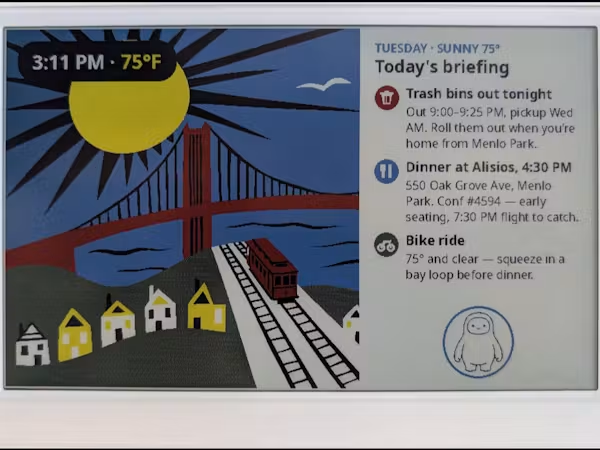
Meta recently introduced Muse, a personal AI agent designed to help users with everyday tasks, answer questions, and interact with digital services. Like other AI assistants, Muse is primarily a software-based tool, but Meta wants to give it a presence in the physical world as well. To make that possible, the company has released Muse Gadgets , an open source software development kit (SDK) that lets makers connect the AI agent to their own hardware. Muse Gadgets supports both ESP32 microcontrollers and Linux-based computers, such as the Raspberry Pi. Rather than building an AI assistant from scratch, developers can use the SDK to give Muse access to displays, microphones, speakers, buttons, sensors, and actuators. That makes it possible to create everything from voice-controlled smart home interfaces to desktop AI assistants that display useful information and respond to physical inputs. Build your own Muse Gadgets Meta has released two separate SDKs to support different hardware platforms. The ESP32 Device SDK is intended for microcontroller-based projects, allowing developers to connect displays, handle audio input and output, and interact with external sensors and other electronics. The Linux Device SDK targets Raspberry Pi boards and other Linux computers, with additional capabilities such as executing custom commands, automating system administration tasks, and interacting with Home Assistant. Several example projects are already available to help developers get started. One uses the Waveshare ESP32-S3-Touch-AMOLED-1.75C, which features a 1.75-inch round AMOLED touchscreen, microphone, speaker, and battery. Another uses the Seeed reTerminal E1002, a color E Ink display that can show daily briefings, reminders, shopping lists, and other information provided by Muse. A Raspberry Pi 5 can also be used to connect Muse with Home Assistant and other Linux applications. Meta is additionally developing an HDMI stick that will allow users to interact with Muse through their televisions, although details about that hardware have not yet been released. An off-the-shelf alternative For users who would rather skip the hardware assembly, Meta has also developed a device called Muse Home Link. It connects to a home Wi-Fi network and allows Muse to communicate with compatible smart home devices and other equipment through local HTTP APIs. Home Link is built around an ESP32-C5 microcontroller that supports dual-band Wi-Fi 6, Bluetooth LE, and IEEE 802.15.4 connectivity for Zigbee and Thread. It also includes 8 MB of flash memory, 8 MB of PSRAM, a USB-C port, and an LED. These units will be distributed free to active Muse subscribers in the United States while supplies last. Developers who want to build their own gadgets will need an SDK token and the Muse mobile app for pairing. The SDKs and firmware have been published on GitHub under the Apache 2.0 license, aside from certain third-party components that retain their original licenses. Take a look at the official SDK repository for more details or to get started with Muse Gadgets.Muse Gadgets running on a Seeed reTerminal E1002 (📷: Meta)
Originally published by Hackster News ↗
· rebuilt here from its own full-text RSS feed · all rights
remain with the publisher, please read and support them there.
↑ Back to top
© 2026 PaperWeb. Content remains property of respective publishers. · Privacy Policy · Terms · Copyright takedown