← Technology, Science & Infrastructure
▣ Distilled locally
Are Two Robots Better Than One?
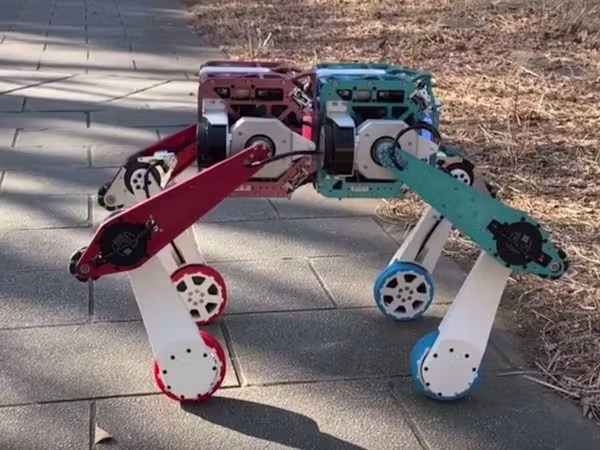
Whether working on an assembly line or vacuuming the floor, a robot is generally designed with a particular purpose in mind. But a robot that's good at one of these tasks may not be particularly useful for another. Reconfigurable robots offer a potential solution by changing their physical structures to perform different jobs. Researchers at the University of Tokyo have now developed a robotic system called TwinX that takes this concept a step further, allowing two robots to join together, separate, and cooperate using little more than a single wire connecting them. Most modular robots rely on rigid mechanical connections to assemble themselves into different configurations. Once connected, the individual modules function as a single machine. TwinX takes a different approach by using a retractable wire that serves two purposes: pulling the robots together to form a larger machine and enabling them to work together while physically separated. TwinX consists of two identical wheeled-legged robots called WiXus, each equipped with articulated limbs that have wheels at their ends. The robots are connected by a 2 mm diameter Dyneema wire, which is controlled by a motorized winding mechanism capable of generating 313 newtons of continuous tension. When the wire retracts, it pulls the robots together until four docking pins engage corresponding holes. These mechanical connections provide the rigidity needed to withstand bending and twisting forces, while tension in the wire keeps everything securely connected. By selecting different docking surfaces, TwinX can assume three configurations. The first is a quadruped that uses its four wheeled legs to navigate uneven terrain. The second is a swerve-drive vehicle with independently steerable wheels, allowing it to move in different directions without first turning. The third is a mobile manipulator that positions one robot vertically on top of the other, creating a wheeled platform with two articulated arms. The researchers demonstrated these capabilities in a series of experiments. In quadruped mode, TwinX successfully traveled through grass, descended stairs, and stepped over a curb. Another demonstration showed the robot driving toward a piece of trash, transforming into its mobile manipulator configuration, picking up the trash, depositing it into a bin, and transforming back into its wheeled configuration. When separated, the robots remain connected by the wire, which can be used to manipulate objects or transmit forces between them. The researchers demonstrated this by having the robots surround and transport objects using the wire, hook onto objects to move them, and assist one another through tension transmitted along the wire during slope traversal. TwinX is still an experimental platform, and the researchers have plenty of work ahead of them, particularly when it comes to automating cooperation between the separated robots. They also hope to expand the concept to systems with more robots and multiple connecting wires. Such systems could take on a much wider variety of tasks without requiring specialized hardware for each one, making reconfigurable robots far more versatile.These robots can team up (📷: S. Inoue et al.) An overview of the TwinX system (📷: S. Inoue et al.) New capabilities are acquired after docking (📷: S. Inoue et al.)
↑ Back to top
Originally published by Hackster News ↗
· rebuilt here from its own full-text RSS feed · all rights
remain with the publisher, please read and support them there.