A crypto and AI money guide to election night
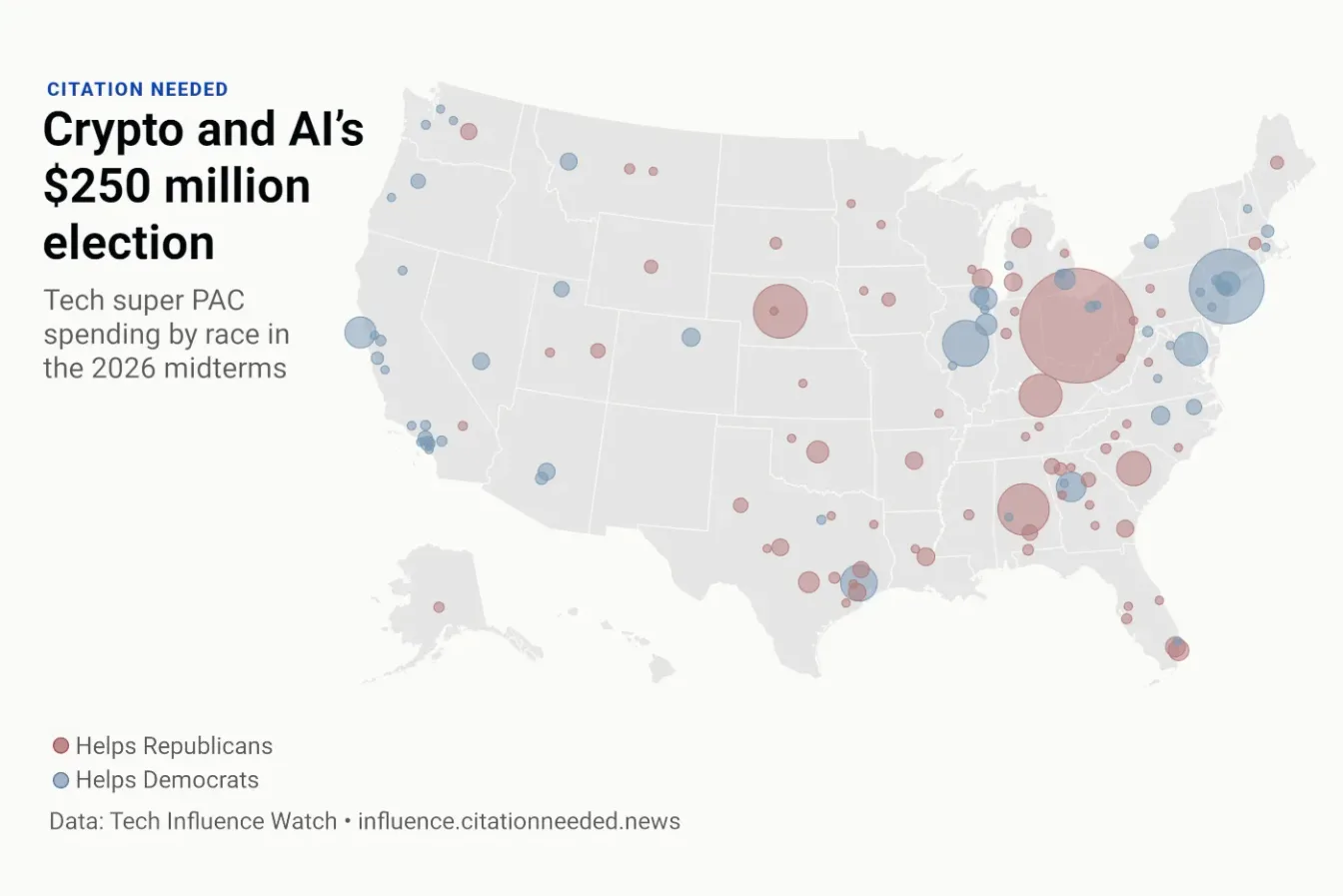
Cryptocurrency and artificial intelligence industry super PACs have poured $250 million into this year’s federal elections. Crypto alone has surpassed the $130 million it spent in 2024, when the industry became one of the biggest corporate spenders in politics almost overnight. Tonight, we find out what all that money bought.
The bird’s eye view
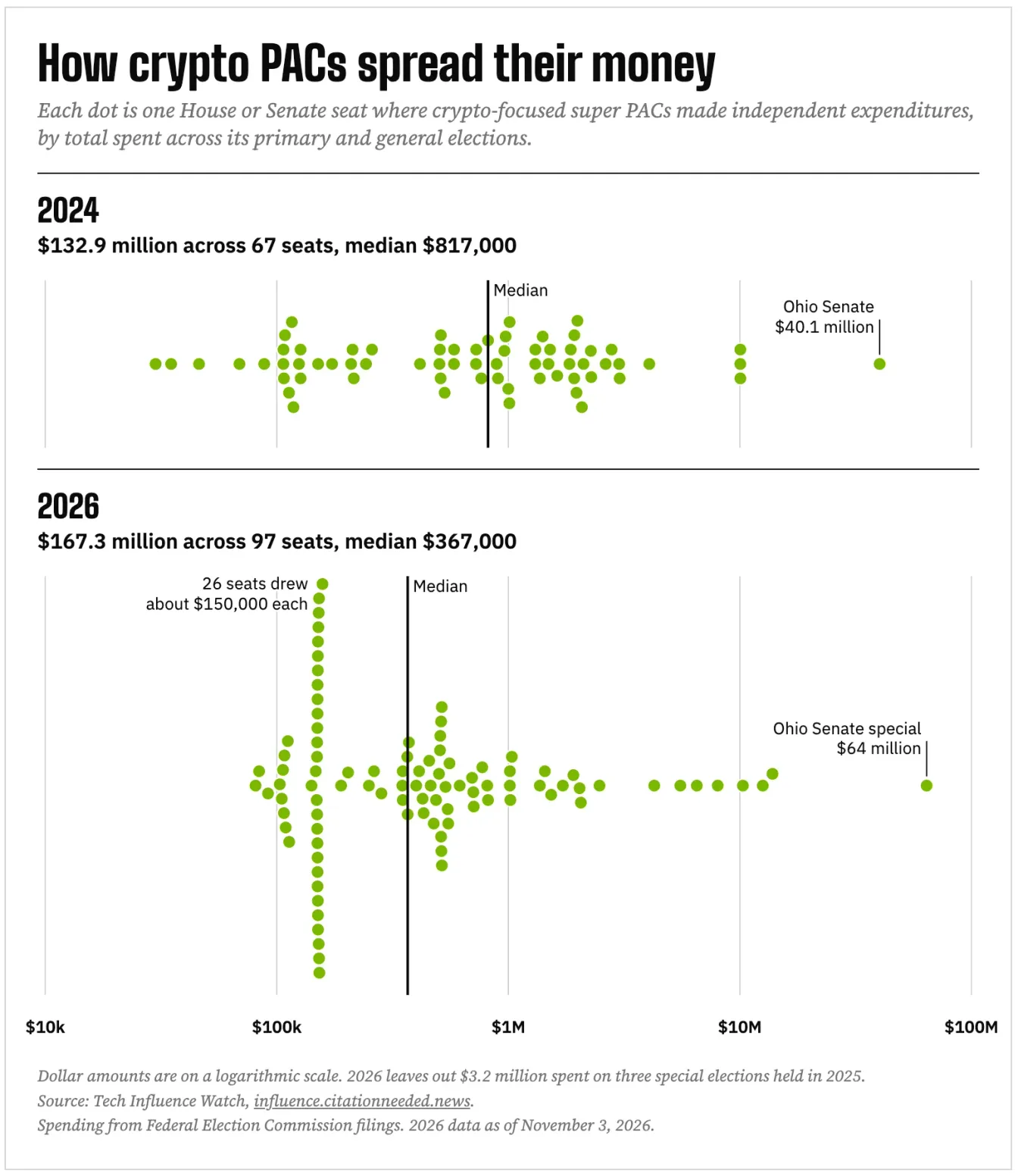
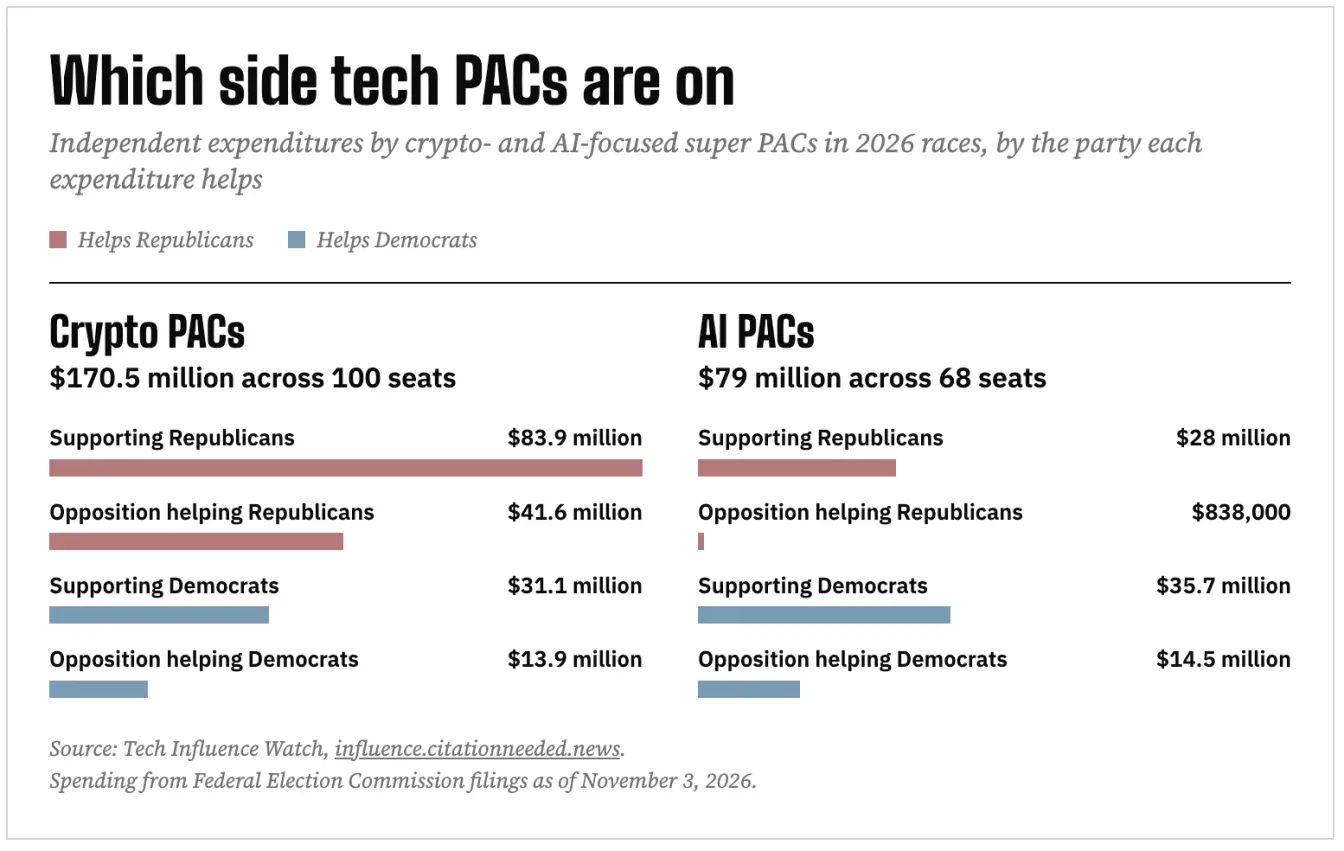
- Crypto PACs have spent $170.5 million across 100 seats, mostly on the Republican side. They’ve spent $125.5 million boosting Republicans and $45 million to help Democrats. But the typical seat is drawing less: the median fell from $817,000 to $367,000. Twenty-six seats drew nearly identical buys of about $150,000 each.
- In general elections, the crypto industry has stopped spending big to help Democrats. In 2024, it spent about $10 million apiece helping Democrats Elissa Slotkin and Ruben Gallego win their Senate races. This cycle, its Democratic spending has largely been confined to primaries against other Democrats. Even then, its biggest expenditure in a Democratic primary didn’t help any Democrat in particular: it was $10 million in opposition spending against Juliana Stratton in Illinois’s Senate race. Stratton won anyway, by nearly 8 points.
The crypto sector hasn’t spent more than about $1 million helping any Democrat in a general election, and those are mostly rewards to industry allies who will safely win re-election regardless. Its biggest general-election spending supporting Democrats was about $1 million apiece for three incumbents in safe or likely seats: Janelle Bynum (OR-05, Solid D), Steven Horsford (NV-04, Likely D), and Derek Tran (CA-45, Likely D), who all voted for the industry’s top priorities, the Clarity [I110] and Genius Acts [I89]. - AI PACs have spent $79 million across 68 seats and lean the other way: $50.2 million to benefit Democrats and $28.8 million to benefit Republicans.
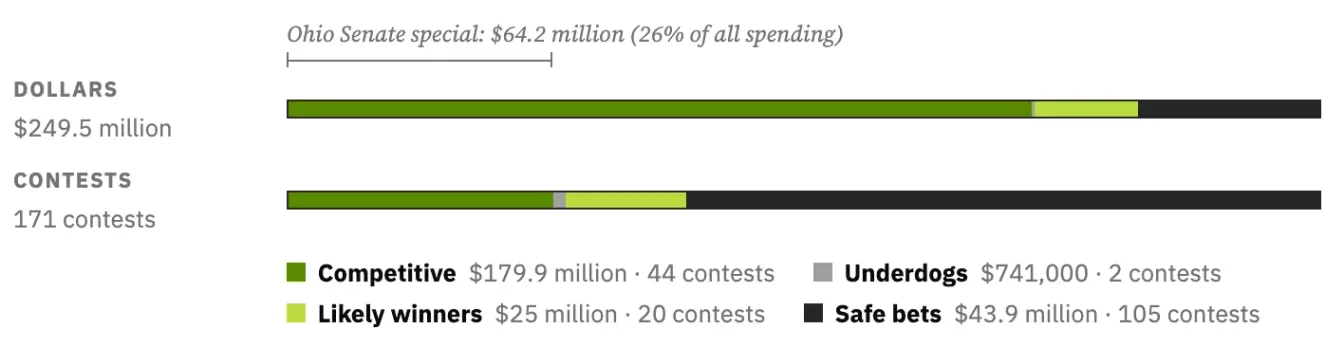
- Nearly three-quarters of the money ($179.9 million) went to 44 competitive races, meaning those Cook rates as Toss-up or Lean (or, for primaries, close in polling). But it’s heavily concentrated in just a few of them. Ohio’s Senate race, the Democratic primary in New York’s 12th district, and Nebraska’s Senate race account for $105.6 million — almost 60% of the competitive spending.
- The major PAC networks didn’t back a single underdog. The only crypto money behind a longshot candidate, about $700,000 for Republican John Deaton in his Massachusetts Senate race against incumbent Ed Markey, came from Commonwealth Unity Fund, a crypto-funded super PAC that exists only to support Deaton. (Deaton lost to Elizabeth Warren by nearly 20 points in 2024.) On the AI side, a small AI-focused PAC spent $35,000 opposing Dan Koh in the Democratic primary for Massachusetts’ 6th District, where he led by 15–20 points. Think Big, the Democratic arm of the AI industry’s largest PAC network, spent more than $700,000 supporting Koh in that primary.
- The rest mostly backed the winners. Looking at spending, less than a fifth of it went to safe bets. But by count, they make up the majority: the PACs spent in 105 contestsa whose outcome was never really in question, compared with only 44 competitive ones. In these, they’re not trying to change the outcome; they’re buying (or rewarding) loyalty and padding their win rate [I111]. Safe bets are 61% of races but 18% of dollars; competitive races are 26% of races but 72% of dollars.
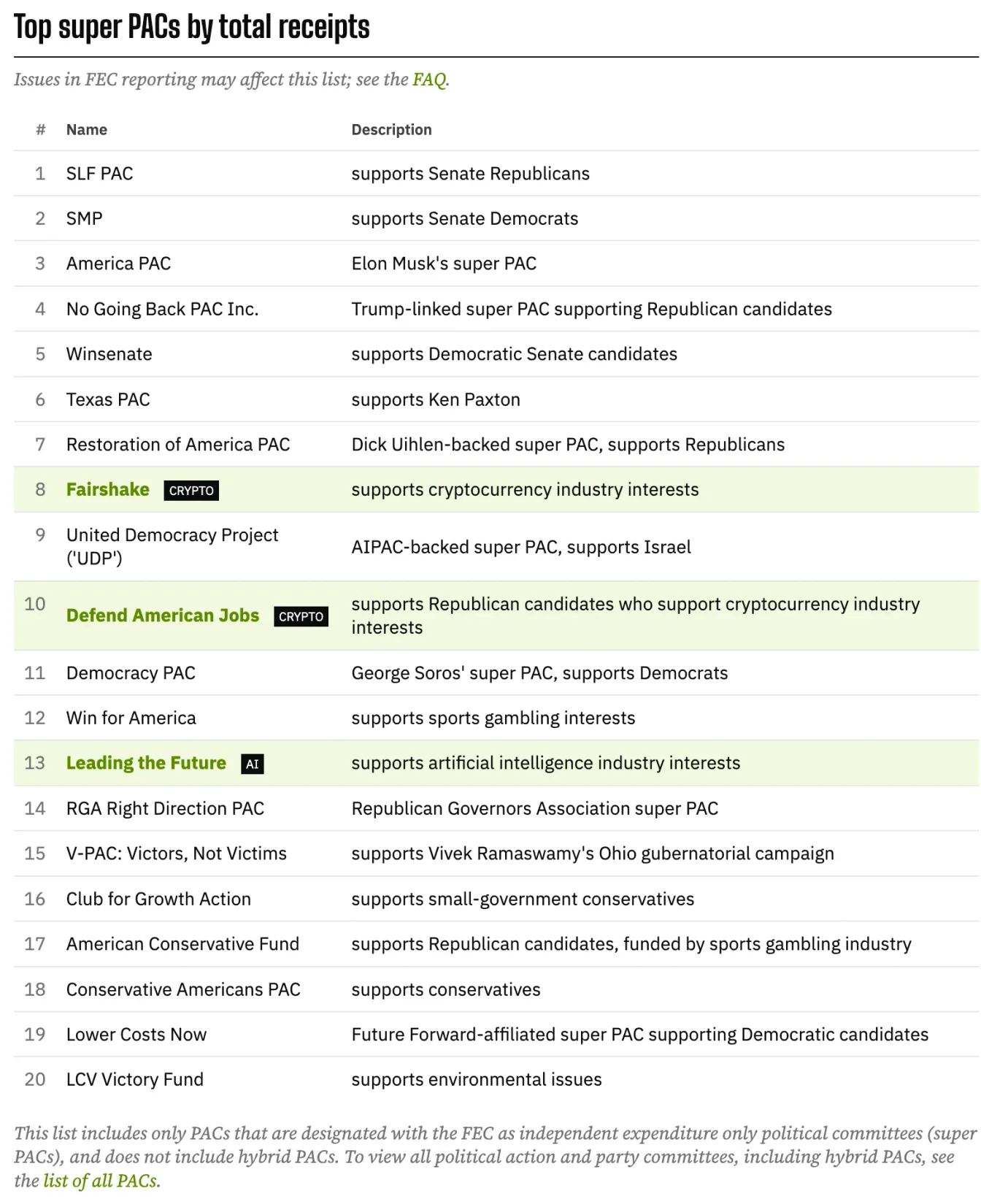
- These are now some of the biggest super PACs in politics. Two PACs belonging to crypto’s flagship Fairshake network are in the top ten super PACs by total receipts. Leading the Future, an AI super PAC backed by OpenAI president Greg Brockman and Andreessen Horowitz, appears in 13th place.
Spending over time
You can watch all of this unfold on Tech Influence Watch’s new spending timeline, which shows the spending spread across the country week by week.
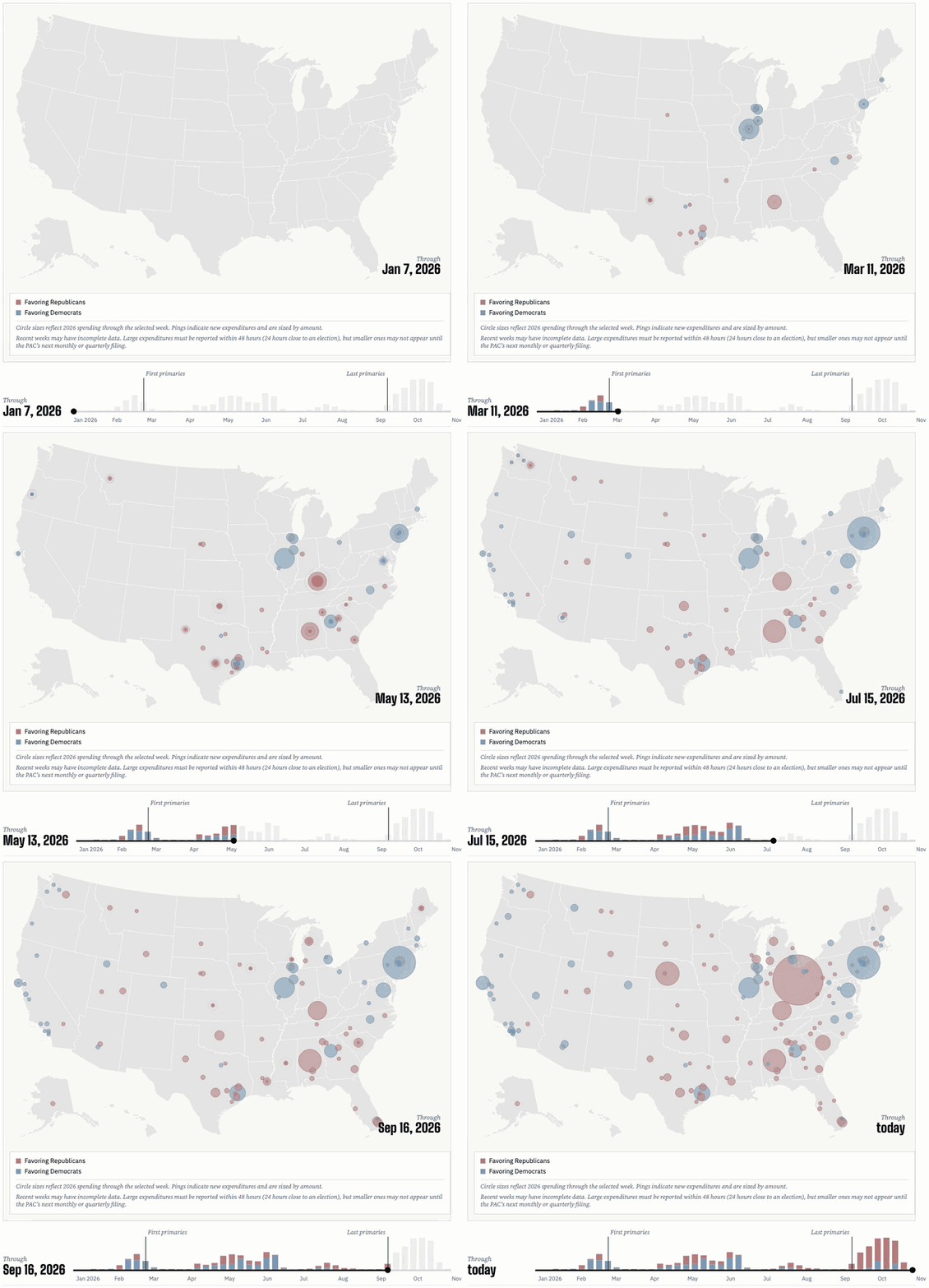
I think the most striking thing in it is Ohio. On September 15, the crypto industry’s top legislative priority, the Clarity Act, failed in the Senate without a single Democratic vote [I110]. Days later, Fairshake announced it would spend $30 million against longtime opponent Sherrod Brown in Ohio’s Senate race. Until the first expenditure went out on September 22, the race didn’t appear on the map at all. Within a few weeks it was by far the biggest race in the country, and crypto PACs flooded the state with more than $64 million supporting incumbent Jon Husted and opposing Brown. $56.6 million of it came from the Fairshake network — almost double its initial promise.
The crypto and AI industries have spent hundreds of millions on this election. Tracking it is a one-person, reader-funded operation. Subscribe for free to get post-election results and analysis, or become a paid member to support this work.
SubscribeRaces to watch
Ohio Senate (special): Jon Husted (R) vs. Sherrod Brown (D)
$64.2 million spent • Toss-up • Almost all from crypto PACs
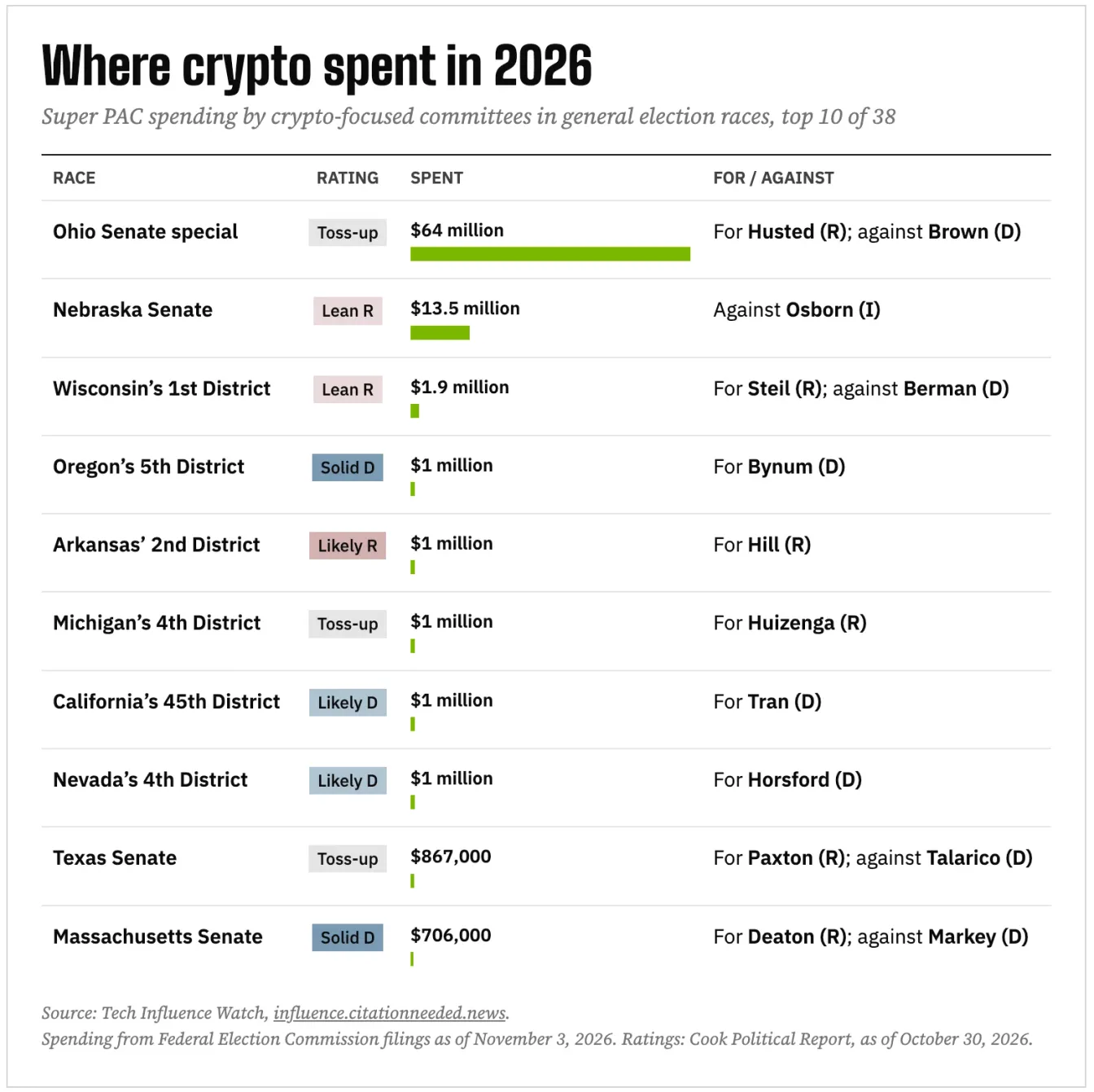
Ohio’s Senate special election, to fill the remaining two years of JD Vance’s term, is the biggest tech-money race of the cycle by far, and accounts for about a quarter of all of the election spending I’ve tracked at Tech Influence Watch. But the money is almost exclusively coming from the crypto sector, and accounts for more than a third of all money the crypto industry has spent in the midterms, drawing nearly five times what they’ve spent on any other race.
Husted, who was appointed to the seat when Vance became vice president, is facing Sherrod Brown, who represented Ohio in the Senate for 18 years before losing his seat in 2024. This year, Defend American Jobs, the Republican arm of Fairshake’s super PAC network, unleashed $36.9 million to support Husted and $19.7 million to oppose Brown. The Digital Freedom Fund — a new, explicitly MAGA super PAC mostly backed by the Winklevoss twins — dumped another $3.1 million into the race to boost Husted and $4.3 million to oppose Brown. The only AI money is $115,000 from Guardrails Alliance against Husted.
All of it has landed since September 22 — days after the industry’s last hopes of the Clarity Act passing were dashed by a cloture vote opposed by all Democrats and three Republicans [I110]. Defend American Jobs’ first ads attacking Brown started running almost immediately. As usual, they don’t mention crypto. One of the most-run ads instead accuses Brown of having “voted to add 87,000 IRS agents to come after you and give Social Security benefits to illegals”.
As chair of the Senate Banking Committee, Brown was one of crypto’s most vocal critics in Congress. On the campaign trail, he has softened his stance on the asset class somewhat, telling the New York Times that crypto “has a part, a role, in our economy.”1 But he’s vowed to continue to “take on” the “crypto/data center crowd”.2 The Winklevoss twins, who founded the Gemini crypto exchange and bankroll the Digital Freedom Fund, have called Brown a “crypto public enemy” and cast him as a “henchman” and “co-conspirator” of Elizabeth Warren, the industry’s favorite villain.34 In 2024, Fairshake spent $40 million to help Bernie Moreno unseat him — also the most it spent on any race that cycle, and four times what it spent on the next biggest.
Crypto is far from the only big money in this race. Independent expenditures have surpassed $350 million, and estimates that also count other groups’ electioneering communications and reserved ad time have topped half a billion dollars.5
Brown has maintained a narrow lead in recent polls, by between 1.7 and 3.1 points according to several polling aggregators.6 If he wins, it would be the most expensive — and humiliating — failure in crypto’s brief campaign finance history. It would also undercut the message the industry has worked hard to send. “This is what happens when you mess with the crypto army,” Cameron Winklevoss gloated after Brown’s loss in 2024.4 Coinbase CEO Brian Armstrong wrote, “DC received a clear message that being anti-crypto is a good way to end your career.”7 The crypto industry’s stranglehold on Congress depends on that threat being believable. A Republican crypto lobbyist speaking to Politico warned that if Brown wins, “it is going to further neuter Fairshake’s perceived Sword of Damocles that they hang over candidates.”5
Husted has received $188,000 in candidate-specificb contributions from crypto and AI executives, mostly from Paradigm, Andreessen Horowitz, Coinbase, Oracle, Palantir, Google, and Solana Labs. Brown has received $58,000, mostly from Ripple Labs’ Chris Larsen and tech investor Ron Conway.
Nebraska Senate: Pete Ricketts (R) vs. Dan Osborn (I)
$14.1 million spent • Lean Republican • Almost all from crypto PACs
Fairshake’s Defend American Jobs has spent $13.5 million to oppose Dan Osborn, an independent who’s giving incumbent Pete Ricketts an unexpectedly close race in the reliably red Nebraska. Ricketts was backed by $350,000 from the Cantor Fitzgerald-funded Fellowship crypto PAC, and $263,000 from the Anthropic-backed Public First AI-focused PAC network.
Ricketts has been an ally to crypto from his seat on the Senate Banking Committee. This has likely spurred most of the opposition to Osborn, even though Osborn has also signaled some support for crypto. “I do not want the United States to get left behind in anyway [sic] including crypto and digital assets,” he wrote in response to a questionnaire disseminated by the Coinbase-linked Stand With Crypto advocacy group.8 But since crypto started spending against him, he’s had harsh words for some members of that sector: “Pete Ricketts takes money from crypto con men who defrauded thousands of investors. Just another day serving the billionaire Epstein class instead of Nebraskans,” Osborn wrote on Twitter, alongside a graphic of the Winklevoss twins that cited Gemini’s $5 million fine by the CFTC [I73].9c
Ricketts has received $186,500 in candidate-specific contributions from crypto and AI executives, mostly from Andreessen Horowitz, Don Wilson of DRW, and Google. Osborn has received no crypto- or AI-associated PAC support, and no candidate-specific contributions from the associated companies I track (or their executives).
South Carolina Senate: Darline Graham (R) vs. Annie Andrews (D)
$5.7 million • Lean Republican • From crypto and AI PACs
The South Carolina Senate race wasn’t supposed to be competitive. Trump carried the state by 18 points in 2024, and it hasn’t elected a Democrat to the Senate since 1998.10 But then Lindsey Graham died while in office in July and was replaced by his sister Darline, who was appointed by the governor and has never held elected office. Her apparent lack of qualifications, combined with party divisions and strong Democratic fundraising, has made the race surprisingly competitive, and aggregate polls have recently shown Graham leading by just 1.4 points.11
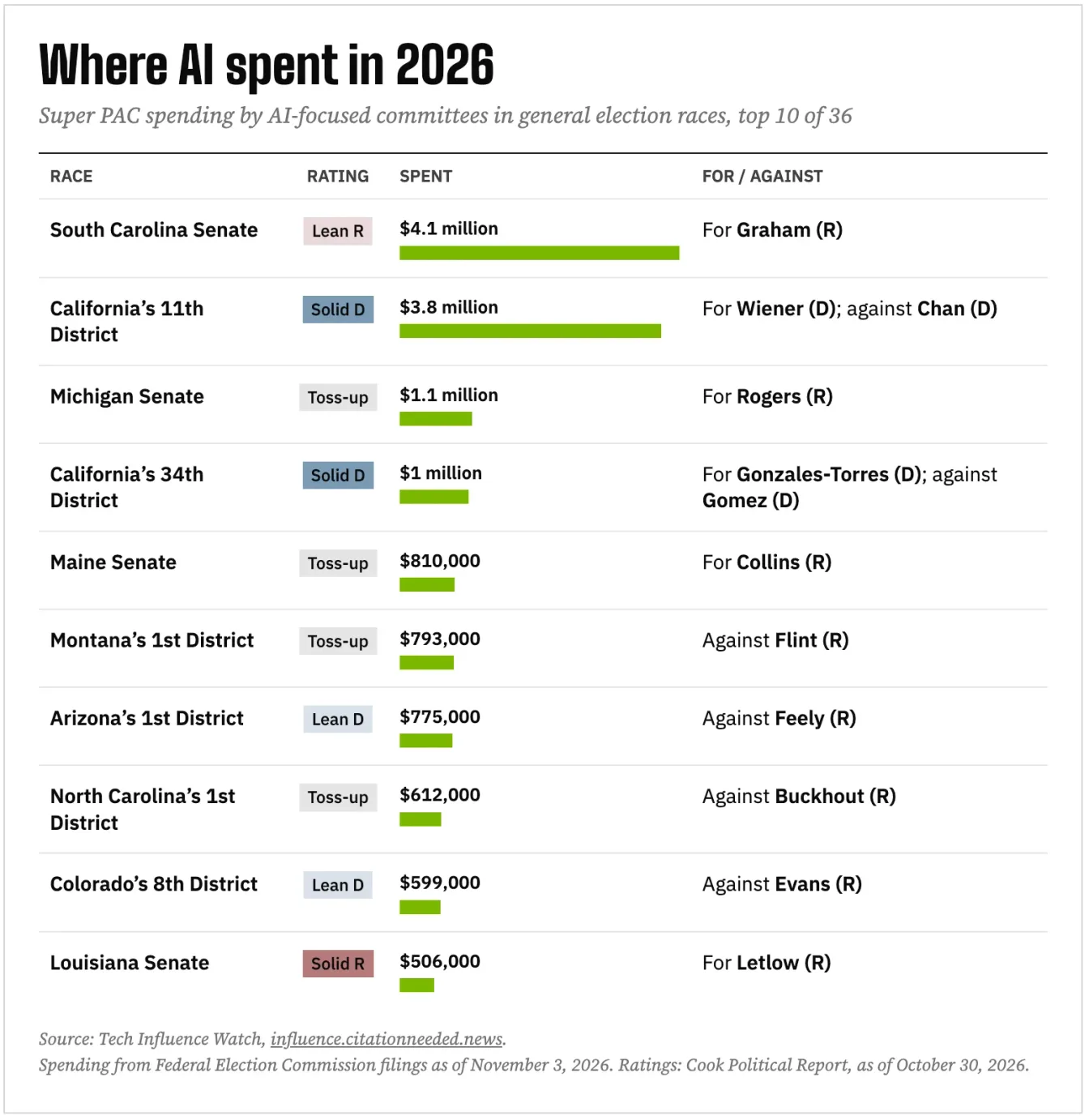
This is the artificial intelligence sector’s biggest bet on a competitive general election race. American Mission, the Republican arm of the Leading the Future PAC network, may have thought they were backing an easy winner with their first expenditure of around $375,000 to back Lindsey Graham in his primary. But since then, it has added more than $2 million to back Darline Graham in her primary runoff election and general election. In mid-October, Leading the Future brought in reinforcements: Building the Future, a new arm of the network created specifically to support pro-data center candidates, has spent $2.5 million supporting her in the general, its only federal spending so far. Crypto’s Fellowship PAC also spent $550,000 to back Lindsey Graham in the primary, but did not show up with additional funds to back his replacement.
Andrews has used the data center issue and Graham’s AI funding to tar her opponent as “Data Center Darline”. While Andrews has called for moratoriums on new data centers in the state, Graham has opposed them, saying they would give China a chance to get ahead on AI development.12
Graham has received just over $48,000 in candidate-specific contributions from crypto and AI executives, mostly from Andreessen Horowitz, the Winklevoss twins, and Microsoft. Andrews has received no crypto- or AI-associated PAC support, and no candidate-specific contributions from the associated companies I track (or their executives).
Wisconsin’s District 1: Bryan Steil (R) vs. Mitchell Berman (D)
$1.9 million • Lean Republican • All from crypto PACs
Incumbent Republican Bryan Steil chairs the House Financial Services subcommittee on digital assets and has co-sponsored numerous crypto industry-friendly bills, including the House’s versions of the Clarity and Genius Acts. Fairshake has spent just over $1 million supporting him this cycle, after spending $764,000 to back him in 2024.
The Wisconsin Working PAC, a super PAC primarily funded by the Singapore-based cryptocurrency exchange Crypto.com, has spent solely to oppose Democratic challenger Mitchell Berman. It has put more than $880,000 into two attack ads that condemn Berman as a “woke radical activist” and claim he “caused a lockdown at his daughter’s school”.13 (Berman went to the school’s office to request records that he’d previously sought via an open records request, which pertained to decisions around book bans and changing curriculum to remove anti-bullying material that specifically referenced racial, gender, and LGBTQ harassment. The school went on “soft lockdown” following his request, citing “possible disruptions” but stating there was no threat to students. The school later settled a lawsuit and paid Berman’s legal fees after it was found to have held a “retreat” at a board member’s home where it failed to provide public notice or make the meeting open to the public.1415161718)
Steil has received $361,000 in candidate-specific contributions; 84% are from the crypto sector (primarily Solana Labs, the Winklevoss twins, and Coinbase), 7% are from AI-linked companies (Microsoft), and 10% are from companies with ties to both (Andreessen Horowitz). Berman has received no crypto- or AI-associated PAC support, and no candidate-specific contributions from the associated companies I track (or their executives).
Michigan Senate: Mike Rogers (R) vs. Abdul El-Sayed (D)
$1.9 million • Toss-up • From crypto and AI groups
The Michigan Senate race is one of the hottest of the cycle. Republican Mike Rogers, who narrowly lost to Elissa Slotkin in 2024, is facing Democrat Abdul El-Sayed, one of the most progressive Senate nominees in the country. El-Sayed has held a slight lead in recent polls.19
Naturally, tech has its fingers in the race, and the crypto industry has switched sides. In 2024, Fairshake spent just over $10 million to help Slotkin (a much more moderate Democrat) beat Rogers: its second-biggest outlay of the cycle, and the most it spent backing any Democrat. Now, crypto industry support is coming from First Principles Digital, a Cynthia Lummis-affiliated super PAC that hopes to put “Republican crypto champions at the helm”. The PAC spent $810,000 to back Rogers.
Artificial intelligence joined in with just over $1 million in electioneering spending from the Alliance for a Better Future to back Rogers. That’s a conservative pro-AI advocacy group that urges, “we need to build superintelligenced for American families, shaped by American faith, and securing our American freedoms.” Its advisory council lists members from groups including the Heritage Foundation, the NCOSE anti-pornography organization, and the effective altruist-aligned Future of Life Institute.e
Rogers is a crypto convert. As a congressman, he warned that cryptocurrency was primarily a tool for crime,20 but on the campaign trail in 2024 he was penning op-eds titled “Saving crypto from Democrats.”21 His stance on data centers has also been wobbly. In March, he enthusiastically endorsed the Trump administration’s policy outline for artificial intelligence, which called for expediting data center development.22 By the fall, with data centers increasingly unpopular in Michigan, and just days after The Lever reported that he holds millions in investments that stand to benefit from the boom,23 he backed a statewide moratorium on new ones.24 He’s been more consistent in his stance on AI development, calling for guardrails and expressing concerns over national security.25
El-Sayed has gone much further on AI, and it’s become something of a centerpiece of his platform. He’s described AI as “the existential crisis of our time” and called for bans on “superintelligent” AI, supported liability and reporting requirements for model developers, opposed preempting state AI laws unless Congress passes its own, and supported programs that would protect workers from AI-related layoffs and job degradation.25 On crypto, he’s called it (and sports betting) “institutionalized get-rich-quick” schemes and called for “regulation around the kind of pernicious, predatory get-rich-quick schemes we’ve seen across the economy”. He’s also expressed some openness to the idea that blockchain can “foster innovation,” while stressing the need for regulation. That last part may sound a lot like the boilerplate crypto companies put out themselves, calling for “clear rules of the road to protect innovation”. But the regulation El-Sayed describes — consumer protections, transparency, “robust guardrails against misuse”, and an end to Trump’s crypto schemes — is a far cry from what the industry means by the word, which tends to be carveouts from the securities and banking rules everyone else has to follow.26
Both candidates have received candidate-specific contributions from the sector. Rogers has received more than $110,000 in donations, mostly from the Winklevoss twins, Paradigm, and Andreessen Horowitz. El-Sayed has received $77,550, mostly from Ripple’s Chris Larsen and various Microsoft execs.
Maine Senate: Susan Collins (R) vs. Troy Jackson (D)
$810,000 • Toss-up • All from AI groups
Republican incumbent Susan Collins is seeking her sixth term in the Senate. She’s facing Troy Jackson, a former president of the Maine Senate who finished third in the Democratic primary for governor earlier this year. Jackson stepped in after the original Democratic nominee, Graham Platner, withdrew when a former girlfriend accused him of rape. (Platner denies the allegation.) Running on a similarly populist platform, Jackson is hoping to harness the energy Platner’s campaign generated, and to win over voters who think Collins has been in office long enough.
AI has been an issue in the Maine race — in particular, opposition to data centers coming to Maine and out-of-state billionaire tech donors’ influence on its politics. A recent, headline-making interruption to a debate between Collins and Jackson came from a man interjecting, “I’m terrified! AI data centers are destroying our climate. They’re poisoning our water.”27 (The headlines that followed were less about his concerns than about the candidates’ reactions: Collins blamed the outburst on Jackson’s campaign, and Jackson fired back, “Oh, shaddup. I don’t even know that kid.”)
AI and out-of-state-billionaire money has indeed come into the race to back Collins. The same conservative pro-AI advocacy group that backed Rogers, the Alliance for a Better Future, has also supported Collins with $810,000.
As for crypto, it’s more the lack of money that’s noteworthy. The crypto sector is desperate to keep a Republican majority in the Senate, and Maine is one of the most at-risk Republican seats on the map. But Collins cast one of the three Republican “no” votes in the Clarity Act cloture vote, and the only one from a Republican up for re-election [I110]. As I wrote then, she probably decided that giving up potentially millions of dollars in crypto super PAC support was worth it to avoid defending a vote for a bill with meager ethics provisions, in a state fired up about Trump’s corruption. And it’s not as though she’s hurting for money: GOP spending has poured into the race without crypto’s help.
She’s received more than $325,000 in candidate-specific contributions from executives at AI-linked firms including Palantir and Andreessen Horowitz. Crypto executives from Paradigm, Coinbase, and Solana Labs also contributed to her campaign, though most of that money landed before the Clarity Act vote soured the industry towards her. Jackson has received no crypto- or AI-associated PAC support, and no candidate-specific contributions from the associated companies I track (or their executives).
Other races to watch
- Arizona’s District 1 pits one of the most outspoken defenders of data centers, Republican Jay Feely, against Democrat Amish Shah, who’s promised a data center moratorium. AI PACs have spent $1.4 million on both sides of the race: Leading the Future’s Republican arm has spent about $616,000 backing Feely, while the Guardrails Alliance has spent $775,000 against him. One Guardrails Alliance ad says Feely’s vote is “for sale” to “AI oligarchs” who are hoping to “build data centers near you” that are “unleashing rogue AI agents that experts say might even kill us all.”
- In Alabama’s District 2, crypto has done an about-face on Democratic incumbent Shomari Figures. Fairshake put $2.4 million behind his successful 2024 campaign, and Figures has since voted for the Clarity and Genius Acts and co-sponsored the “Promoting Innovation in Blockchain Development Act”. But this cycle, Fairshake has skipped the thank-you spending it’s given other allies, and the Republican-aligned First Principles Digital spent $200,000 to oppose Figures and support his Republican opponent, Rhett Marques. Fairshake’s absence may have less to do with Figures than with the race itself: Cook rates it Lean Republican, and it doesn’t want to risk tarnishing the industry’s win rate. Marques also landed almost $960,000 in backing from Public First’s Republican arm during his primary.
- Michigan’s District 4 has Republican Bill Huizenga in a toss-up race against Democrat Sean McCann. The Fairshake network has spent over $1.5 million supporting Huizenga. Huizenga is vice chair of the House Financial Services Committee, making this an important race for the crypto sector.
- All eyes are on the Texas Senate race between Republican Ken Paxton and Democrat James Talarico, though it hasn’t drawn any AI money. The crypto money that has come in arrived late — a possible sign the industry is worried about Paxton’s chances. All $868,000 that the pro-MAGA, pro-crypto Digital Freedom Fund has spent supporting Paxton and opposing Talarico has come in since October 19, and more than $300,000 of it went out on October 31 for last-minute text blasts. Crypto backed Paxton in his primary, too: Fellowship PAC spent $500,000 supporting him once Trump endorsed him, after pulling an earlier planned $1.75 million buy under pressure from GOP officials [I105].
Follow along
Every race above has a page on Tech Influence Watch, which will continue to be updated with last-minute spending. See the full breakdown of who’s spending where, or check out the new analysis pages covering competitive vs. safe races, what PACs are running ads about (spoiler: mostly not crypto or AI), and spending over time.
I’ll be updating Tech Influence Watch with results as races are called, so you can see which industry-backed candidates won and lost. I’ll send a short results roundup as a [noted] post on Wednesday, followed by a longer postmortem next week once close races are called and the industries have time to react.
Want the results roundup and the postmortem in your inbox? Subscribe to Citation Needed — it’s free. If you’d like to support my independent reporting, which includes projects like Tech Influence Watch, consider becoming a paid member.
Sign upFootnotes
I count primaries and general elections separately here, so a seat where the PACs spent in both the primary and the general counts as two “contests”. ↩
Contributions to a candidate’s campaign committee, or to super PACs that exist solely to support that candidate. ↩
This was a somewhat odd choice of which crypto con men to highlight, given that the Winklevoss twins have mostly directed their spending to explicitly MAGA pro-crypto super PACs this cycle, finding Fairshake — which is backing Ricketts — too bipartisan. The Winklevosses’ super PACs did not spend on the Nebraska Senate race. However, they were backers of Fairshake in 2024, and some of the money Fairshake is spending this cycle came from 2024 fundraising. ↩
“Superintelligence” is the coinage President Trump is insisting should be used for “artificial intelligence”, and anyone who does not adopt it is “THE ENEMY”. ↩
The Future of Life Institute disputes any connection to either the effective altruist or longtermist movements, but it’s widely associated with both: co-founder Jaan Tallinn is one of the biggest funders of EA-aligned “AI safety” work, and much of its money has come from the same donor networks. ↩
References
“The Crypto Industry Aims to Crush One of Democrats’ Top Senate Candidates”, The New York Times. ↩
“In Ohio, Crypto Revenge Spending Runs Into a Data Center Backlash”, The American Prospect. ↩
“The Senate race giving Big Tech the chills”, Politico. ↩
Summary of aggregate polls, “2026 United States Senate special election in Ohio”, Wikipedia, November 2, 2026. (Permalink). ↩
Dan Osborn profile on Stand With Crypto. ↩
“Top Republican super PAC pledges $5 million for South Carolina Senate race”, NBC News. ↩
Summary of aggregate polls, “2026 United States Senate election in South Carolina”, Wikipedia, November 2, 2026. (Permalink). ↩
“SC Senate candidates clash over data center expansion in debate”, WIS TV. ↩
“Ad from crypto-backed PAC slams Berman as ‘woke radical activist’”, WisPolitics. ↩
“Raymond School tosses social-emotional learning curriculum in the garbage amid board controversy”, Racine County Eye. ↩
“Southeast Wisconsin principal files discrimination complaint after dismissal”, Wisconsin Examiner. ↩
“UPDATE: Raymond School on ‘soft lockdown’ for issues related to the board meeting Wednesday evening”, Racine County Eye. ↩
“Open meetings lawsuit settled, Raymond School District admits violation and undergoes special training”, Racine County Eye. ↩
“An ad says Mitchell Berman put Raymond School in lockdown. Here’s what the records show”, Racine County Eye. ↩
Summary of aggregate polls, “2026 United States Senate election in Michigan”, Wikipedia, November 2, 2026. (Permalink). ↩
“Mike Rogers’ crypto evolution”, Punchbowl News. ↩
“Saving crypto from Democrats”, Washington Examiner. ↩
“Rogers applauds White House AI framework that establishes global leadership and protects kids online”, Mike Rogers. ↩
“The Senate Candidate Who Could Get Rich Off Data Centers”, The Lever. ↩
“After data center investments revealed, Rogers backs statewide moratorium”, Michigan Advance. ↩
“Rogers, El-Sayed outline differing approaches to tariffs and AI during Detroit Economic Club forum”, Michigan Advance. ↩
Abdul El-Sayed profile on Stand With Crypto. ↩
“Maine’s data center revolt will decide who controls the Senate”, The Verge. ↩
Have information? Send tips (no PR) to molly0xfff.07 on Signal or molly@mollywhite.net (PGP).
I have disclosures for my work and writing pertaining to cryptocurrencies.
Social share image is via Tech Influence Watch.