← Technology, Science & Infrastructure
▣ Distilled locally
ESP-Mosaico Lets AI Agents Do the Coding
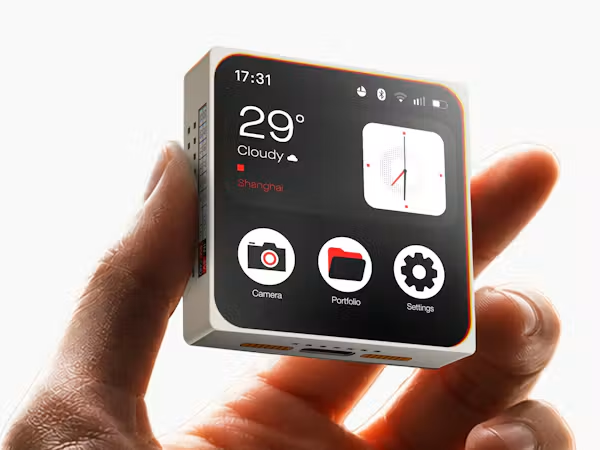
Building a microcontroller-based hardware project generally involves a fair amount of programming, even when using beginner-friendly platforms like Arduino. AI coding assistants can help with some of that work, but getting the generated code onto a physical device and verifying that everything works is still largely a manual process. Espressif Systems is looking to change that with ESP-Mosaico, a modular development platform that allows AI agents to handle everything from writing firmware to testing it on real hardware. ESP-Mosaico is built around Espressif's ESP32-S31 microcontroller, which features a high-performance RISC-V processor running at up to 320 MHz and a separate low-power core. The chip is paired with 16 MB of PSRAM, 16 MB of SPI NOR flash, and 128 MB of SPI NAND flash for storing additional assets. Wireless connectivity includes Wi-Fi 6, Bluetooth 5.4, and an IEEE 802.15.4 radio supporting Zigbee and Thread. The most prominent feature is a 2.16-inch AMOLED touchscreen with a resolution of 480×480 pixels. The device also includes a microphone, speaker, vibration motor for haptic feedback, and a six-axis accelerometer and gyroscope. Two three-axis magnetometers provide additional sensing capabilities, and a 65 mAh rechargeable battery allows the device to operate without a USB connection. The hardware is divided into two boards connected through a 60-pin connector. The CoreBoard contains the processor, display, and most of the electronics, while the BaseBoard provides the battery, speaker, and expansion connections. Two 20-pin headers allow additional hardware to be connected. Espressif has developed two expansion modules so far. One adds a camera capable of capturing images at 1024×768 resolution, while the other includes a light sensor, passive infrared motion sensor, infrared LED, six RGB LEDs, and connections for buttons or capacitive-touch inputs. However, the hardware is only part of what makes ESP-Mosaico interesting. The platform is specifically designed to work with AI coding agents, offering two different development workflows. The first, called Chat Coding, uses Espressif's ESP-Claw framework. Users describe what they want to build in natural language, and the AI generates and runs the application without requiring a locally configured development environment. Additional instructions can be provided to refine the application. The second approach, called Vibe Coding, uses ESP-ZeroCode AI to automate more of the development process. A desktop AI agent can write code, simulate its operation, deploy it to the hardware, run tests, and use feedback from the physical device to make further improvements. It can iterate through a complete development cycle without a human in the loop. ESP-Mosaico is priced at $59 , making it an affordable option for developers who want to experiment with AI-assisted hardware design. Whether its AI agents can reliably handle the entire development process remains to be seen, but the platform could significantly reduce the time and effort required to turn an idea into a working prototype.ESP-Mosaico was built for AI-assisted hardware design (📷: Espressif) A look inside the enclosure (📷: Espressif) Chat Coding gives makers the most control (📷: Espressif)
↑ Back to top
Originally published by Hackster News ↗
· rebuilt here from its own full-text RSS feed · all rights
remain with the publisher, please read and support them there.