Why Integrated Gate Drive Regulation Matters For High Reliability Space GaN Designs
As Gallium Nitride (GaN) technology becomes increasingly prevalent in space power systems, designers are leveraging its inherent capabilities to deliver higher efficiency, faster switching speeds, and greater power density. These advantages help designers support the growing demands of modern satellite platforms.
While GaN devices are central to many modern power architectures, achieving their full efficiency and switching performance depends on the gate driver that controls them. Infineon HiRel’s new, rad hard single-channel gate driver for GaN delivers the precise drive conditions that GaN devices require. Designed specifically for extreme environment applications, the device incorporates an integrated low dropout regulator (LDO). The LDO simplifies gate-drive implementation while providing a tightly regulated voltage optimized for GaN operation, while also reducing the total bill of materials (BOM).
GaN performance starts at the gate driver
The switching advantages of GaN stem from device characteristics such as low gate charge, reduced output capacitance, and fast transition times. These attributes enable lower switching losses and support operation at higher frequencies than traditional silicon MOSFET (Si) technologies.
Designers must provide stable and controlled gate-drive voltages to achieve optimal switching behavior. Even relatively small variations in gate voltage can affect switching losses, power-stage efficiency, electromagnetic interference (EMI), device stress, and long-term reliability. GaN devices have extremely high slew rates (dv/dt) when switching. As a result, maintaining a stable and well-controlled gate-drive voltage is critical for predictable system performance across operating conditions.
Improve drive consistency
Traditionally, designers generate the gate-drive supply rail using external regulators, bias circuits, or dedicated auxiliary power supplies. While effective, these approaches add components, consume board area, and create additional design considerations related to regulation accuracy, startup behavior, and power sequencing. In space systems, every additional component increases design complexity. It can also drive up qualification and testing costs, add weight, and extend development timelines. Infineon HiRel’s new RIC70115 gate driver simplifies this architecture with many integrated features, such as an integrated LDO that generates a tightly regulated 4.8 V gate-drive rail from input voltages ranging from 4.75 V to 15 V.
By regulating the gate-drive supply internally, the RIC70115 helps ensure that GaN transistors receive a consistent drive voltage, even as upstream supply rails vary during normal operations. This approach aligns directly with recommendations outlined in the application note, which emphasizes the importance of maintaining tightly controlled gate-drive conditions to support efficient and reliable GaN HEMT operation in space environments. Even better is that no additional external components are needed to deliver this regulated drive voltage, helping customers meet their SWaP-C needs. For space programs operating under tight development timelines, this reduction in design complexity can support faster qualification efforts and lower implementation risk.
Reducing design complexity
Space power systems present unique challenges beyond those encountered in terrestrial applications. Every additional component introduces potential reliability considerations, increases PCB area requirements, and compromises qualification and system-level verification efforts.
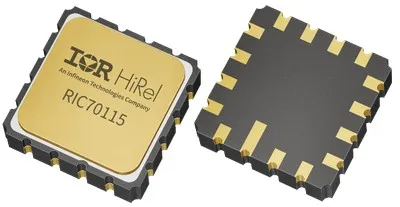
The integrated LDO within the RIC70115 eliminates the need for a separate bias regulator dedicated to the gate driver. This results in a more streamlined power architecture that supports the industry’s ongoing pursuit of reduced size, weight, and power (SWaP) advantages. By consolidating gate-drive regulation within the controller itself, designers can reduce component count without sacrificing the precision required for high-performance GaN operation.
Enabling reliable GaN adoption
As designers transition from Si to GaN, solutions that simplify implementation without sacrificing performance stand out.
The RIC70115 does just that. With high-speed gate driving and integrated voltage regulation, the device helps optimize GaN operation. Rather than developing and validating a separate regulated gate-drive supply, designers can rely on the device to provide a controlled and consistent bias environment directly within the gate-driver architecture. The integrated approach helps reduce design complexity while enabling the efficiency, switching speed, and power density advantages that drive GaN adoption in next-generation satellite power systems.
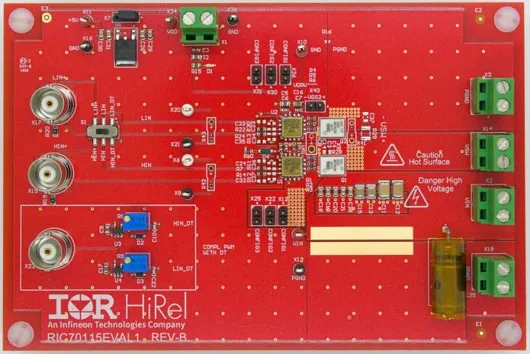
Evaluate RIC70115 with Infineon HiRel’s companion evaluation board, the RIC70115EVAL1. Prepopulated with two RIC70115 gate driver ICs and two IG1NT052N10R GaN HEMTs in a half-bridge configuration, the evaluation board highlights RIC70115’s ability to operate in both high- and low-side configurations.
Conclusion
When paired with the right gate driver, GaN can enable a more power-dense spacecraft power architecture. Through its integrated LDO, the RIC70115 helps designers reduce complexity, streamline development, and take full advantage of GaN’s efficiency and performance benefits. Take the next step in next-generation space exploration: download the RIC70115 datasheet and the application note to learn more.
The post Why Integrated Gate Drive Regulation Matters For High Reliability Space GaN Designs appeared first on Semiconductor Engineering.