← Technology, Science & Infrastructure
▣ Distilled locally
Building an Articulated 8-Foot Satellite Ground Station
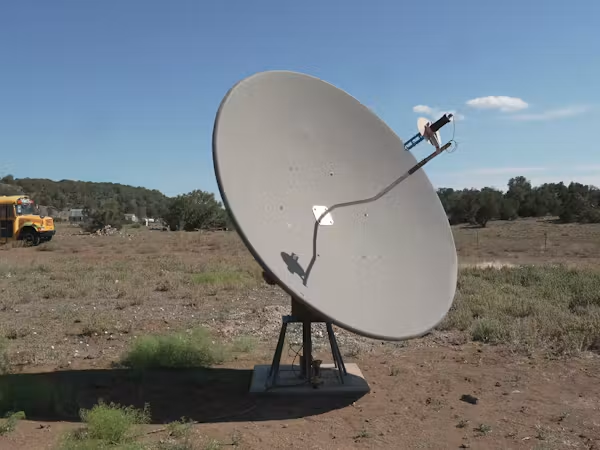
Satellite services are weird. Most of them, for TV and radio and such, are one-way systems. The satellites are up there just beaming that down to all of us , whether we pay for the service or not. That’s why your uncle was able to “acquire” free satellite TV back in the ‘90s — he just bought a questionable box to decrypt the signals already coming down. When Cranktown City stumbled across a massive eight-foot satellite dish, he decided to see what signals he could acquire by building a ground station . Cranktown City recently purchased a decent-size plot of land, so he has plenty of space for something like this. But that satellite dish wasn’t in great condition. It really doesn’t need to be, because there isn’t much about a dish that is very important, aside from that parabolic shape that helps turn a weak, dispersed signal into a strong signal at one point. This project was about everything else, like pointing the dish at sky things. Fortunately, the dish did come with a motorized mount for automatically adjusting for elevation (uppy-downy tilt). So, Cranktown City’s first step was to build a motorized base for automatically adjusting for azimuth (righty-lefty spin). For that, he used a wheel chair motor that came with its own worm gear driving a sprocket. Machining and fabrication are a big part of his whole thing, so fabbing up a rotating stand was right up his alley. Though he did have to rebuild and tweak the design, because nothing ever goes to plan. For control, he used magnetic encoders for positioning. A Raspberry Pi tells the motors to spin through beefy driver modules. That Raspberry Pi pulls data from the internet to figure out where to point the dish. That is more straightforward than you might think. As long as you know where you are (which is easy because an eight-foot dish isn’t traveling), simple calculators can tell you the azimuth and elevation you want to look at a specific part of the sky. Online databases can tell you the positions of satellites in the sky, so all the puzzle pieces are there. To actually receive something, Cranktown City needed to put an antenna at the focus (the point to which the parabola reflects waves). He built that as a helical antenna, using a 3D-printed scaffold. That antenna connects to an amplifier, which goes to an RTL-SDR, which goes to the Raspberry Pi, which runs SatDump, which is software for decoding a wide range of satellite transmissions. Now Cranktown City can point his huge dish at any desired satellite and look at what they have to offer, assuming SatDump can decode the data. It also gives him the ability to experiment with other fun stuff, like radio astronomy.
↑ Back to top
Originally published by Hackster News ↗
· rebuilt here from its own full-text RSS feed · all rights
remain with the publisher, please read and support them there.