How Sinch modernized its enterprise data warehouse from Snowflake to BigQuery to power AI
As the scale of global communications grows larger and larger, enterprise platforms must process billions of interactions with customers across a complex network of touchpoints without breaking them. A prime example is Sinch, one of the world’s leading cloud communications and customer engagement (CPaaS) companies, which processes billions of customer interactions, SMS routing events, voice calls, and transactional messages.
Managing massive international messaging traffic brings significant architectural challenges, so Sinch built a distributed, multi-cloud data footprint across AWS and GCP, with separate Snowflake instances running in the EU, US, and Australia. To eliminate data silos, curb monthly billing spikes, establish a single governed source of truth, and unlock the next generation of predictive AI capabilities, Sinch partnered with Google Cloud Professional Services to migrate its enterprise data warehouse to Google BigQuery.
Here’s how we engineered Sinch’s new, modern, cost-efficient, and AI-ready platform architecture
The challenge: untangling distributed warehouses and escalating spikes
Before it embarked on this modernization journey, Sinch faced several architectural and operational friction points:
-
Cross-regional data sprawl: The company’s separate Snowflake instances in the EU, US, and Australia required intricate inter-region replication, which caused multi-directional dependencies and complex cross-warehouse data management.
-
Resource spikes and commercial inefficiencies: Heavy monthly billing runs drove severe compute spikes in the US, even as other regions had underutilized capacity.
-
High-volume scanning vs. dialect disparities: A single US email event table could generate up to 100 TB of daily scans. Meanwhile, mission-critical SQL relied on Snowflake-specific concurrency and table-swapping paradigms for concurrency validation, which lacked 1:1 equivalents in cloud-native SQL.
“Google Cloud's engineering expertise helped us overcome several technical challenges during our migration, particularly around optimising Spark partitioning and restructuring incremental data loads. This allowed us to identify more efficient approaches, improve performance and ensure we built a scalable, reliable solution for the future.”
Dan Peters, senior manager, Data Delivery, Sinch
Phase 1: validating architecture with a target MVP
To mitigate operational risk and prevent downtime for Sinch’s critical enterprise workloads (including ERP and NetSuite integrations), we initiated a phased migration framework:
-
A use case pilot validation: The migration kicked off with a dedicated use case MVP that spanned 20 tables and 125 GB of refined data and automatically validated end-to-end data fidelity.
-
Layered strategy for coupled pipelines: Rather than attempting to cleanly slice interconnected business domains in the EU, the team adopted a layered approach — migrating raw and base (bronze and silver) layers, establishing automated data ingestion, and stabilizing core entities before repointing consumption marts.
-
Orchestration consolidation: Sinch consolidated 36 independent ETL workflows into a single parameterized orchestrator by using Google Cloud Workflows, which streamlined CI/CD deployment logic, and reduced operational overhead.
Re-engineering for scale: key architectural pillars
1. Decoupled storage and optimized ingestion
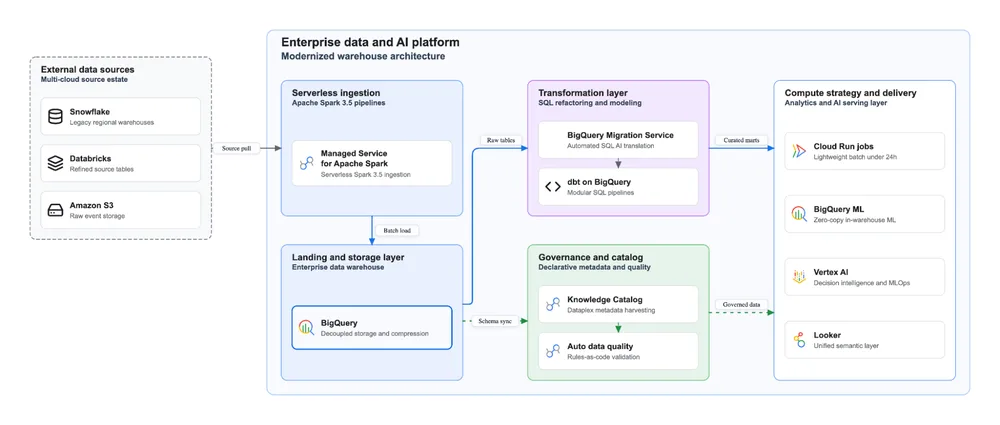
Sinch transitioned its data ingestion pipelines to Dataproc Serverless (running Apache Spark 3.5), which directly pulled refined data into native BigQuery tables from S3 and Databricks Unity Catalog. And to overcome batch quota limits and resource exhaustion on billion-row datasets, Sitch optimized jobs by increasing Spark repartitioning factors to 50.
For its incremental pipelines, the team eliminated data duplication while minimizing query read costs by replacing slow, keyless merge statements with an optimized insert-and-overwrite windowing strategy.
2. AI-assisted SQL and macro translation
In order to accelerate the translation of more than 1,200 dbt models across global projects, Sinch utilized Google Cloud BigQuery Migration Service alongside a set of custom AI translation skills. Here’s how:
-
The team refactored Snowflake-specific table versioning and concurrency management paradigms into deterministic transaction blocks and view abstraction pointers. This ensured atomic updates and consistent data access.
-
Sinch leveraged specialized Google skills for other regional migration — specifically the dbt-sf-to-bq-translator skill powered by the underlying BigQuery Translation API — to automate the conversion of dbt models from Snowflake to BigQuery SQL syntax. This significantly reduced manual refactoring effort and error rates.
-
Concurrency checks that relied on row-level locking were redesigned into serialized batch validations.
-
Integer overflow risks in massive calculation tables were solved by adopting a tiered precision strategy (favoring NUMERIC over BIGNUMERIC), which cut storage costs and preserved absolute precision.
“Migrating over a thousand complex dbt models and translating legacy SQL required a robust, automated approach. Google Cloud's guidance on query restructuring helped us streamline pipeline development and remove compilation blockers. The team shared best practices for migrating code from Snowflake to BigQuery, such as replacing Snowflake SWAP WITH and hybrid-table patterns with BigQuery time travel. They also helped us build workflows that copy data from Snowflake to BigQuery and run our dbt jobs along the way, which sped up our move to BigQuery.”
Varun Gupta, Senior Data Engineer, Sinch
Real-world business impact
By completing the migration, Sinch successfully transformed the operational bottleneck of its global data footprint into a driver of enterprise growth:
Metric / capability
Before (Snowflake)
After (BigQuery)
Pipeline performance
High data churn; lengthy multi-hour batch runs
Significantly faster query and pipeline processing speeds across billions of records
Compute and billing efficiency
Unpredictable month-end billing spikes
Predictable capacity management with BigQuery reservations and slot autoscaling
AI readiness
Segmented data warehouses requiring external pipelines
Native BQML and Vertex AI decision intelligence platform
Looking ahead
With its core European warehouse workloads stabilized on BigQuery and data validation consistently outperforming legacy benchmarks, Sinch is now expanding this modern blueprint across its Australian (SMB) and US analytics. The SMB instance migration is already in progress and is utilizing Antigravity skills for the Snowflake to BigQuery translation.
By unifying data storage, operational governance, and serverless compute, Sinch has built a resilient platform that delivers real-time messaging reliability today while positioning the company to capture the full potential of enterprise AI tomorrow.