← Technology, Science & Infrastructure
▣ Distilled locally
"Scentronic" Wearables Could Beam Smells Across the Internet for More Immersive Telepresence
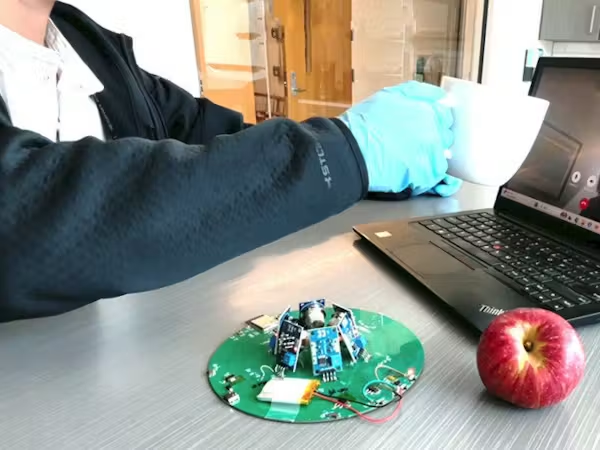
Researchers from the Ohio State University Columbus and Zhejiang Laboratory have developed a new method to make teleoperation a more immersive experience while potentially boosting accessibility: Scentronic, a way to share smells over the Internet of Things (IoT). "This work combines innovations in hardware and software to bring new solutions to societal challenges," says senior author Jinghua Li, assistant professor of materials science and engineering at The Ohio State University, of the research project. "Our long-term goal here is to incorporate these systems into compact and personalized devices. There are many potential opportunities for these technologies to shine. The initial demonstrations are promising, so digitized smells may arrive sooner than you think." The Scentronic system is designed to expand existing and telepresence and teleoperation systems — in which an operator can perceive and participate in a remote environment over an internet connection — by expanding beyond current support for sight, sound, and relatively limited touch by adding the sense of smell. The smell-beaming system works by combining a sensor known as an "electronic nose" or "e-nose" at the remote end with a wearable device designed to emit smells on-demand. Then the e-nose detects a known scent, the Scentronic wearable releases that same scent to the operator. Participants in testing showed that a Scentronic system trained on five food scents — coffee, beer, red wine, orange, and chocolate cake — could transmit an identifiable odor around 73% of the time, dropping to 71% of the time when transmitting two paired odors at the same time. The technology has potential beyond the remote sniffing of foodstuffs, too: the team suggests that some of the Espressif ESP32-powered Scentronic variants tested, including a wristband-based scent emitter and a necklace-style system, could aid with accessibility by detecting local smells and boosting their strength — effectively acting as a "smelling aid" for those with olfactory conditions in the same manner as a hearing aid for those with auditory conditions. "The loss of olfaction is related to many neurological diseases and infections," Li explains. "As a result, it's important that we create technologies to first decouple the secrets within our olfactory systems and then try to reconstruct them based on that information." The team's work has been published in the journal Science Advances under open-access terms. Wearable "Scentronic" devices, combined with electronic nose sensors, could bring a sense of smell to future telepresence systems. (📷: Yang et al) The prototype system uses Espressif ESP32 microcontrollers for both the e-nose sensor, which transmits its findings to a machine learning model on nearby computer for classification, and the wearable scent emitters. (📷: Yang et al)
↑ Back to top
Originally published by Hackster News ↗
· rebuilt here from its own full-text RSS feed · all rights
remain with the publisher, please read and support them there.