← Technology, Science & Infrastructure
▣ Distilled locally
Robots Get a Lesson in Teamwork
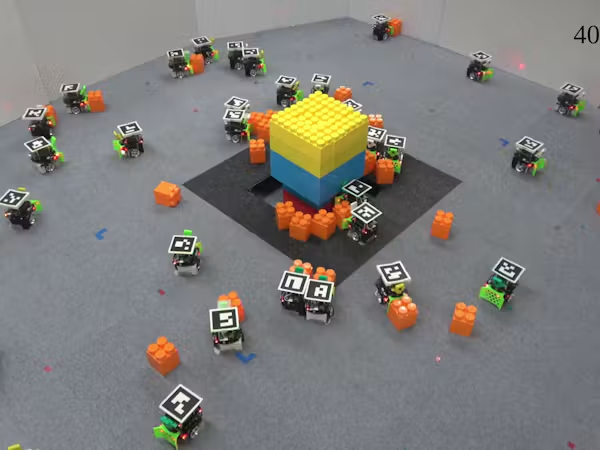
Getting a single robot to operate autonomously is challenging enough, but getting dozens of robots to work together introduces an entirely new set of problems. Even when the robots know how to do their jobs, they can interfere with one another, creating traffic jams and other situations that limit their effectiveness. Progress in this area has been slow because teaching robots to coordinate their actions generally requires a lot of training data, but collecting that data is difficult when a human operator can only control one robot at a time. Researchers at Japan's National Institute of Advanced Industrial Science and Technology, Institute of Science Tokyo, and University of Tokyo have been investigating whether large groups of robots can learn to coordinate their actions by observing demonstrations performed with just a single robot. Their approach uses imitation learning to train robots to perform tasks without communicating with one another or relying on external positioning systems. To evaluate their approach, the researchers assembled a group of small wheeled robots based on the Raspberry Pi Mouse V3 platform. Each robot measures 14 centimeters wide and is equipped with a Raspberry Pi 4 and Camera Module 3. The robots operate independently, using a forward-facing camera with a 120-degree field of view to navigate their surroundings. The experimental task involved collecting 28 orange blocks scattered throughout a 3.5-meter-square workspace and pushing them toward a collection area in the center. Although a single robot could complete the task, deploying multiple robots simultaneously offered an opportunity to finish the job more quickly. The researchers trained the robots using demonstrations collected by a human operator controlling a single robot with a joystick. These demonstrations included navigating around obstacles, pushing blocks, and recovering from situations where the robot became stuck. To investigate how robots learn to avoid interfering with one another, the team collected additional demonstrations under two different conditions. In one, other robots remained stationary throughout the workspace. In the other, additional robots moved autonomously while the operator controlled a single robot. The control system uses a lightweight neural network combining MobileNetV2 for visual processing with a mixture-of-experts architecture. Two LSTM-based expert networks process sequences of camera observations, while a routing network determines how much each expert contributes to the final movement commands. With just 2.4 million parameters, the model is able to run entirely on the robots' Raspberry Pis without GPU acceleration. It processes camera observations and generates velocity commands at 5 Hz, allowing each robot to operate independently. The researchers tested their approach with groups containing up to 40 robots. It was found that policies trained using demonstrations involving stationary robots generally performed better than those trained with moving robots. The researchers suspect that the additional complexity of moving robots introduces inconsistencies into the training data, making effective coordination more difficult to learn. Increasing the number of robots also failed to produce proportional improvements in productivity, primarily because congestion became more problematic as the workspace filled up. The results show that large groups of robots can acquire useful coordination behaviors from single-robot demonstrations, even with limited onboard computing resources. However, teaching them to anticipate one another's movements remains an important challenge before this approach can scale efficiently to larger robotic teams.Robots learning to work together (📷: Keisuke Okumura) Swarms of robots can learn from individuals (📷: R. Matsumoto et al.)
↑ Back to top
Originally published by Hackster News ↗
· rebuilt here from its own full-text RSS feed · all rights
remain with the publisher, please read and support them there.