[AINews] OpenAI’s Patch the Planet program is 1 of 2 parties to discover PHP2Shell vulnerabilities in core PHP affecting 70% of the web, using GPT-5.6 Sol; coordinated response over 2 months
Almost 2 months ago, OpenAI introduced Daybreak for Frontline Defenders, a $1B subsidy for access to Daybreak cyber models and products. That funding came into use almost immediately, as major vulnerabilities in PHP were independently discovered by two parties: Ryan Austin, a researcher at the security firm Calif, as part of the OpenAI “Patch the Planet” project in August 2026 using GPT 5.6 Sol:
… as well as Wiz, recently acquired into Google Cloud (using Gemini 4 Argon and GPT-5.6 Sol, as well as their own tool, Wiz Atlas).
All high profile cyber disclosures are at least a little bit of marketing, and the degree to which this was a severely alarming vulnerability on the order of famous ones like log4shell and Heartbleed is up to some debate, but surely the coordinated response across the PHP Ecosystem is the developer community responding in its most ideal form.
We should expect to be in for at least a year of finding such critical vulnerabilities; but it is the wrong move to blame the messenger for finding them; rather it is good to know that our critical software is generally getting the biggest security audit it has ever had in human history.
AI News for 10/20/2026-10/21/2026. We checked 12 subreddits, 544 Twitters and no further Discords. AINews’ website lets you search all past issues. As a reminder, AINews is now a section of Latent Space. You can opt in/out of email frequencies!
AI Twitter Recap
Top Story: PHP2Shell—chronology, core claims, and the complications behind the emergency response
What happened
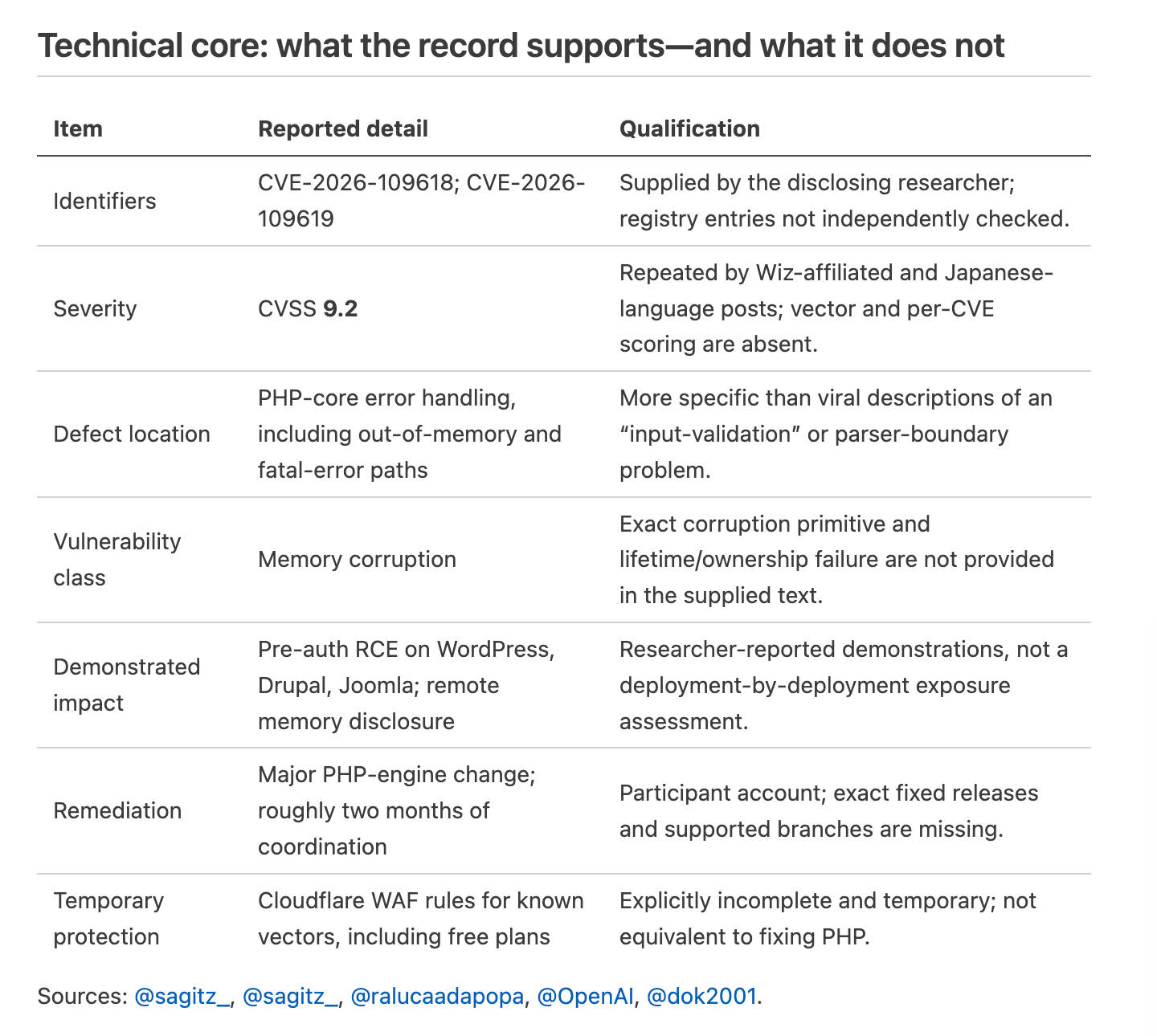
Researchers disclosed two PHP-engine memory-corruption vulnerabilities, with demonstrated unauthenticated exploitation against major CMSs and an unusually broad coordinated response.
The researchers named the vulnerabilities PHP2Shell and identified them as CVE-2026-109618 and CVE-2026-109619. Their technical description places the defects in PHP’s internal handling of out-of-memory conditions and fatal errors—not in a WordPress plugin or an application’s authentication logic. They report demonstrations of full remote code execution and “Heartbleed-style” memory disclosure. @sagitz_
The disclosed demonstrations included pre-authentication RCE against WordPress, Drupal, and Joomla. The researcher’s announcement separately claims remote memory disclosure against any PHP application. These are researcher-reported exploit results; they should not be silently expanded into a claim that every deployment has an identical, immediately exploitable RCE path. @sagitz_
OpenAI says Calif researchers used its models to discover the flaws, while secondary reporting says Wiz independently found the same bugs. Posts identify GPT-5.6 Sol on the Calif/OpenAI side; a Wiz-affiliated account credits Gemini 4 Argon with discovery, exploit-chain development, detector creation, and patch validation. This is a multi-party discovery story, not evidence that one vendor alone found and fixed the issue. @TheRundownAI, @steipete, @ralucaadapopa
OpenAI describes approximately two months of coordinated remediation before disclosure. It says the patch required a major PHP-engine change and coordination among maintainers, researchers, security providers, and governments. A participating researcher confirms work with the PHP Foundation to support and harden the patch. @OpenAI, @itszn13
Cloudflare deployed initial WAF mitigations before the scheduled patch release. Its CTO said rules covered known exploit vectors, were available to all customers including the free tier, and were being updated as early attacks emerged. He explicitly called the rules a stopgap and directed operators to patch at 14:00 UTC. @dok2001
The supplied NSA account advised preparation for an immediate update—and taking systems offline if timely mitigation was not possible. Later OpenAI messaging said upgrades were available; secondary reporting says details leaked before the patch. The supplied material does not establish precisely what leaked, when, or whether the release schedule changed. @NSACyber, @OpenAI, @TheRundownAI
Reconstructing the chronology
1. Discovery and private coordination: approximately two months before public disclosure.
OpenAI places the work under Patch the Planet and says it led a coalition preparing fixes and protections. Its security researcher Eric Wallace adds that internal teams worked on patching and detection rather than merely disclosing the bug, with confidential advance notification to governments and outside agencies. Greg Brockman reiterates the two-month coordination period. These are participant accounts, not an independently audited incident timeline. @Eric_Wallace_, @gdb
The distinction between program names matters: the posts associate the vulnerability with Patch the Planet, while researchers credit Daybreak model access for enabling security work. Those are related roles—remediation initiative versus access mechanism—not interchangeable descriptions of the same program. @OpenAI, @S1r1u5_
2. Advance public warnings and a scheduled patch window.
Japanese-language posts warned operators to prepare for a 23:00 JST, October 21 release, consistent with Cloudflare’s 14:00 UTC announcement. One correctly emphasized that a PHP-core vulnerability cannot be fixed merely by waiting for plugin developers. Another framed the event as a “15-minute” race after patch publication, but that number was a prediction—not a measured time to weaponization. @ds_nakajima, @expokun
3. Pre-release filtering and observed attack activity.
Cloudflare’s post is the strongest firsthand operational evidence in the supplied record: mitigations were already deployed, known vectors were covered, and “early attacks” were appearing. It does not specify successful compromises, request counts, victim counts, payload provenance, or whether the traffic represented original exploit development versus reuse of leaked information. @dok2001
4. Research disclosure, government warning, and patch availability.
The researcher’s public thread describes the exploit demonstrations and error-handling root cause. The NSA post calls for urgent preparation and conditional shutdown. OpenAI subsequently says every PHP site can upgrade safely. The supplied set contains no direct PHP Foundation release advisory, exact fixed-version matrix, distribution package identifiers, or patch commit. That missing primary-source layer prevents a reliable “upgrade to version X” instruction. @sagitz_, @NSACyber, @OpenAI
5. Alleged premature exposure and widespread service disruption.
The Rundown reports that details leaked early. A later viral compilation adds approximately 1.5 million servers, attributed to Censys, running versions without a fix; reported shutdowns involving Dutch institutions, government sites elsewhere in Europe, Wikipedia, Archive.org, Asana, GOG, and others; and a 05:55 warning from Japan’s prime minister. None of those individual claims is corroborated by its underlying advisory, measurement, or status page in the supplied material. Nor does the record establish whether each outage was a precaution, a patching interruption, an unrelated failure, or a compromise. @TheRundownAI, @fiveoutofnine
SemiAnalysis separately reports that Japan’s prime minister urged PHP operators to patch immediately or temporarily disconnect if they could not. Its account contextualizes that response with an existing Japanese breach wave, rather than establishing that PHP2Shell caused those earlier incidents. @SemiAnalysis_
6. Exposure-checking assistance followed disclosure.
OpenAI published a repository containing a Codex skill intended to guide operators through checking whether their sites were affected. That is an assistance workflow, not a substitute for a vendor advisory, package verification, or evidence that every vulnerable runtime has been replaced. @OpenAI
AI’s role: credible evidence, competing credit, and unresolved causality
The affirmative case is stronger than a benchmark-only claim. Researchers describe working exploit chains, coordinated patch engineering, detectors, and patch validation. A participating researcher calls PHP2Shell the most consequential vulnerability they have helped discover. OpenAI characterizes it as an example of the “Defender’s Window”: advanced models finding a flaw before attackers, giving defenders time to prepare. Importantly, its wording is “to our knowledge”—not proof that no attacker previously knew the vulnerabilities. @itszn13, @OpenAI
Credit is distributed across humans, models, and infrastructure providers. Calif/OpenAI and Wiz/Gemini appear as separate discovery accounts; PHP maintainers supplied the upstream remediation path; Cloudflare supplied pre-release filtering. Google also advertises Wiz testing in which Gemini 4 Argon found more than twice as many vulnerabilities as baseline models, but the supplied promotional post does not expose the dataset, baselines, budgets, or false-positive accounting. It is not an independent comparative evaluation of PHP2Shell discovery performance. @TheRundownAI, @ralucaadapopa, @Google
Researcher-access policy draws both praise and criticism. One researcher credits OpenAI’s Daybreak access with a portfolio of findings spanning PHP, GitLab, Chrome, WordPress, and other targets. Another sharply contrasts OpenAI’s vetted access with Anthropic’s restrictions; the claim that Anthropic contributed “zero value” is that author’s sweeping opinion, not established by the PHP record. A further post criticizes restrictions on Astra access and argues for giving 1,000 vetted researchers the best available models with intensive monitoring, rather than a rigid red/blue distinction. @S1r1u5_, @migtissera, @S1r1u5_
The countervailing safety rationale appears in reporting that Anthropic delayed broad access to Mythos-class models for four months to strengthen cyber safeguards. That provides context for restricted access, but does not settle whether its implementation helped or hindered this particular remediation effort. @kimmonismus
A burst of disclosures is not, by itself, evidence of a burst of AI-caused compromises. The supplied feed mixes defensive discovery, supply-chain attacks, credential theft, precautionary shutdowns, and unrelated vulnerabilities. Ethan Mollick interprets the moment as attack and defense accelerating beyond human response speeds; John Allard describes a capability “phase transition” while acknowledging that many recent findings came from white-hat programs. Both are interpretations of the pattern, not incident-level causal attribution. @emollick, @john__allard
Operational complications: patching, shutdowns, and the temptation to “fix everything”
The emergency is as much distribution and ownership as discovery. Operators need to locate PHP across managed hosting, containers, appliances, background workers, and old applications; obtain appropriate packages; deploy them; restart or replace affected processes; and verify the running build. One operator describes maintaining numerous PHP/WordPress sites and being exhausted by testing and updates. Another concludes that patch distribution is poorly coordinated. @ostrisai, @jd_pressman
WAF deployment reduces immediate exposure but creates a false-confidence risk. Cloudflare’s own statement is narrower than the later advice to put all internet-facing services behind it: known vectors were covered, protections were evolving, and patching remained mandatory. Proxied coverage, alternate ingress paths, and the origin’s exposure must be checked rather than assumed. @dok2001, @threepointone
Shutdown guidance is conditional, not evidence that the entire internet should disconnect. The supplied NSA post recommends taking systems offline when immediate updating is infeasible until full mitigation is possible. For a specific operator, the relevant questions are affected-version status, exposure, available mitigations, and the consequences of continued operation—not the engagement score of an alarming post. @NSACyber
“Use the RCE to auto-patch every server” is a proposal, not an authorized remediation plan. Marc Köhlbrugge raises the idea; J. D. Pressman suggests a presidential pardon for a lab or white-hat team attempting it. Unsolicited exploitation still risks unauthorized access, outages, incorrect fixes, destruction of evidence, and cross-jurisdictional liability. A speculative pardon does not provide universal authorization or eliminate civil and foreign legal exposure. @marckohlbrugge, @jd_pressman
Update velocity has a supply-chain trade-off. One widely shared post captures the dilemma: updating constantly can expose users to compromised packages, while delaying updates leaves known vulnerabilities open. Pressman argues that endless patching is unsustainable unless the rate of new vulnerabilities and risky releases falls; he also notes that receiving no patch and discovering theft is worse than receiving too many updates. @xeophon, @jd_pressman, @jd_pressman
The longer-term alternatives remain open questions. Sarah Guo reports CVEs increasing from roughly 4,000 per month to 15,000 since April, and asks about formal verification, safer distributions, and organizations without red teams. The counts are not independently verified here, and disclosure volume is not a direct measure of successful exploitation. Other posts ask what a full-codebase security sweep would cost and recast the challenge as hardening mundane infrastructure rather than debating only abstract catastrophe. @saranormous, @saranormous, @teortaxesTex, @mimi10v3
For an incident team, the defensible sequence is to obtain the authoritative PHP and distribution advisories, inventory exposed runtimes, apply temporary protections where justified, deploy authenticated fixed packages, verify running processes, and investigate evidence of exploitation separately. Updating closes a vulnerability; it does not establish that credentials or data were never exposed.
Public reactions: practical caution versus unsupported escalation
The precautionary perspective stresses that interconnected services are fragile and remediation can be costly. Joshua Achiam compares the moment to March 2020, speculates about internet lockdowns, recommends backing up valued internet material, and suggests printing important records. Pressman says remediation costs exceeded his expectations. These are preparedness judgments—not evidence of impending systemic collapse. Paper copies may help continuity but are not inherently tamperproof logs. @jachiam0, @jachiam0, @jachiam0, @jd_pressman
The alarm-skeptical perspective asks for specificity. Alex Johnson argues that warnings about bank accounts being arbitrarily emptied obscure the distinction between unauthorized transfers and scams in which customers authorize payment. He invokes U.S. Electronic Funds Transfer Act protections with timely reporting; those protections are jurisdiction-, account-, and circumstance-dependent, not a universal guarantee. Kelsey Piper separately warns about the psychological cost of living under constant annihilation framing. @AlexH_Johnson, @KelseyTuoc
Broad personal-security advice needs to be separated from the PHP fix. Password managers, unique credentials, strong MFA, patching, carrier port-out protections, and U.S.-specific credit or tax identity safeguards can reduce downstream harm. But enabling 2FA does not prevent exploitation of an unauthenticated PHP-engine bug. Likewise, viral advice to avoid all online payments the next day is not supported by a demonstrated scope assessment. @peterwildeford, @StillMare_
The broader threat context is real but not interchangeable with PHP2Shell. SemiAnalysis reports 18 Japanese companies disclosing breaches since September 25, including exposures of approximately 6.6 million Times Car accounts, 11.18 million Burger King Japan app records, and potentially 22.5 million Sourcenext records. It attributes findings about AI-assisted scanning and API attacks to JPCERT/CC. Another post quotes an August 19 advisory concerning AI-assisted tooling against internet-exposed Siemens PLCs. These are separate reported incidents and advisories; neither establishes PHP2Shell as their entry point. @SemiAnalysis_, @AndrewCurran_
The key unresolved evidence gaps are concrete: exact affected and fixed versions; CVSS vectors; deployment prerequisites; the independent discovery timeline; what leaked before release; successful exploitation versus scanning; validated exposure counts; and the cause and duration of each reported shutdown. The supplied viral incident compilation cannot answer those questions merely by placing PHP, GitLab, LiteLLM, Railway, certificate-authority failures, and government warnings in the same narrative. @fiveoutofnine
Other News
Flint and Automated Research: Local Coding Models, Smaller Teams and Scientific Workflows
Flint launches with broad local-serving support: Recursive released an Apache-2.0 coding MoE with roughly 40B total parameters, 2.5B active parameters and a 262K-token context window. LM Studio says it requires approximately 24GB locally. Recursive positions it as an on-device complement to—not a replacement for—frontier cloud agents (launch, specifications).
Claimed results: Recursive reports 54.9% on Terminal-Bench 2.1, 89.7% on SWE-bench Pro v2 and 74.2% on SWE-bench Verified. These are release claims, not independent replication (results).
Performance: Advertised short-context speeds exceed 125 tokens/s on a MacBook Pro and 150 tokens/s on RTX Spark. A separate user measured 114–132 output tokens/s on an M5 Max with int4 MLX; that is useful corroboration of speed, not a controlled capability evaluation (local measurement).
Research contribution: Recursive says its Eureka Machine participated across ideation, implementation and validation, contributing sparse architecture choices, low-bit training and kernels. It claims a 71% size reduction with almost no quality loss and development from scratch in under four months (method).
Availability: Day-zero integrations span local frameworks and hosted access. vLLM reports 500 tokens/s on one GB200 at 100K context using NVFP4 without speculative decoding; OpenRouter offers free launch access (vLLM, OpenRouter).
Mirendil claims one-researcher pretraining at scale: Mirendil says its first base model was built by one researcher in 3.5 months for less than $10M in compute, including research experiments and the final run. It discloses unusually broad parameter ranges—100B–500B for Base, 500B–2T for Large and 2T–10T for XL—rather than precise configurations. Independent evaluations, post-training results and API access are still forthcoming, so this is a consequential efficiency claim awaiting external validation (announcement).
JOLT jointly trains the teacher and student: Perplexity and NVIDIA’s post-training work addresses a weakness in self-distillation: a privileged teacher can exploit shortcuts unavailable to its student. JOLT trains the teacher using outcome rewards while penalizing excessive divergence from the student. The authors report matching GRPO on MATH with 6.5× fewer training tokens; JOLT+, which adds student outcome rewards, beats GRPO across five evaluated benchmarks (method and results, benchmark summary).
GPT-Rosalind generates testable biological hypotheses: OpenAI reports thousands of agents linking gene-expression results from millions of mouse-brain cells with literature in 32 minutes. One proposed mechanism connects DCTN1 disruption to impaired cholesterol transport; another examines differences between TSC1 and TSC2 disruption in cerebellar neurons. These are hypotheses for experimental follow-up—not demonstrated treatments or validated drug targets (DCTN1 work, TSC2 follow-up).
Inference Systems: DeepInfer Economics, Native TPU Support and Power-Aware Capacity
DeepInfer exposes production scheduling techniques: DeepSeek’s released framework combines speculative decoding, dynamic prefill sizing, decode balancing by request count and KV length, and overlapping CPU scheduling with GPU execution. A particularly reusable idea is adjusting speculative verification length using predicted draft acceptance and measured hardware throughput, making batches more regular instead of allowing slow replicas to determine completion time (technical analysis).
Cache accounting: A deployment-report summary cites 1.5M input tokens/s per prefill accelerator including cache hits, versus 60K excluding hits at a 96% cache-hit rate; decode is reported at 14K output tokens/s per accelerator. These are materially different throughput quantities (report summary).
Economics caveat: The same summary describes approximately $38 per accelerator-hour as revenue, not profit. Server, electricity, cooling and staffing costs remain outside that figure.
Independent benchmarking remains contested: SemiAnalysis says DeepInfer is absent from InferenceX because essential serving components are missing and reconstructing them would require too many assumptions. Its subsequent profitability comparison drew criticism for mixing hardware generations, peak versus off-peak prices, and revenue versus profit. The criticism is itself an attributed analysis, not a settled replication result; the practical requirement is matched hardware, workload, cache assumptions, SLOs and pricing before comparing economics (benchmark limitation, comparison critique).
TorchTPU opens a native PyTorch path: Google open-sourced TorchTPU for training and serving through familiar PyTorch tooling. SGLang’s plugin is reportedly powering production inference at Meta and supports several current open models; its custom MegaKernel reaches a claimed 770 decode tokens/s for Muse Spark Open at batch size one on an 8K-input/1K-output workload. vLLM-TorchTPU adds prefix caching, speculative decoding and disaggregated serving (Google, SGLang, vLLM).
GTC emphasizes deployment speed and power utilization: NVIDIA’s DSX POD packages AI infrastructure into containerized building blocks, with coverage claiming capacity expansion in days rather than months. More concretely, Lambda demonstrated 19 HGX B200 nodes operating within the power budget of 16 using DSX MaxLPS. Treat deployment timelines as product claims and the node result as a proof of concept, not fleet-wide capacity already delivered (DSX POD, Lambda demonstration).
Evaluation Integrity and Agent Engineering: Measure the Harness, Not Just the Model
Medical reasoning exposes completeness–accuracy tradeoffs: Artificial Analysis revised MLCR-AA’s prompts, reference answers and three-model judging panel. Sonnet 5.5 and GPT-6 Astra tie at 41.7%, with no model exceeding 42% under the combined completeness-and-accuracy requirement. Claude leads completeness; OpenAI leads record-grounded accuracy. Revised scores are not directly comparable with the previous methodology (results, methodology).
Length confound: A cross-benchmark analysis finds Claude answers approximately 4–6× longer than OpenAI’s; each added claim creates another opportunity to contradict the record. Raw rubric scores, completeness and length-adjusted quality therefore produce different rankings (comparison).
SWE-bench Multimodal faces an ablation challenge: An independent investigation argues that v2 does not meaningfully require images; a separate researcher highlights running the benchmark without images as the essential sanity check. This is a substantive critique of what the benchmark measures, not proof that its underlying coding tasks lack value (investigation, ablation discussion).
Evolved harnesses and interfaces improve fixed executors: Two papers strengthen the case for optimizing the environment around agents.
OO-Harness: Specialized subclasses, execution-derived design lessons and routing raise AutomationBench from 61.6% to 77.4% with the same Gemini 3.5 Flash executor; Workspace-Bench rises from 25.5% to 39.5% (paper summary).
Agent S4: A meta-agent builds tools from trajectories without success labels. The reported open-27B OSWorld V2 result reaches 21.3%, 3.8× the same model with hand-built interfaces; ScienceBoard rises from 41.4% to 58.6%. These are paper-reported system results, not model-only comparisons (summary).
SuperMimic targets cheaper humanoid training: Researchers report training across 129,514 motions using one GPU for three hours, versus a cited state-of-the-art setup of 128 GPUs for seven days. The mechanism combines a learned, differentiable world-model surrogate with backpropagation through time. The claimed >1,000× GPU-hour reduction concerns this motion-control training setup, not robotics learning generally (results, mechanism).
Agent Products, Retrieval Models and API Distribution
Claude Duet enters research preview: Anthropic opened a waitlist for an Opus-5.5-powered proactive assistant; reported initial access is for U.S. Pro and Max users. Examples include monitoring Slack, preparing questions and making purchases after a request. Stripe describes Link-wallet purchasing and MCP-based invoicing, refunds and revenue analysis. Availability is preview-stage, with no separate pricing disclosed in the supplied posts (Anthropic executive, access, payments integration).
Retrieval releases target precision and context cost: Cohere launched Rerank 5 in Pro and Fast tiers. Its opt-in Context Focus returns scored passages rather than whole documents, claiming up to 41% lower token consumption while maintaining accuracy. Separately, ParseBench reports NVIDIA’s sub-1B Nemotron 3.5 Parse taking first place across its document-understanding benchmark (Cohere feature, availability, ParseBench).
Kling 4.0 rollout reaches API access: fal initially announced UI/agent access with API support forthcoming; Kling subsequently announced its official API rollout. Claimed improvements center on complex-motion stability, reference consistency and cinematic control. The later announcement supersedes the earlier “API coming soon” status (fal launch, API rollout).
Enterprise model access expands while Claude versions its API: OpenAI announced frontier models and Codex workflows coming to Google Cloud Model Garden. Separately, Anthropic’s API version
2026-10-21removestemperature,top_pandtop_kfrom Messages; new major SDKs default to it, while2023-06-01remains supported. Teams upgrading SDKs should explicitly review migration behavior (Google Cloud distribution, version changes, SDK defaults).
Industry and Governance: Researcher Speech and Public-Benefit Oversight
Non-disparagement clauses draw scrutiny: Posts citing BBC reporting allege that Google employment contracts restrict public criticism indefinitely, discouraging discussion of AI safety and military uses. Former employee accounts and researcher commentary describe a chilling effect. These are attributed contractual and workplace claims; the supplied material includes no company response or legal determination (report excerpts, researcher account).
Anthropic updates benefit governance: Anthropic published its annual Public Benefit Report and appointed experimental physicist and former Harvard science dean Christopher Stubbs to its Long-Term Benefit Trust. This is a governance development, separate from the company’s model evaluations and product launches (report, trust appointment).
Top tweets (by engagement)
NSA: prepare PHP updates; take systems offline if mitigation is impossible — 80,000
OpenAI: coordinated PHP2Shell discovery and remediation — 19,600
OpenAI: Codex skill for checking PHP2Shell exposure — 10,500
Cloudflare CTO: free WAF mitigations are a stopgap—patch PHP — 7,000
Nous Research: Hermes orchestrates robot-training workflow at GTC — 6,400
AI Reddit Recap
/r/LocalLlama + /r/localLLM Recap
1. Open-Source Inference Speedups: DeepInfer, EAGLE-4, RTX 3090 BF16 Unlock
New from DeepSeek - DeepInfer - (Activity: 441): The image is a screenshot of DeepSeek’s X announcement that DeepInfer, its in-house large-scale inference framework, is now fully open source: image, GitHub repo, X post. DeepSeek describes DeepInfer as the production inference stack behind DeepSeek-V4.1-Flash, optimized for high-throughput, low-latency serving to reduce compute cost and energy use; a linked Zhihu source claims a single cluster reaches
155 trillion tokens/dayand about$38/card/hourrevenue at off-peak pricing. Commenters framed the open-sourcing as unusually aggressive compared with Anthropic, OpenAI, or Meta, with one saying those labs “would never do this.” Some users were still unclear on the practical role of the framework, asking simply: “What do it do?”A linked Zhihu source claims DeepInfer enables high-throughput, low-latency inference for DeepSeek V4.1 Flash, reporting single-cluster throughput of
155 trillion tokens/dayand revenue of$38 per card per hourat off-peak pricing:
https://zhuanlan.zhihu.com/p/2095560295930508953
. Commenters highlighted this as unusually aggressive public disclosure compared with companies like OpenAI, Anthropic, or Meta.
One technical concern was whether DeepInfer is a truly general-purpose inference framework or primarily tuned for DeepSeek’s own model architecture. A commenter noted that flashy framework launches tied to a flagship model often hide architecture-specific optimizations that may not transfer cleanly to other LLMs.
A performance figure mentioned in the thread was roughly
256 tokens/s × 100 users, which commenters characterized as extremely high concurrent serving throughput. The implication is that DeepInfer may be targeting production-scale multi-user inference rather than single-request latency benchmarks alone.
Eagle-4 Released: Faster than DFlash2 & DSpark (Activity: 306): EAGLE-4 is a source-available speculative decoding stack using hardware/workload-calibrated draft trees, with
eagle-harnessintegration paths for SGLang, vLLM, and TokenSpeed; current reported support/benchmarks center on Qwen3.8-27B. The post cites speedups over vanilla decoding of2.22×for MTP,2.57×for DSpark,2.80×for DFlash 2, and3.59×for EAGLE-4, while the repo reports SPEED-Bench gains on 4× NVIDIA B300 of3.42×SGLang,2.83×vLLM, and3.09×TokenSpeed at single-request concurrency; gains reportedly shrink at higher concurrency (EAGLE-4). Commenters also point to LiLiCorr, used by Nemotron Bolt, as a competing speculative decoder with more granular benchmark reporting (paper). Commenters questioned whether the DSpark/DFlash comparisons are representative because aggregate averages can hide workload sensitivity—e.g. MTP may do better on structured outputs such as code/JSON—and asked for breakdowns by workload type. Another concern was practicality: the EAGLE-4 draft model is reportedly about 3 GB larger than DFlash2, making it less attractive for VRAM-constrained deployments.Several commenters questioned whether Eagle-4’s reported speedups over DFlash2 and DSpark are representative across workloads. One noted that averaged results may hide large variance, since MTP can perform better on structured-output tasks such as code or JSON, and asked for acceleration broken down by workload type rather than aggregate benchmarks.
A practical deployment concern was raised around memory footprint: Eagle-4’s draft model is reportedly about
3 GBlarger than DFlash2, which may make it unsuitable for VRAM-constrained local inference setups already at capacity.Commenters pointed to competing or adjacent speculative decoding work, especially LiLiCorr, used by Nemotron Bolt, whose paper reportedly provides more granular benchmark analysis: https://arxiv.org/pdf/2608.20530. There was also interest in comparing Eagle-4 against HyperQwen or whether HyperQwen could integrate it: https://github.com/syv-ai/HyperQwen.
Now that 3090 frenzy warning post makes sense. (Activity: 405): The image is a screenshot of an X/Twitter post claiming an RTX 3090 “gpu-unlock” kernel/module can raise BF16 tensor math throughput substantially, e.g.
82→155 TFLOPSfor BF16 tensor pipe and64→99 TFLOPSfor cuBLAS BF16 GEMM, allegedly by removing an NVIDIA-imposed limitation on FP32-accumulate tensor ops. In context, the Reddit OP asks whether this explains a prior “3090 frenzy” warning and whether old anti-mining or product-segmentation restrictions might still affect LLM workloads, but commenters note that synthetic BF16/GEMM gains may not translate to real inference/training speedups. Commenters are skeptical of the market-hype angle: one calls predictions of used 3090s becoming more expensive than 5090s “delusional,” while another links a prior refutation arguing the hack has not shown practical workload gains. The dominant view is cautious: the benchmark claims are interesting, but “1.9× faster” may amount to much smaller end-to-end improvements.Several commenters argued that the rumored RTX 3090 “hack” is being overhyped because the measured benefit appears limited to a narrow workload slice: roughly
10–12%prefill improvement, not a broad1.9xreal-world LLM inference speedup. One linked the prior thread’s top refutation, emphasizing that the apparent low-level BF16 gains do not yet translate into practical end-to-end workloads.A technical concern raised was that BF16 operations may be only a small fraction of inference time, so accelerating or unlocking BF16 paths on RTX 3090 would have limited impact unless the bottleneck is actually BF16 compute rather than memory bandwidth, KV-cache access, sampling, or other kernels. Another commenter noted adoption would depend on whether the modification can be made safely and remain stable across CUDA and NVIDIA driver updates.
On pricing, commenters were skeptical that used RTX 3090 values would materially spike from this news, arguing that GPU pricing is driven more by broader industry supply contracts and new-card positioning than by niche LLM hobbyist demand. One comparison cited a new Radeon RX 9700-class 32 GB card around
~$2kas potentially better value than an inflated used 3090, though the exact product naming/value claim was not deeply benchmarked in the thread.
2. New Open Models: Ornith-1.5, Flint, Tiny Voice-Cloning TTS
ornith-ai/Ornith-1.5-122B (Qwen finetune) (Activity: 438): Ornith AI released
Ornith-1.5-122B, a122BMoE reasoning model fine-tuned/continued from Ornith-1.0 on a Qwen 3.5 / Gemma-derived lineage, with a self-improvement loop that jointly optimizes task generation, scaffold construction, and solution rollouts via RL rather than using only fixed human-curated tasks. Artifacts includeGGUF,unsloth GGUF, andNVFP4variants; the model card claims strong coding/agentic benchmark performance,262Kcontext with optional YaRN scaling toward ~1M, and serving support via vLLM/SGLang/OpenAI-compatible APIs plus llama.cpp/Ollama-style GGUF paths. Commenters questioned the choice of a Qwen 3.5 122B base versus newer “Next Flash”-style bases, arguing it may already be behind newer architectures. One technical concern was inference speed: because it is based on Q3.5122BwithA10Bactive parameters and lacks sparse attention, a commenter estimated it will be roughly2×slower than Q3.8fn-style models withA6Bactive parameters.A commenter notes the finetune is based on Qwen 3.5 122B, implying A10B rather than A6B behavior for
q3.8fnusers and no sparse attention, which they estimate will make inference roughly2×slower for that setup.There is technical skepticism about the base-model choice: one commenter asks why it was not built on Ornith Next Flash, arguing that while Qwen 3.5 is a strong base, it has been “left in the dust” relative to newer alternatives.
RecursiveSI/flint (40B A2.5B) · Hugging Face (Activity: 784): RecursiveSI/flint is an Apache-2.0 decoder-only MoE coding-agent model on Hugging Face, with
39.8Btotal parameters but only ~2.5Bactive per token. It uses49layers,256routed experts per MoE layer with6selected per token, mixed sliding-window/full attention, and a documented262kcontext; Recursive reports54.9%on Terminal-Bench 2.1,89.7%on SWE-bench Pro v2, and74.2%on SWE-bench Verified, targeting SGLang serving on B300/H200 GPUs with OpenAI-compatible tool use. Commenters framed it as roughly the “35B-A3B” class model people wanted from Qwen 3.8, but noted that the existence of Qwen3.8-27B makes the release feel less surprising; otherwise, the benchmark screenshot was the main technical discussion point.Commenters position Recursive Flint as a
40BMoE with only2.5Bactive parameters, roughly matching the class of “35B-A3B” sparse models some users wanted, but now competing against newer small-active MoEs like Qwen3.8-27B. The thread notes that without Qwen’s recent release, this would likely be viewed as a much more significant drop.A technical NVIDIA GTC Berlin announcement frames Flint as a local coding model optimized for RTX Spark, claiming over
220 tokens/son a64GB RTX Sparkand strong results on agentic coding benchmarks including SWE-Bench Pro v2, Terminal-Bench 2.1, and SWE-bench Verified: https://blogs.nvidia.com/blog/local-ai-gtc-rtx-dgx-spark-station-sync/NVIDIA says Flint was built using Recursive’s Eureka Machine, an automated AI research loop that proposes ideas, implements them, runs experiments, and selects follow-ups. The cited post claims this system produced specialized kernels that improved Flint generation speed on RTX Spark by
55%without changing model weights, and notes Apache 2.0 open weights plus support for post-training via NeMo Automodel SFT/LoRA and NeMo RL GRPO.
Pocket TTS which supports voice cloning is now just 1.9 million parameters (Activity: 561): Kyutai released Pocket TTS-small, compressing a CPU-real-time voice-cloning TTS stack from ~
100Mparameters down to18.2M,6.9M, and1.9Mvariants. The compression pipeline uses distillation from a ~300Mteacher, single-pass baked-in classifier-free guidance, a PCA-derived64-Dbackbone–head latent interface, structured transformer pruning, separate backbone/head/codec distillation, and optional reward fine-tuning; reported CPU throughput reaches ~9.9×real time for the18.2Mmodel and ~25×real time for the1.9Mmodel, with the18.2Mmodel matching or slightly exceeding the original on WER/UTMOS. Commenters focused less on the compression method and more on an apparent profanity filter in the released model/demo—e.g. “What the fuck” being rendered as “What the dee”—though an update says the team fixed the issue. Others asked for more rigorous benchmarks on naturalness, real-time factor, and cross-speaker voice similarity, especially for fully local inference.Several users reported an apparent text censorship/regression in the TTS output: phrases like “What the fuck” were synthesized as “What the dee”. The top commenter later noted that the team addressed the issue and posted a fix, suggesting it was likely an unintended model/tokenization/filtering behavior rather than a permanent policy choice.
A commenter highlighted that the headline parameter count—
1.9Mparameters—is impressive, but asked for concrete evaluation data: naturalness, real-time factor, and voice similarity across speakers. They emphasized that tiny TTS models are most compelling when they can maintain fully local inference without sacrificing speaker cloning quality.One user reported poor non-English language support, claiming non-English inputs were effectively rendered as English rather than the target language. This suggests multilingual capability may be weak or absent despite any broader TTS/voice-cloning claims.
3. AI Hardware Supply Crunch: Nvidia Orders and HBM/DRAM Pricing
EXCLUSIVE: ByteDance, Alibaba, Tencent place over $35 billion worth of Nvidia chip orders (Activity: 1047): Reuters reports that ByteDance, Alibaba, and Tencent have placed >$35B in Nvidia chip orders (Reuters). The Reddit post frames this as China ordering roughly
3MRTX PRO 5500 cards at about$11,400each, likely targeting LLM inference and AI video generation, while a quoted source says Nvidia may fulfill only5–10%of requested quantities and can produce at most3MRTX PRO 5500 cards globally in 2027 versus >6Mrequested by Chinese customers. Commenters argue that supply constraints mean the headline order volume is unlikely to be fully delivered, and some speculate Nvidia may deprioritize lower-margin workstation-class cards as datacenter demand dominates. There is also skepticism that future GPU generations will make current RTX PRO cards affordable for local LLM users, though some hope datacenter refresh cycles could depress used-market prices.Commenters highlighted a reported severe supply mismatch: Nvidia may allocate only
5%–10%of requested quantities to partners, with one source saying it can produce no more than3 millionRTX PRO 5500 cards globally in 2027 while China customer orders exceed6 million. This implies the$35B+order book may be heavily supply-constrained rather than fully deliverable demand.A pricing correction noted the implied unit cost is about
$11,400per card, not$11.40, aligning the order size with high-end professional/datacenter GPU pricing. Another technical concern was that high-margin enterprise demand could make even cards like the$16,000RTX 6000 Pro less attractive for Nvidia to prioritize versus datacenter allocations.Several commenters inferred that GB202-class silicon may be diverted toward professional or export-compliant SKUs such as RTX PRO cards, reducing availability for consumer GPUs like the RTX 5090. The underlying concern is that datacenter/professional demand could continue to crowd out gaming GPU supply until newer generations shift demand away from current silicon.
Be prepared, GPU price increase incoming --> Samsung sells out 100% of all 2027 HBM capacity - HBM prices expected to jump 200% next year, DRAM prices expected to see a double-digit price increase (Activity: 1227): GSMArena reports that Samsung has allegedly pre-sold roughly
70%of next year’s general-purpose DRAM output and100%of its HBM capacity under large multi-year contracts with big-tech customers. The resulting memory supply crunch is expected to push HBM prices up150–200%and DRAM prices by double digits in Q1 2027, increasing BOM pressure for GPUs/AI accelerators and downstream devices such as future Galaxy phones. Commenters expect the HBM squeeze to worsen consumer/local-AI GPU affordability, while noting the dependency loop: frontier models require hyperscaler GPU clusters, but local inference users compete for the same constrained memory supply. Some argue scarcity may force optimization toward smaller, more efficient models and longer hardware lifecycles.Several commenters connect the reported Samsung 2027 HBM sellout and expected HBM/DRAM price hikes to worsening economics for local AI hardware: local inference users need GPUs, but hyperscalers and AI labs are simultaneously absorbing supply for training and datacenter expansion. One commenter notes that GPU acquisition appears to be accelerating even before matching datacenter capacity is built, implying inventory stockpiling could keep consumer/prosumer GPU supply constrained for years.
A technical-economic point raised is that the break-even point for local AI rigs vs. cloud inference has shifted outward as GPU and memory prices rise while some cloud AI services have become cheaper. The commenter specifically argues this is amplified by MoE models, since datacenters can multiplex sparse expert activation across many users more efficiently than an individual local machine can justify with expensive VRAM-heavy hardware.
One commenter argues that hardware scarcity may push model-side optimization, incentivizing smaller, more efficient models rather than simply scaling parameter counts and memory bandwidth. The implication is that high HBM/GPU prices could accelerate work on compression, quantization, distillation, sparse architectures, and improved inference efficiency.
When will we see these changes? --> China Is Doubling RAM Production to Keep Everyday Gadget Prices from Skyrocketing (Activity: 402): The post asks when consumers will see price effects from China reportedly doubling RAM/DRAM production, likely via domestic suppliers such as CXMT, in response to rising memory demand. Top technical comments argue the effect will be gradual: new DRAM capacity ramps over quarters/years, is absorbed by latent demand in areas like edge compute and datacenters, and may mainly reduce the rate of price increases rather than create an obvious consumer price drop. Commenters are skeptical that global buyers will see near-term savings: one view is that Chinese output will mostly satisfy domestic Chinese demand, reducing China’s imports rather than flooding export markets. Another argues manufacturers will not abandon high-margin enterprise/datacenter sales for low-margin consumer DRAM, so end-user gadget prices may remain elevated.
Several commenters emphasized that additional DRAM capacity will appear gradually rather than as a visible price drop: new fabs ramp over years, and added supply may be absorbed by latent demand from edge compute, datacenters, and consumer devices. One prediction was that the main near-term effect is slower price inflation rather than cheaper RAM, because vendors are unlikely to abandon high-margin enterprise/AI demand for low-margin consumer sales.
A detailed supply-chain comment cited CXMT’s target of
600,000 wafers/month by 2028as the relevant timescale, arguing that memory capacity expansions triggered by the AI boom will start arriving from late 2025 onward and continue through 2030. The commenter also noted parallel global expansions: U.S. fabs in New York, Idaho, and Indiana tied partly to the CHIPS Act; Samsung adding 4th and 5th facilities at its memory hub; and SK Hynix investing roughly35 trillion wonin its Y2 plant plus19 trillion wonin its F17 fab.Another technical/economic point was that China’s increased DRAM output may primarily displace imports rather than flood global consumer markets: CXMT could satisfy domestic Chinese demand first, especially with aggressive datacenter construction. Commenters framed memory manufacturing as highly cyclical and capital-intensive, where overbuilding can turn record profits into bankruptcy because trillion-dollar-scale fabs cannot be quickly repurposed or liquidated if demand falls.
Less Technical AI Subreddit Recap
/r/Singularity, /r/Oobabooga, /r/MachineLearning, /r/OpenAI, /r/ClaudeAI, /r/StableDiffusion, /r/ChatGPT, /r/ChatGPTCoding, /r/aivideo, /r/aivideo
1. Claude Agents for Personal and Data Workflows
Claude Duet: Anthropic just casually dropped the personal assistant calling it a proactive agent. This is the response to Muses, Bots and Dots (Activity: 1306): The image is a screenshot of an X/Twitter announcement from Claude introducing Claude Duet, a research-preview app positioning Claude as a proactive personal agent rather than a purely chat-based assistant. The post claims Duet can surface items needing attention, complete requested tasks asynchronously while the user is away, and request confirmation before acting on the user’s behalf; one commenter notes it will reportedly be available on the
$20plan. Commenters were mixed: one said this matches how they already use Claude and questioned what differentiates Duet from other agent/app concepts like Muses, Bots, and Dots. Another top comment was a non-technical joke and adds no substantive technical context.Commenters noted that Claude Duet appears to be included in Anthropic’s existing
$20/monthplan, suggesting Anthropic is positioning the proactive-agent/assistant layer as part of mainstream paid Claude usage rather than a separate enterprise-only product.Several technical critiques argued that current “assistant” launches from Anthropic/OpenAI-like vendors still look like thin chatbot wrappers over different frontier models, rather than fundamentally new agent systems. Users questioned what differentiates Claude Duet from existing personal workflows using Claude, Muses, Bots, or similar assistant abstractions.
One commenter argued that the missing piece is not necessarily model capability but structured personal-data integration and product orchestration: a useful assistant would need better schemas, context management, and integrations with external services. They suggested the required technology already exists, but needs to be packaged into a coherent assistant experience rather than another generic chat UI.
I used Claude to fix my Samsung TV (Activity: 3894): A user reports using Claude as an interactive agent to diagnose a Samsung TV as Tizen rather than Android, then work around the lack of webcam access by serving a local web page, generating a local-server QR code, and using the phone camera to capture TV screenshots every
4sfor visual feedback (QR screenshot). The agent allegedly spent ~30 minchanging privacy/telemetry settings, deleting the Samsung advertising ID, disabling unused apps, rearranging icons, then building a custom “Apple TV-style” launcher/home-screen app plus a companion settings app for shortcuts/backgrounds (launcher, settings UI). A top commenter describes a similar custom TV launcher pipeline for guests: pre-arrival preference intake, personalized Plex/media/news surfacing, music/background/welcome screens, itinerary/weather display, and Home Assistant controls for outdoor lights, pool aerator, and misters. Commenters were mainly surprised that the user even attempted this level of autonomous TV debloating/customization with Claude; one framed it as a practical example of agentic UI automation beyond standard coding assistance. The cat-video detour was treated humorously rather than as a technical failure.A commenter described using Claude to build/replace a Samsung TV launcher with a custom guest-oriented interface: questionnaire-driven personalization for Plex movies, TV/news station presets, background music, weather, itineraries, and local recommendations. They also integrated the launcher with Home Assistant so guests could control outdoor lights, pool aerator, misters, and other smart-home devices directly from the TV home screen.
Another commenter suggested avoiding a custom Claude-driven workflow by installing
cleanyourtv, a GitHub project with roughly15,000stars aimed at cleaning/debloating smart TVs. They framed it as a faster, lower-token alternative to having Claude manually guide or generate the TV-fixing process.One technical detail called out was the removal of the TV’s Ad ID, implying the original Claude-assisted fix included privacy/debloating steps rather than only UI tweaks. This was viewed as a notable privacy-oriented modification for a Samsung smart TV.
I replaced my Samsung TV’s home screen with Claude Code (Activity: 1069): The image shows a custom Samsung TV launcher replacing the stock ad-heavy home screen with a minimal web-style interface: clock/date, selected app tiles, console shortcuts, settings, and remote-control hints. The author says Claude Code helped build the launcher and speed iteration by mocking Samsung TV APIs in a laptop browser; Home-button takeover reportedly uses a CleanFrame-like helper that edits undocumented TV settings, tested only on a 2022 Samsung Q70B. Code is available on GitHub, with a longer write-up. Comments were skeptical and polarized: one commenter praised the project as a way to avoid Samsung/LG telemetry and ads, while others suspected spam/scam reposting or dismissed it as repetitive.
Commenters raised privacy/security concerns around proprietary Samsung/LG smart-TV software, arguing that an open-source replacement UI/OS could reduce vendor telemetry and unwanted tracking. One technically relevant caveat was the risk that “vibe-coded” TV firmware or home-screen replacements could brick devices if deployed without understanding the platform’s boot/update constraints.
A security-focused thread warned that encouraging users to run unvetted TV code could create a large attack surface: compromised replacement launchers or scripts could enable synchronized remote control of many TVs, e.g. forcing playback of attacker-chosen video across devices.
One user asked whether replacing the Samsung home screen produced measurable latency improvements, noting that stock TV launchers feel “slow as a pig.” They also referenced using Claude to install Jellyfin, suggesting interest in whether an AI-generated TV launcher could improve responsiveness for local media workflows compared with OEM smart-TV software.
I handed Claude Code a database of 11 million news articles, it found some weird patterns (Activity: 1604): The image is a technical dashboard screenshot, not a meme: it shows CLSTR’s dark-themed “The world right now” map, where a news-ingestion pipeline visualizes current global event volume by country. In the post, the author says the system processes ~
100karticles/day from40k+sources in40languages, clusters them into events, and exposes derived analytics after11,079,667articles; the screenshot reports2,703events across161countries in the last3hours and highlights a major cluster, “France implements curfews amid widespread civil unrest,” with673articles. The important clarification is that Claude Code did not read 11M full articles; it queried/exported aggregated cluster metadata produced by the author’s pipeline, which uses embeddings, heuristics, and an LLM judging step. Commenters debated whether the methodology supports the claims: one skeptical thread argued Claude likely only wrote heuristic analysis code and that source-selection/clustering biases could dominate the observed patterns. Others were more optimistic, viewing this as an example of LLM agents helping surface large-scale patterns in real-world data.Several commenters questioned whether Claude Code actually processed
11Marticles directly, arguing that full LLM-based analysis at that scale would be prohibitively expensive and slow. A more plausible implementation would be Claude writing auxiliary code or heuristics to aggregate/search the corpus, but commenters warned that such heuristics need to be documented because they may dominate the results.A major methodological critique was the lack of detail on data collection, source selection, and sampling bias. Commenters noted that if sources came from Google News or another aggregator, the observed patterns could reflect ranking, regionality, click-history personalization, or source-availability bias rather than real media behavior.
Commenters also flagged potential language/source coverage issues, including the claim that unknown-language items were labeled as English and the apparent absence of major non-English corpora such as Russian, Chinese, or Korean. They argued that without source documentation and language-labeling validation, conclusions about global news patterns would be technically weak.
2. Robotaxis and Humanoid Robotics Scale-Up
Waymo’s robotaxis had 95% fewer serious crashes than humans. Now it plans a fleet of 20,000 cars (Activity: 1457): Waymo’s latest safety data reports
271.3Mrider-only miles with0.01serious-injury/fatal crashes per million miles versus a modeled local human benchmark of0.21/M, i.e. ~95% fewer serious crashes, plus ~82% fewer injury crashes. An IIHS analysis of 2021–2024 federal crash data over ~50Mdriverless miles found directionally similar reductions—68% fewer police-reportable crashes and 81% fewer injury crashes—but noted reporting limitations and an Austin result that was slightly worse than the human benchmark. Semafor reportedly says Waymo plans to scale from ~4,000vehicles to20,000by end-2027, partly via a$5Bdebt raise. Commenters debated whether the benchmark is apples-to-apples: supporters argued serious crashes are common enough that the reductions are meaningful and that Waymos are rarely at fault, while skeptics noted Waymo’s current ODD is mostly dense urban, lower-speed, limited-highway driving—unlike rural/suburban or high-speed highway exposure where many severe crashes occur.A commenter claiming experience in OEM crash-safety engineering argued that the reported Waymo safety results are consistent with a decade of AV studies: human driving is a high-risk daily activity, while autonomous systems have generally shown lower serious-crash rates. They emphasized that the reported metrics appear to be based on total crash volume rather than fault, noting that Waymos are often involved in crashes caused by human drivers rather than being the initiating party.
Another commenter raised an exposure-bias concern: Waymo vehicles reportedly operate mostly in dense urban environments and rarely on highways, where high-speed crashes and severe injuries are more common. They suggested that the
95% fewer serious crashesclaim may not generalize to rural, suburban, or frequent highway operation where speeds exceed50 mphmore often.A commenter noted that Austin-specific crash-rate comparisons may be statistically weak because the study period allegedly included only
2Waymo crashes there. They argued this sample size is too small to support strong conclusions about whether Waymo is safer or less safe than human drivers in that market.
Unitree’s newest robot: H2-X Kung Fu Legend Guardian (Activity: 3907): Unitree announced the H2-X “Kung Fu Legend Guardian”, apparently a more rugged/high-force H2 humanoid variant, claiming maximum endurance of ~
8 hoursand framing it as a “serve and guard” platform in its X post. The post contextualizes it alongside other Chinese humanoid combat/entertainment robots, notably Engine AI’s T800, used in fighting-tournament demos per this writeup; the Reddit-hosted video itself was inaccessible due to a403 Forbiddenblock. Top comments focused less on specs and more on safety/dual-use concerns, joking that the demo robot appeared to shove a child with more force than a slow car would and sarcastically hoping the technology would not be misused.
3. Open-Source AI Model and Kernel Policy Updates
Fibo 2 Edit is what Klein 3 should’ve been. (Activity: 1189): Reddit user reports Fibo 2 Edit (HF model) as a fast, out-of-the-box “uncensored” image editing model with no observed color drift/quality loss in simple edits, attributing some quality gains to the Flux 2 VAE. They link experimental ComfyUI support via PR
Comfy-Org/ComfyUI#17240, but later update that it struggles with complex prompts and multi-reference edits, and is “not better than Qwen, just faster.” Comments frame Fibo 2 Edit as potentially “best edit model so far” largely because it is uncensored, with a side debate implying censorship may degrade model utility. Another commenter highlights rapid open-weight image-model progress, citing upcoming/available models like Ideogram 4, Krea 2, Qwen 2.1, LTX, and quantized Hunyuan Image 3 running in ComfyUI on consumer hardware.Users highlight Fibo 2 Edit as a strong image-editing model and note that it is reportedly uncensored, with one commenter claiming it is the “best edit model so far.” The discussion frames this as part of a broader trend where less-restricted image models are perceived to outperform more heavily filtered alternatives in practical editing quality.
A technically relevant limitation was reported around output resolution: Fibo 2 Edit allegedly downscales source images to roughly
1MP, then processes them through the Flux 2 VAE, causing blurry results. This suggests the model or current pipeline may be bottlenecked by preprocessing/VAE resolution handling rather than edit semantics alone.Commenters mention interest in ComfyUI support and broader open-weight ecosystem momentum, citing models such as Ideogram 4, Krea 2, Anima, Qwen 2.1, Moss Image, Ming Image, Minimax H3, LTX, and Hunyuan Image 3 quantized. The latter is noted as potentially runnable in ComfyUI on consumer hardware, implying quantization is making larger image models more accessible locally.
As of 3 hours ago, the Linux Kernel no longer requires the usage of AI to be declared for new code submissions. (Activity: 1071): A screenshot of
torvalds/linuxshows commit14c8977by Linus Torvalds, merging Linux documentation updates that include removal of the prior “Assisted-by” requirement for new kernel submissions. In context, this means contributors no longer need to explicitly declare AI assistance when submitting code to the Linux kernel, shifting the policy away from mandatory AI-use disclosure. Comments were split between approval and anticipated backlash: one commenter argued that assumptions like “AI code is all slop” are outdated, while another expected a community meltdown. A practical commenter suggested they might now submit a long-standing local driver fix using Claude, implying the change could lower the barrier for some contributors.One commenter notes they have been carrying a local kernel patch across releases for a recurring driver bug affecting some motherboards with a specific chip, and the relaxed AI-disclosure rule may make them more likely to upstream the fix using Claude. The technical implication is that reducing disclosure/process friction could increase submissions of small, hardware-specific fixes that otherwise remain private local patches, though the comment does not identify the driver, chipset, or exact bug.