← Technology, Science & Infrastructure
▣ Distilled locally
A New AI Controller Helps Humanoid Robots Think on Their Feet
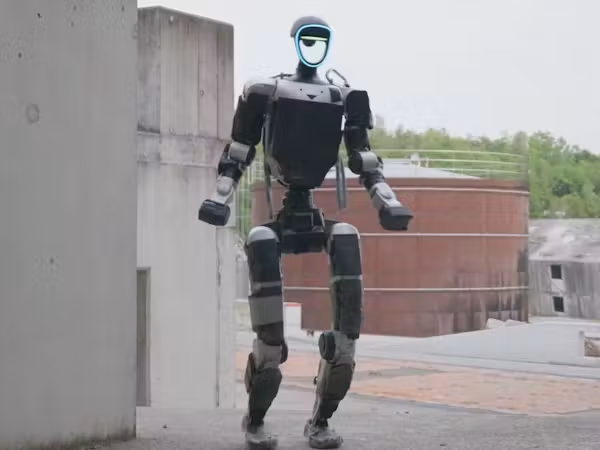
Humanoid robots have become very good at walking, running, dancing, and doing backflips on stage. But these carefully controlled demonstrations don't always translate into success in navigating the real world. Climbing ladders, crawling under obstacles, and scrambling over uneven terrain require more than a preprogrammed sequence of events. Researchers at ETH Zurich have developed a new AI-based control system that allows a humanoid robot to tackle all of these challenges without needing separate controllers for each task. The research, detailed in a recent paper , demonstrates the system on a Unitree G1 humanoid robot. Using a single neural network-based control policy, the robot can climb stairs and ladders, vault over obstacles, traverse stepping stones, crawl across platforms, and recover after falling down. The robot doesn't simply memorize how to do these tasks. Instead, it learns where and how its body should make contact with the surrounding environment, then figures out the movements needed to get there. Most approaches to humanoid locomotion typically rely on reinforcement learning or motion imitation. Reinforcement learning allows robots to discover effective behaviors through trial and error, but teaching complex whole-body movements can be difficult. Motion imitation produces more natural movements by training robots on human demonstrations, but those movements don't necessarily translate well to unfamiliar environments. The team combined the advantages of both approaches through a technique called attention-based contact planning. Rather than predicting every joint movement, the system identifies suitable contact points for nine body parts, including the hands, elbows, knees, feet, and pelvis. A separate controller then coordinates the robot's 23 actuated degrees of freedom to execute those plans. Training the system takes place in three stages. First, the robot learns coordinated movements from human motion data adapted to its mechanical structure. Next, an attention-based neural network learns to predict useful contact locations based on terrain observations, the robot's physical state, and its destination. Finally, reinforcement learning allows the system to refine these abilities on unfamiliar terrain. At runtime, onboard LiDAR sensors provide detailed terrain information, allowing the robot to identify features as small as ladder rungs. Both the contact planner and whole-body controller operate at 50 Hz, continuously adapting movements to the surrounding environment. In simulation, the new system achieved a 92.5% success rate across eight challenging obstacle courses, compared with 58.8% for a competing motion-generation approach. Real-world demonstrations also showed the robot recovering from failed jumps, unsuccessful attempts to stand, and getting stuck while climbing a ladder. Importantly, these behaviors emerge from a single general-purpose controller rather than a collection of individually programmed skills. The system still has limitations, including its focus on local navigation and terrain-based interactions, but it is a promising step toward humanoid robots that can handle the unpredictable environments they will eventually encounter outside the laboratory.This robot can do more than just put on a show (📷: ETH Zurich) The system is very versatile (📷: J. He et al.)
↑ Back to top
Originally published by Hackster News ↗
· rebuilt here from its own full-text RSS feed · all rights
remain with the publisher, please read and support them there.