← Technology, Science & Infrastructure
▣ Distilled locally
Luxonis' Latest Modular OAK 4 Camera Board Puts Five Cameras in Your Next Robot
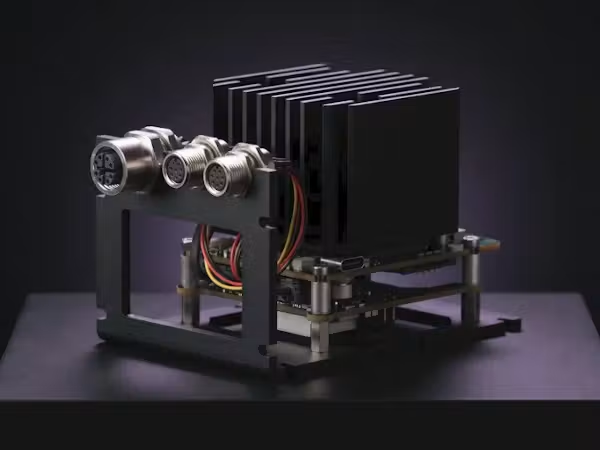
Computer vision specialist Luxonis has launched a new entry in the OAK family, the OAK 4 FFC — an OAK Modular device that lets you connect up to five cameras for multi-view robotics projects. "The machines our customers are building, from humanoids and drones to surgical and mobile robots, don't have room for a camera designed for someone else's machine. They kept asking for the same thing: let us choose the sensors and where they go, and you handle the hard parts underneath," says Luxonis chief executive officer Bradley Dillon of the new launch. "With OAK Modular now on OAK 4, a team can design its vision system around its robot, instead of its robot around a camera." The OAK 4 FFC "modular vision platform" is based around the OAK 4 system-on-module, a six-core Arm-based processor with an integrated graphics processor delivering a claimed four tera-operations per second (TOPS) of compute at FP16 precision and a dedicated neural coprocessor adding a further 12 TOPS of FP16 or 48 TOPS of INT8 for on-device computer vision models. The modular board gets its name from the five flat flexible circuit (FFC) connectors is boasts, linked to five four-lane MIPI Camera Serial Interface (CSI) inputs. These can take wide- and standard-angle camera modules with the user's choice of three sensors: the Sony IMX586 48 megapixel full-color rolling-shutter sensor, the Omnivision OV9828 one-megapixel monochrome global-shutter sensor, and the Omnivision OG05 five-megapixel global-shutter sensor in monochrome or color. As you would expect from an OAK system, the OAK 4 FFC includes on-board stereo generation to calculate depth from a stereo camera pair along with feature tracking and neural network interface capabilities. There's a 2.5-gig-Ethernet port on a Hirose M12 connector plus a USB Type-C port handling up to 5Gb/s in either Host or Device mode, plus SPI, I2C, UART, I2S, CAN bus and general-purpose input/output (GPIO) expansion options, along with an SD Card slot for local storage. Power-over-Ethernet Plus (PoE+) is supported via an optional add-on module. Finally, there's an on-board six-axis inertial measurement unit (IMU) plus a separate three-axis magnetometer. Luxonis has announced two variants of the board at launch: the OAK-4-FFC-BAREBONE, which is just the carrier board plus bundled OAK 4 system-on-module, and the OAK-4-FFC-DEVKIT that includes the carrier board, SOM, PoE+ module, panel-mount connector set, passive heatsink, and an L-bracket plus mounting hardware. Both models are now available to order on the Luxonis site , priced at $729 for the barebones version and $829 for the developer kit; launch pricing includes what the company describes as a "temporary $200 surcharge for memory and storage," in a reversal of most companies' early-bird discounts. A reference design for the carrier board is also available under an open hardware license. The board is available barebones (above) or as a ready-to-run developer kit (top) including desktop bracket mount and heatsink. (📷: Luxonis)Luxonis has announced a new entry in its OAK Modular family: the five-camera OAK 4 FFC carrier for its OAK 4 system-on-module. (📹: Luxonis)
↑ Back to top
Originally published by Hackster News ↗
· rebuilt here from its own full-text RSS feed · all rights
remain with the publisher, please read and support them there.