Introducing object enrichments: Transform unstructured data into agent-ready context
The vast majority of enterprise information is unstructured, locked away in object storage as petabytes of images, PDFs, videos, and audio files. This data holds the institutional knowledge AI agents need to do business-critical work. But to an agent, a raw object is just bytes it can't reason over. As enterprises start to deploy agents in production, the focus has shifted toward transforming these raw objects into rich, agent-ready context.
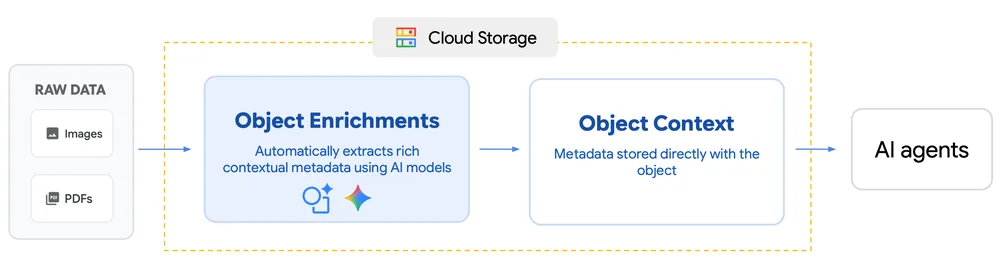
Today, we are introducing object enrichments, a new Google Cloud Storage capability that uses AI models to automatically extract rich contextual metadata from Cloud Storage objects and saves it in-place as object context, enabling agents to acquire the information needed to make complex business decisions. Object enrichments gives customers access to the AI models used by internal Google services such as Google Photos, offering image annotations like object detection and image labeling at 75% cost savings when compared to similar services from other cloud providers. Available in preview, this fully managed service also includes high-quality PDF classification model, enabling customers to seamlessly turn their object store into an intelligent, AI-ready foundation.
“L'Oreal is the 4th largest advertiser in the world, and managing media assets at that scale is complex. Cloud Storage object enrichments’s high quality and cost-effective annotations enable us to discover, understand, and govern our content at scale, accelerating marketing and advertising operations while remaining compliant in all markets. Object enrichments enables L'Oreal to label its extensive creative asset repository 100x faster at a fraction of the cost of existing pipelines and processes.” – Antoine Castex, Principal Data & AI Architect, L’Oreal
Agents need context, not raw bytes
To operate efficiently, agents need grounded knowledge; however, reading every raw file at scale is cost- and performance-prohibitive. For example, if an operations agent needs to pinpoint a specific event—such as a doorstep package delivery or a roadway hazard—streaming thousands of smart-camera or vehicle frames into the AI model on every user prompt would burn through expensive tokens and add minutes of delay. To bridge this gap, teams must pre-process raw data and extract rich, contextual metadata, which agents can then leverage at runtime. Historically, achieving this meant dealing with three challenges:
-
Cost: Running models over millions to billions of objects is expensive, pushing organizations to compromise and process only a fraction of their data, creating blind spots that lessen agents’ accuracy.
-
Operational toil: A self-managed pipeline means stitching together multiple services — from event triggers and queues to custom infrastructure built on Cloud Run or Google Kubernetes Engine (GKE) — along with scalable retry/error logic and job scheduling. Once deployed, that infrastructure still requires continuous upgrades and capacity management. Teams sometimes spend months on this plumbing rather than focusing on building agents that solve actual business problems.
-
Fragmented metadata: Extracted metadata often lands in a separate data store, decoupling context from the bytes it describes. Teams must pay for and maintain a second storage system, govern access policies across disconnected permission models, and run custom cleanup jobs to keep metadata in sync when source objects are copied, moved, or deleted.
This is why we built object enrichments: to natively provide agent-ready context for your unstructured data, equipping your agents with complete, grounded knowledge without prohibitive costs, custom pipeline plumbing, or fragmented metadata.
Key benefits of object enrichments
1. Reduce costs with Google models
Object enrichments offers dramatic savings at scale: enriching 10 million images or PDFs costs just $700 (according to published pricing). You can use Google’s high-quality AI models for image annotations—including object detection, face detection, image labeling, and explicit content detection—at one of the industry’s best price points. In addition, the PDF classification model lets you categorize documents into standard business and industry categories like Finance, Games, News, and Health.
"Even with a highly accurate baseline, Hyperscience leveraged object enrichments to drive a 50%+ lift in document classification accuracy, while simultaneously reducing classification inference costs by 2-3x.” – Mayur Pillay, VP Partnerships, Hyperscience
2. Generate richer context with Gemini
For complex multimodal reasoning across text, PDFs, images, audio, and video, you can leverage Gemini natively with object enrichments, unlocking advanced use cases such as summarization, entity extraction, transcription, and translation. Please reach out to us at storage-ai@google.com to learn more and request access to this upcoming functionality.
3. No pipeline, low toil setup
Skip the brittle, multi-component DIY pipelines. Setting up an enrichment job just takes three simple steps, with no code required in the Google Cloud console, or programmatically via the Cloud Storage API, following these steps:
-
Define your scope: Provide a set of buckets containing the objects to process and specify the processing location. Object enrichments can scale to millions or billions of objects.
-
Choose your models: Pick one or more of the five first-party Cloud Storage models for images and PDFs.
-
Grant permissions: Grant the necessary IAM permissions to the object enrichments service to access your Cloud Storage buckets.
Object enrichments handles the rest: It orchestrates model inference, parses the responses, and writes the results to each object's object context, with built-in retries and throttling. There are no queues to manage, workers to scale, or glue code to maintain.
"Cloud Storage object enrichments and BigQuery, slashes AI development from 6 months to 1 month while rapidly improving our models." - Brandon Bunker, VP of Product AI, Vivint
4. Context lives where the bytes live
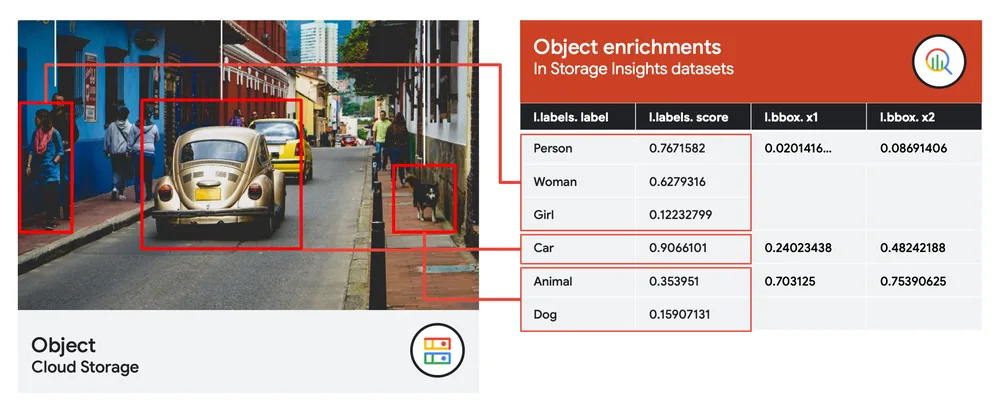
Instead of parking metadata in a separate data store, object enrichments writes model outputs directly to object context, a specialized Cloud Storage metadata construct that’s purpose-built for storing contextual information as structured key-value pairs alongside the object itself. Because context is stored alongside object’s actual bytes, you get enterprise-grade data management out of the box, with:
-
Cloud Storage durability and simplified lifecycle management: Object context shares the same durability and consistency properties as the underlying Cloud Storage object. It travels automatically with the object during copy, move, and replication operations and is automatically removed when the object is deleted — no more cleanup jobs!
-
Fine-grained IAM governance: Using IAM, administrators can control who can read, add, update, or remove object context.
-
Fast object filtering and serving: Applications can filter object listings directly by object context key-value pairs or read context metadata alongside objects, in order to serve richer experiences.
-
Turnkey multimodal analytics in BigQuery: You can easily configure your object context to natively flow into BigQuery via Storage Insights datasets, allowing data teams to run SQL analytics, build dashboards, and join unstructured file insights with structured enterprise tables, without writing a single line of ETL code.
What customers are building
Early customers are already putting object enrichments to work across key business scenarios:
-
Creative asset search and media archives: Marketing, retail, and media organizations manage petabytes of creative image assets, where finding a specific asset, e.g., "a red car driving at sunset" or "a vintage convertible in the desert during golden hour", requires rich semantic metadata. Object enrichments automatically generates descriptive labels in object context, which can then be indexed into a vector database or BigQuery to power accurate retrieval-augmented generation (RAG) applications and asset-discovery agents.
-
Automated trust, safety, and content moderation: Social platforms, marketplaces, and digital media pipelines scan millions of user uploads and supplier catalogs every day for explicit content. Historically, scaling this for every single upload has been cost-prohibitive, but not anymore. With object enrichments, you can process 10 million images for just $700.
-
Training data curation for frontier AI: Autonomous driving, smart home, and robotics companies capture hundreds of millions of raw camera and sensor files. They often need targeted data samples for specific fine-tuning scenarios, which make up only a tiny fraction of their corpus. By enriching raw captures in place with object detection and image labeling models and then querying the resulting metadata in BigQuery, ML engineers can pinpoint exact training cohorts in minutes rather than months.
-
Multimodal analytics: Combine insights from images and documents with structured business data to drive personalization, fraud detection, and trend discovery — for example, analyzing customer uploaded images of the product alongside their comments and recent sales data.
Get started with object enrichments
Object enrichments is available in preview today in the Cloud Storage console and through the Cloud Storage API. To get started, check out the following resources
-
Read the documentation: Learn how to configure an enrichments job and use object contexts.
-
Analyze in BigQuery: Set up Storage Insights datasets and query your enrichments alongside your BigQuery business data.
-
Connect your agents: Pair object enrichments and object context with the Cloud Storage MCP server to give agents secure, IAM-scoped access to your data and its context.
-
Review pricing: See Cloud Storage pricing for details.
-
Gemini enrichments: Reach out to us at storage-ai@google.com to learn more and request access to this upcoming functionality.
-
Start building: Head to the Cloud Storage console to enrich your first bucket in just three clicks.