← Technology, Science & Infrastructure
▣ Distilled locally
AI Has Officially Come for the Candle
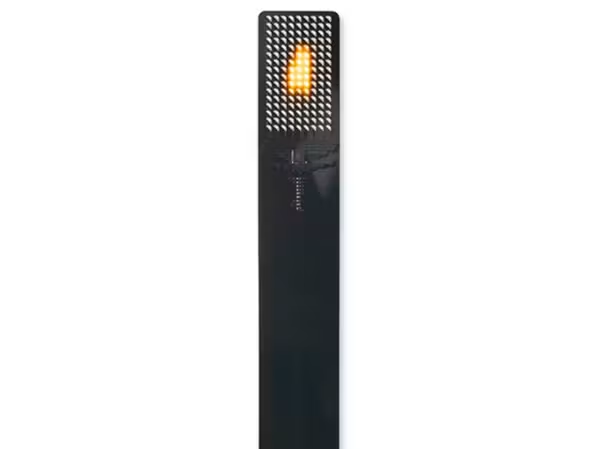
There is something about the warm, flickering glow of a candle that a light bulb cannot reproduce. Unfortunately, real candles also come with a few drawbacks, like the risk of starting a fire, dripping wax, and eventually burning out. LED candles solve some of those problems, but their repetitive flickering patterns rarely look convincing. Maker Kevin Bates has come up with a more interesting alternative that uses artificial intelligence to create a realistic flame that never repeats. Bates, best known for creating the Arduboy handheld gaming console, has developed the Digital Candle, an electronic candle that uses a tiny neural network to generate the appearance of a flickering flame in real time. Rather than playing a prerecorded animation, the device continuously creates new flame patterns based on what it learned from watching a real candle burn. The hardware consists of a tall, narrow printed circuit board measuring approximately 10 inches by one inch. Near the top is a 9×16 matrix of 144 amber LEDs, each capable of displaying 256 brightness levels. An IS31FL3731 LED driver controls the matrix, while an Espressif ESP32-S3 microcontroller handles the AI processing. The entire assembly is powered through USB-C, with a dock that holds it upright. The big differentiator between the Digital Candle and other LED candles is how it generates its flame. Bates trained a small convolutional neural network using video recordings of a real candle. The recordings were reduced to the same 144-pixel resolution as the LED matrix, allowing the model to learn how the flame changes shape and brightness over time. The resulting neural network has just 3,545 parameters and uses eight variables to represent the flame's behavior. A stochastic model based on eight damped oscillators drives those variables, while a convolutional decoder translates them into LED patterns at 30 frames per second. This produces an endlessly changing flame without requiring prerecorded animation sequences or an internet connection. If you have more than one Digital Candle, they will all behave differently. Each device uses the unique hardware address programmed into its ESP32-S3 to establish its initial flame characteristics, ensuring that no two candles flicker in exactly the same way. Owners can reprogram the ESP32-S3 through USB-C and repurpose the LED matrix for other applications if they choose. Bates demonstrates several possibilities, including a clock, notification display, Conway's Game of Life, digital rain, and even a simple Breakout game. Wi-Fi and Bluetooth Low Energy are also available for custom projects. The Digital Candle is available in black or white for $149. That's on the expensive side for something that replaces a candle. But for someone who wants to play with edge AI and lots of blinkenlights — and wind up with a finished product worthy of being displayed in their home — this platform may be well worth that price.The Digital Candle uses AI to render the flame (📷: Kevin Bates) It also comes in white (📷: Kevin Bates) This Digital Candle was reprogrammed to be a clock (📷: Kevin Bates)
↑ Back to top
Originally published by Hackster News ↗
· rebuilt here from its own full-text RSS feed · all rights
remain with the publisher, please read and support them there.