← Technology, Science & Infrastructure
▣ Distilled locally
Classic Reel-to-Reel Control Goes Digital with TWEACMAN
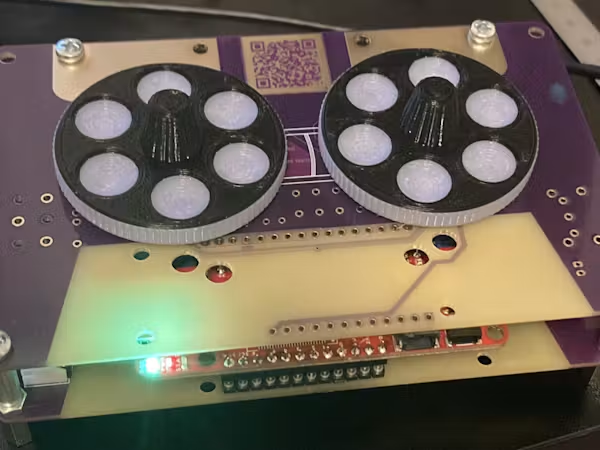
Digital audio offers plenty of flexibility when it comes to manipulating recordings, but something has been lost in the transition away from physical media. With a reel-to-reel tape deck, for example, you can grab a reel and manually move the tape backward or forward to find a particular spot in a recording. Maker Mykle wanted to bring that kind of tactile control to digital audio, so he built TWEACMAN, a pocket-sized WAV player that lets users manipulate recordings with a pair of rotary controls. Inspired by classic TEAC tape decks and Sony Walkman portable cassette players, TWEACMAN can play audio files stored on an SD card at speeds ranging from 0.001x to 1000x, in either direction. Users can also manually scrub through recordings by turning a knob, effectively moving a virtual tape head backward and forward through the audio. Additional effects and a Bluetooth interface provide even more control. Rather than using standard rotary encoders, Mykle selected a pair of Taiwan Alpha RV112-FF dual 360-degree potentiometers. Each component contains two potentiometers positioned 90 degrees out of phase with one another. By reading their analog outputs and performing some trigonometry, the system can determine the shaft's absolute angular position with a high level of precision. Unlike ordinary potentiometers, these controls can rotate continuously in either direction. At the core of TWEACMAN is a SparkFun Thing Plus RA6M5 development board featuring Renesas' RA6M5 microcontroller. Its six 12-bit analog-to-digital converter channels are particularly useful for this project, since each rotary control requires two channels. The microcontroller also provides a pair of output amplifiers, allowing it to generate stereo audio without a separate DAC. Other useful features include a floating-point unit for audio processing, capacitive touch sensing for two additional controls, and a DA14531MOD Bluetooth Low Energy module. The board also includes battery management circuitry, allowing the device to operate from a rechargeable 3.7 V lithium-polymer battery. So far, Mykle has assembled a prototype consisting of the development board, two rotary controls, an audio jack, and a handful of supporting components. He has also developed Arduino libraries to read the unusual potentiometers, calibrate them to compensate for manufacturing variations, and track multiple rotations. One demonstration uses the knobs to control a pair of audio oscillators, showing off the precision of the controls before putting them to work manipulating recorded audio. Beyond its audio capabilities, TWEACMAN shows how inexpensive, unconventional components can be used to create fun and intuitive controls for digital devices. Mykle has made the project's code available as open source , including the Arduino libraries developed to interface with the rotary controls. Those libraries could prove useful well beyond audio applications, making TWEACMAN as much a demonstration of a clever input method as a digital music player.TWEACMAN is a pocket-sized WAV player (📷: Mykle) A closer look at the hardware (📷: Mykle)
↑ Back to top
Originally published by Hackster News ↗
· rebuilt here from its own full-text RSS feed · all rights
remain with the publisher, please read and support them there.