← Technology, Science & Infrastructure
▣ Distilled locally
Don't Throw Away Your Old Phone — Build a Robot Instead
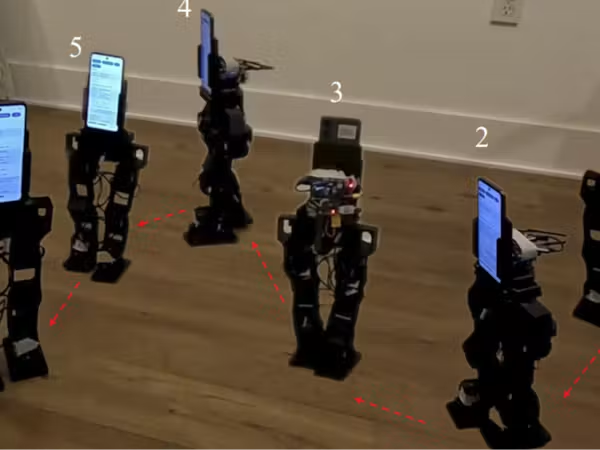
Your old phone might not be worth much on the secondhand market, but it could still have a future in robotics. Even aging smartphones pack powerful processors, cameras, motion sensors, and wireless connectivity into a single device. Researchers at UCLA realized that these capabilities could replace much of the expensive electronics normally needed to build a robot. Their solution is PhoneBot , an open source humanoid robot that uses an ordinary Android smartphone as its brain. PhoneBot stands approximately 19 inches tall, weighs four pounds, and costs around $400 to build, excluding the smartphone. It doesn't have arms or a head, but it can walk on two legs, track people with its camera, and get back on its feet after falling down. The robot's lower body has 12 degrees of freedom, with three joints at each hip, one at each knee, and two at each ankle. A thirteenth joint rotates the torso, allowing the smartphone's camera to track objects without moving the robot's feet. All 13 joints are driven by inexpensive DYNAMIXEL XL430-W250-T servo motors. The smartphone sits in a mount above the hips, where it serves as both the robot's primary computer and sensor suite. Its built-in inertial measurement unit monitors body orientation and movement, while the camera handles object detection, human tracking, and visual navigation. A custom Android application runs the robot's movement and control neural networks using TensorFlow Lite. It communicates over Wi-Fi with a small onboard computer that relays commands to the servos. This wireless arrangement also makes it easy to swap smartphones without changing the robot's electronics. The researchers tested PhoneBot with four Android smartphones, including an Honor 9 from 2017 and three budget models costing approximately $50 to $80 each. All four successfully handled the robot's core functions, clearly showing that even older hardware has enough computing power for the job. Getting a low-cost humanoid to walk reliably took a lot of effort. The researchers ultimately decided to use reinforcement learning to train PhoneBot's locomotion controller in simulation, accounting for the limited torque available from its inexpensive motors. Early training attempts produced an awkward gait in which one leg did most of the work. To correct this, the researchers introduced a technique called sagittal mirroring. Each training example was duplicated with the left and right sides reversed, effectively teaching the robot to use both legs equally without requiring additional physics simulations. Mirroring reduced left-right joint-angle asymmetry from 0.254 to just 0.003 radians in simulation, while also improving training speed and consistency. The platform still has a number of limitations. Its walking controller was only trained on flat terrain, and its motors restrict its payload capacity. The researchers hope to add lightweight arms and improve locomotion on uneven surfaces in the future. They also want to move conversational AI processing, which currently requires an external laptop, onto the smartphone itself. With the price of computing hardware skyrocketing, there has never been a better time to reuse old hardware. Before you start that next robot build, you might want to dust off an old phone rather than place an order for new parts.PhoneBot replaces robotic control and sensing systems with an old phone (📷: R. Hou et al.) An overview of the architecture (📷: R. Hou et al.) I get knocked down, but I get up again (📷: R. Hou et al.)
Originally published by Hackster News ↗
· rebuilt here from its own full-text RSS feed · all rights
remain with the publisher, please read and support them there.
↑ Back to top
© 2026 PaperWeb. Content remains property of respective publishers. · Privacy Policy · Terms