← Technology, Science & Infrastructure
▣ Distilled locally
Sir Isaac Newton Would Love This Portable DIY Vis Spectrometer
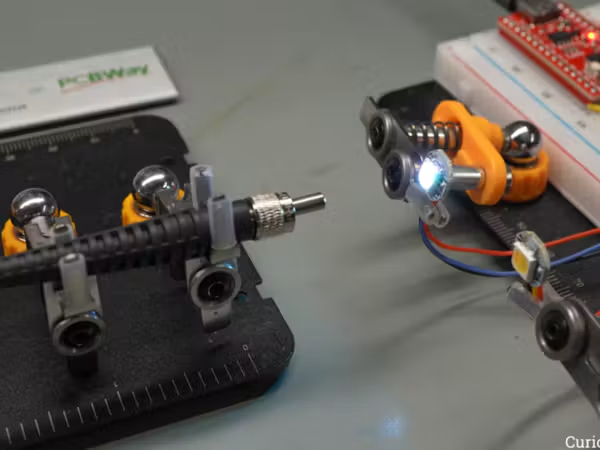
Sir Isaac Newton’s experiments with dispersive prisms were groundbreaking, leading to revelations about the nature of light and wavelengths. Most importantly, they proved that white light contains all colors of light and could be separated into those — and put back together. That later led to other scientists, like Thomas Young, developing wave theory and an understanding of wavelength as color. Both Newton and Young would therefore be amazed by this portable DIY vis spectrometer built by Curious Scientist . A “vis spectrometer” is just a spectrometer that works with visible light, as opposed to UV, infrared, or anything else on the electromagnetic spectrum. A spectrometer is a device that measures the intensity of the wavelengths present in light. Typically, the goal is to look at the light passing through or bouncing off of a sample of material. The wavelengths present and their intensity can then tell you a lot about the material. For example, a scientists might add a reagent to a sample and that reagent changes color in the presence of a particular protein, so a spectrometer can tell them how much color change there is — and therefore how much of that protein is in the sample. But how does a spectrometer actually measure the wavelengths of light? Interestingly, as Curious Scientist demonstrates, it isn’t that different than what Newton was doing. The spectrometer Curious Scientist built takes in light through an optical fiber. A collimating mirror then reflects that light and makes the rays parallel, so they don’t diverge over distance. The rays then hit a diffraction gate, which splits the light by color, similar to Newton’s dispersive prisms. The split light then bounces off a focusing mirror and finally lands on a sensor. That sensor is cool, because it is a CCD (Charge-Coupled Device), which is the same technology that used to be commonly used for digital camera sensors. Specifically, it is a TCD1304 linear CCD, because only one sensor dimension is necessary for the one-dimensional electromagnetic spectrum. The physical position of lit point along the sensor corresponds to a specific wavelength of light. Originally, Curious Scientist used a computer to read the CCD output. His own custom software graphed the results. But he realized he could achieve the same thing without a computer at all and make the whole operation portable. He did that by connecting the CCD sensor to an STM32F401CCU6 development board. A 4” display, connected through SPI, shows a graph similar to the one in the computer software. A rotary encoder allows for settings adjustments and for cursor movement, to see the exact intensity peak at any point on the spectrum. An 18650 lithium battery cell and charging module eliminate the need for an external power supply and all of those components fit into a 3D-printed enclosure. Now Curious Scientist can do spectroscopy wherever he goes. I’m having fun imaging how Newton would react if he could see this.
↑ Back to top
Originally published by Hackster News ↗
· rebuilt here from its own full-text RSS feed · all rights
remain with the publisher, please read and support them there.