DOOM’s DNA: How modern code keeps its family resemblance
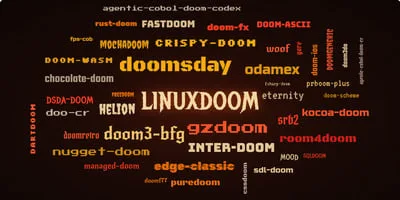
Joe Esquibel scanned 43 descendants of DOOM’s 1997 source release and tried to work out which ones really inherited the original’s code, writing it up on GitGalaxy. The set includes faithful ports, modernized engines, and translations into about twenty languages, from Go and Scheme to Fortran, COBOL and SQL.
Function names turn out to be a poor guide. Chocolate Doom keeps 87% of the original’s function names but only 35% of the code inside them. Doom Retro keeps 69% of the names and 0.2% of the code. So the project used a scanner that doesn’t read names or code at all, just shape: function length, branching, and which function calls which. 93% of the matches it found were real copies, checked against the source text. Quake, Quake II and Lua, all written in C, share 0 to 0.6% of DOOM’s shape. Chocolate Doom shares 31%.
Translations rewrite every line, so look-alike hunting doesn’t find anything. Instead, with all names hidden, the engine sorted a Go port’s functions into the right part of the game 60% of the time, against 20% for guessing. The Scheme and Go ports keep the original’s wiring between parts. The Fortran, Java, Kotlin and C# ones don’t show such connections.
See more at squid-protocol.github.io and content on GitHub.