← Technology, Science & Infrastructure
▣ Distilled locally
Humans Are No Match for This AI Racing Drone
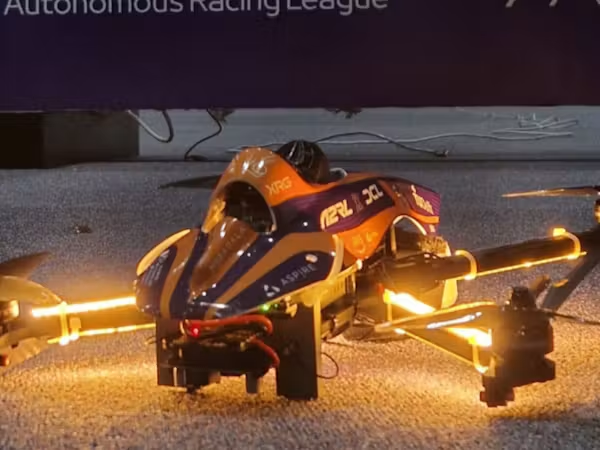
Professional drone racing pilots spend years developing the skills needed to navigate complicated courses at high speeds. Flying through narrow gates while making sharp turns and sudden changes in altitude requires precise control and split-second reactions. But even the best human pilots are now facing some serious competition from AI. Researchers at Delft University of Technology have developed an autonomous drone racing system called MonoRace that can outperform world champion pilots, reaching speeds of up to 100 km/h without anyone at the controls. The system recently demonstrated its capabilities at the 2025 Abu Dhabi Autonomous Drone Racing Competition, where it defeated every competing autonomous team and three world champion human pilots. The researchers have now published the technical details of their approach in Science Robotics . To get results like that, you might expect MonoRace to be dependent on lots of high-end equipment. But it actually gets by with very little sensing hardware. Previous high-performance autonomous racing drones have relied on stereo cameras and, in some cases, external motion-tracking systems to determine their position. MonoRace needs only a single forward-facing camera and an inertial measurement unit (IMU), with all processing performed onboard. The competition drone was equipped with 5.1-inch propellers, a standard flight controller, and an NVIDIA Jetson Orin NX computer. The Jetson processes images from the camera to identify racing gates and estimate the drone's position, while a neural network running directly on the flight controller handles motor control. Rather than using conventional stabilization algorithms, the researchers developed a neural network that generates commands for the motors directly. Despite having only three layers of 64 neurons each, the network, which operates at 500 Hz, allows the drone to make rapid adjustments during aggressive maneuvers. The team trained this controller using reinforcement learning in simulation. During training, they introduced variations in the drone's physical properties and aerodynamic behavior, forcing the network to learn how to maintain control under a wide range of conditions. This helped the resulting controller perform reliably when transferred to the real aircraft. During tests, the team found that rapid acceleration sometimes caused the IMU to exceed its measurement limits, and in some cases, electrical interference corrupted images from the camera. To address these problems, the researchers combined visual gate detection with a mathematical model of the drone's motion. When sensor measurements became unreliable, the system could reject erroneous data or substitute predicted acceleration values. The competition course included 11 gates arranged to require difficult maneuvers, including a rapid dive through vertically stacked gates. MonoRace completed the two-lap course in just 16.56 seconds, beating three world champion pilots in a knockout tournament. There are still some limitations that need to be addressed in the future. The system requires a previously mapped course and cannot yet detect or avoid other drones, which caused a collision during the multidrone event. Nevertheless, the researchers believe their approach could eventually benefit autonomous aircraft operating in environments where external positioning systems are unavailable, particularly when fast reactions are needed.This drone is equipped with the MonoRace system (📷: S. Bahnam et al.) An overview of the system architecture (📷: S. Bahnam et al.) A look at the competition course (📷: S. Bahnam et al.)
↑ Back to top
Originally published by Hackster News ↗
· rebuilt here from its own full-text RSS feed · all rights
remain with the publisher, please read and support them there.