← Technology, Science & Infrastructure
▣ Distilled locally
This Coffee Machine Serves Up a Fresh Cup of Doom
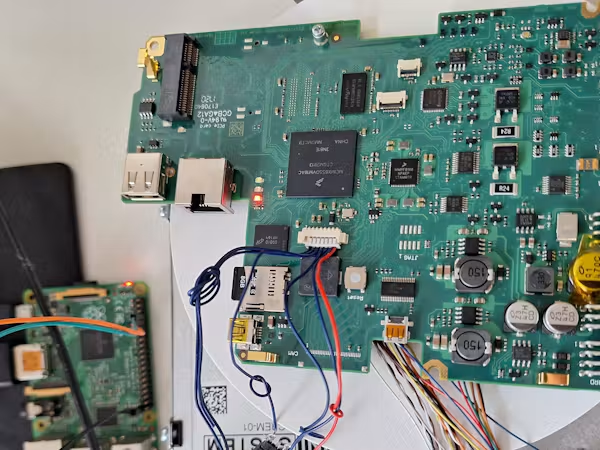
A microphone is an odd — and somewhat disturbing — thing to find inside a coffee machine. That's what caught the attention of hardware hacker Robin M., who spotted one mentioned in the service documentation for a Spengler PSL50. What started as an attempt to figure out why it was there quickly turned into a much bigger hardware hacking project involving embedded Linux, an unsecured debug interface, a questionable USB update system, and, of course, Doom . According to the machine's supplier, the microphone was intended for future presence detection and accessibility features, but wasn't actually being used. Further investigation was unwelcome, so Robin took another route: buying a spare display/controller module on eBay and poking around inside it. The board turned out to be pretty complex for a coffee machine. It was built around an NXP i.MX 6 processor with an Arm Cortex-A9 core, running a Yocto-based embedded Linux system. The hardware also includes Ethernet, USB, microSD storage, and interfaces for payment hardware, cup dispensers, energy-saving modules, and more. After tracing the power circuitry and supplying the board with 24 volts, Robin got it running on the bench. Probing an unidentified connector then revealed a 3.3 V UART interface operating at 115200 baud. A Raspberry Pi connected to the interface provided access to the boot console, and that's where things really started to get interesting. U-Boot wasn't password protected and allowed the kernel command line to be changed. Robin simply configured the system to launch /bin/sh during boot, providing a shell from which the filesystem could be mounted and the root password changed. That access also exposed how the coffee machine handles software updates. Plugging in a USB drive causes the system to look for an autorun.sh script and an accompanying hash. But instead of proper cryptographic code signing, the verification process uses a secret stored in plaintext on the machine itself. Once Robin could read the filesystem, creating an update package that passed the check was possible. Before doing anything too wild with that newfound access, Robin returned to the question that started everything. A custom diagnostic script checked the machine's hardware, networking, audio playback, and recording capabilities. No evidence suggested that the machine was listening to anyone, and most configurations apparently lacked the necessary audio hardware altogether. With that settled, it was time to answer the next obvious question: can it run Doom ? The machine's old Linux 3.10.17 environment and glibc 2.18 complicated matters, but fbDOOM offered a solution. The lightweight Doom port can draw directly to the Linux framebuffer and has few dependencies, making it a good fit for aging embedded hardware. After working around the outdated userspace, Robin got Doom running first on the bench and then on an actual coffee machine using a prepared USB drive. In the end, the mysterious microphone turned out to be much less interesting than everything else Robin discovered while investigating it . The coffee machine wasn't secretly eavesdropping, but it was running Linux on an Arm processor with enough horsepower to play Doom .Hacking a coffee machine (📷: Robin M.) Robin's findings (📷: Robin M.)
↑ Back to top
Originally published by Hackster News ↗
· rebuilt here from its own full-text RSS feed · all rights
remain with the publisher, please read and support them there.