← Technology, Science & Infrastructure
▣ Distilled locally
This Wireless Sensor Board Speaks Your Language
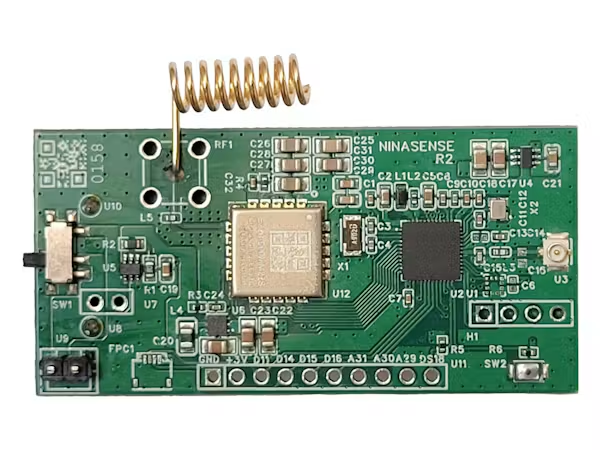
Battery-powered wireless sensors are perfect for everything from home automation to industrial monitoring, but keeping them running for the long haul takes a lot of maintenance. Even when a microcontroller spends most of its time sleeping, power-hungry components on a development board can drain its battery quickly. NearMeter Technologies LLC is taking on that problem with NINASENSE nRF, an open source wireless sensing platform designed to operate for months or even years on just two AAA batteries. And thanks to its companion software, you don't even need to write code to program it. NINASENSE nRF is built around Nordic Semiconductor's nRF52832 microcontroller, which includes a 64 MHz Arm Cortex-M4F processor and Bluetooth Low Energy connectivity. An additional LLCC68-based radio provides LoRa and sub-GHz communication, giving the board both short-range and long-range wireless capabilities. Depending on the application, users can choose between a helical antenna and an SMA connector for the LoRa radio. The tiny board measures just 57×28 mm and uses a four-layer PCB. Onboard sensors include an LIS2DH12 three-axis accelerometer for detecting motion and vibration, along with support for Hall-effect sensing and external DS18B20 temperature sensors. There are also eight GPIOs, three of which support analog inputs, and dedicated circuitry for monitoring battery voltage. Unlike typical development boards, NINASENSE nRF eliminates components that would otherwise consume power unnecessarily, including USB interfaces, USB-to-serial converters, charging circuitry, and always-on voltage regulators. This is a bit of an inconvenience, but it allows the board to operate for extended periods without replacing its batteries. NINASENSE nRF can connect directly to Home Assistant over Bluetooth, allowing it to report sensor readings or trigger automations. For more distant deployments, it can communicate with a separate bridge using LoRa, which then connects those remote nodes to the same Home Assistant installation. The board can also operate as a bridge for existing FSK/GFSK wireless sensors. Supported and in-development integrations include devices from VEVOR, Ambient Weather, and Ecowitt. Bluetooth beacon functionality and experimental OpenHaystack workflows provide additional possibilities for asset tracking. The platform's most unusual feature is nRFClaw Studio, NearMeter's companion software for natural language programming. Rather than manually writing firmware, users can describe their application in plain English using an LLM of their choice. The resulting application can then be flashed wirelessly over Bluetooth. Once programmed, NINASENSE nRF executes its application locally without requiring a permanent cloud connection. NINASENSE nRF is an open source project, and its hardware schematics and bill of materials will be published during the crowdfunding campaign . The nRFClaw Studio software is already available on GitHub , with additional documentation, application examples, and integrations planned for release. Pricing and campaign launch details have not yet been announced.The NINASENSE nRF wireless sensing platform (📷: NearMeter Technologies LLC) The board is slightly larger than a pair of AAA batteries (📷: NearMeter Technologies LLC) NRFClaw Studio simplifies firmware development (📷: NearMeter Technologies LLC)
↑ Back to top
Originally published by Hackster News ↗
· rebuilt here from its own full-text RSS feed · all rights
remain with the publisher, please read and support them there.