A Brave New Space Age: Caltech Convenes Leading Voices to Discuss the Next Frontiers of Exploration
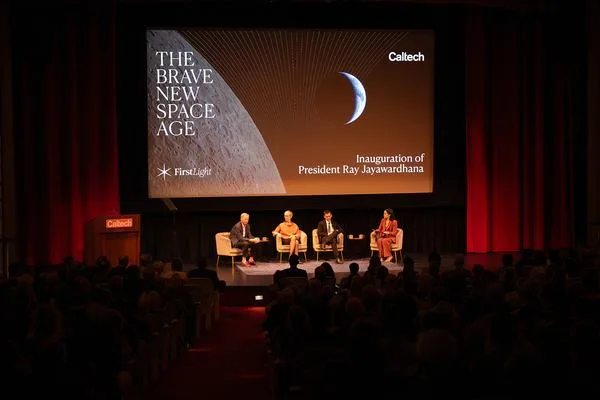
As access to space expands and renewed ambitions draw society's gaze to the Moon and Mars, a new space age is rapidly taking shape, bringing immense opportunities for discovery while also raising profound questions about humanity's future beyond Earth.
Caltech convened leading voices from science, industry, government, and media to explore the promise, challenges, and responsibilities of this unfolding chapter in space exploration at The Brave New Space Age, a public conversation on the eve of the Inauguration of Caltech's 10th president, Ray Jayawardhana.
"Today, advances in science and technology are opening frontiers that were beyond our reach just a generation ago," said Jayawardhana, Sonja and William Davidow Presidential Chair and professor of astronomy, as he welcomed a brimming audience to Beckman Auditorium. "Caltech and JPL fully intend to stay at the forefront, sustaining America's preeminence in space and pushing the boundaries of scientific possibility."
Two major announcements at the start of the program underscored that ambition: First, Jayawardhana revealed gifts totaling $27.5 million from philanthropists Foster and Coco Stanback to significantly expand Caltech's aerospace research and innovation capabilities. He was then joined by Dave Gallagher, Caltech vice president and JPL director, to announce the appointment of NASA astronaut and Artemis II Commander Reid Wiseman as Caltech associate vice president and JPL deputy director.
The event's centerpiece was a wide-ranging conversation moderated by Jo Ling Kent, senior business and technology correspondent for CBS News, featuring Lindy Elkins-Tanton, professor of Earth and planetary science, director of the UC Berkeley Space Sciences Laboratory, and principal investigator of NASA's Psyche Mission; Jared Isaacman, NASA Administrator; and Eric Schmidt, former CEO and chairman of Google, chair and CEO of Relativity Space, co-founder of Schmidt Sciences, and a member of Caltech's Board of Trustees.
In a spirited discussion, the panelists explored the forces reshaping space exploration, from the growing influence of AI and autonomous systems to the evolving relationship between fundamental research and commercial enterprise. They also considered the balance between ambition and risk, the complex decisions that accompany humanity's expanding presence in space, and the partnerships that will shape the future of exploration.
"We can do a lot more today thanks to all of the contributions that are coming across industry," Isaacman said.
Private investments in reusable launch systems and other technologies have helped bring about a turning point in space, he said, in which NASA has greater opportunities to conduct ambitious science and build toward a sustained human presence on the Moon. "We're able to do an awful lot more now with less taxpayer funds."
Elkins-Tanton emphasized the enduring role of fundamental science in this new era.
"The bigger the curiosity and the bigger the exploration, the greater the technological developments, the more jobs that are created, the more people that are inspired," she said. "I think without curiosity-driven exploration, we lose the machine that drives our technological society. And honestly, we lose something of what it is to be human."
All the while, Schmidt noted, artificial intelligence is transforming scientific discovery itself. "The explosion in science in terms of data collection and exploration is like nothing you've ever seen before," Schmidt said. He envisioned a future in which spacecraft are equipped with autonomous agents that engage in scientific work—conducting experiments, analyzing results, and even writing scientific papers.
"The acceleration is ... profound," Schmidt said. "It's a different way of doing science."
Such developments also mean new opportunities on Earth.
Addressing students in the audience, Isaacman invited passionate and tenacious thinkers and innovators of all backgrounds to be a part of NASA's vision for Moon exploration. "We are trying to create the same type of environment on the lunar surface that we've been operating on the International Space Station for 26 years, and the people that you're going to need and their background skills that are going to contribute to it are going to be so much wider than we currently think about when it comes to our astronaut corps," he said. "Never stop learning and it may take you to the Moon someday."