Siemens expands agentic AI for 3D IC design workflows
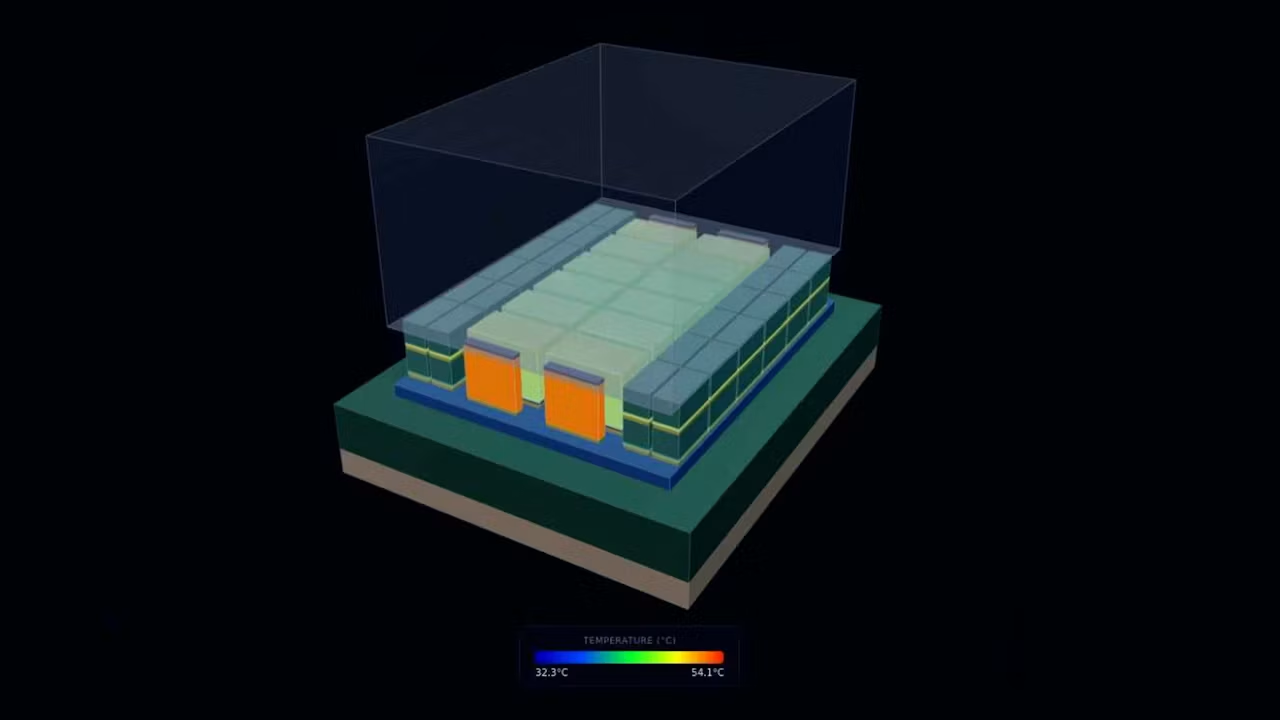
Siemens has announced updates to its electronic design automation (EDA) agentic AI portfolio, developed in collaboration with NVIDIA. The updates combine agentic AI capabilities introduced at DAC 2026 with NVIDIA accelerated computing to support electrical, power, thermal and co-design analysis for 3D integrated circuits (ICs).
The new capability coordinates Siemens’ electrothermal analysis tools through a single workflow. Using Siemens’ Design Space Exploration and Optimization (DSE/DSO) technology, the workflow enables engineers to evaluate and validate design alternatives with physics-based signoff solvers. In benchmark studies, Siemens reported up to a 95% reduction in engineering effort, up to a 99% reduction in workflow setup time and up to 50 times greater design exploration coverage compared with manual workflows.
Packaging requirements for AI systems
AI systems require increased compute capacity, memory bandwidth and thermal management within compact packages. For example, NVIDIA’s Rubin GPU supports up to 50 petaflops of NVFP4 inference and up to 288 GB of HBM4 per GPU. These GPUs can be combined into systems such as NVIDIA Vera Rubin NVL72. As compute and memory are integrated more closely, power density and heat concentration increase. As a result, electrothermal co-design must be considered during the design process rather than only during final verification.
Manual coordination across design domains
Current workflows often require specialists to coordinate multiple tools, transfer data between electrical, power, thermal and extraction analyses and repeat evaluations across design iterations. As design complexity increases, teams may reduce the number of scenarios they evaluate because of time and computing constraints. This can delay the identification of power and thermal issues.
Agentic workflow for 3D IC engineering
In the new workflow, an engineer defines the design objectives while the Fuse EDA AI Agent, integrated with Intelligence Center X, coordinates multiple Siemens tools. The agent runs coupled electrothermal analyses, identifies targets that were not met and evaluates whether the causes involve power delivery, placement, materials or a combination of factors.
The agent uses the analysis results to guide design-space exploration, assess trade-offs and rerun selected configurations against the defined objectives. This process enables engineers to evaluate additional alternatives and identify power and thermal issues earlier in development.
The workflow coordinates nine steps across seven Siemens EDA tools. It performs 50 to 100 reasoning steps during an eight- to 10-hour runtime and can evaluate heat transfer coefficient (HTC) boundaries, power budgets and material stack-ups across 200 to more than 500 design points per cycle. The tool chain includes:
- Innovator3D IC Integrator software: Supports floor planning and 3D IC assembly and package design.
- Solido Characterizer software: Characterizes libraries to generate Liberty files.
- mPower Digital software: Performs power analysis and calculates temperature-dependent instance power.
- Calibre 3DThermal software: Supports 3D IC thermal signoff and power mapping.
- Simcenter Flotherm software: Provides system-level thermal simulation and visualization.
- Calibre xACT software: Performs temperature-dependent parasitic extraction.
- Solido SPICE software: Supports power- and temperature-aware electrical SPICE simulation.
NVIDIA technologies used in the workflow
Siemens combines the NVIDIA Agent Toolkit with NVIDIA accelerated computing and CUDA-X libraries to support the agent-driven EDA workflow. The accelerated simulation tools provide analysis results for the agents to evaluate during design exploration.
- Nemotron open models: Support the orchestration and execution of agentic EDA subflows.
- NeMo Gym: Tracks agent trajectories and identifies areas for refining agent skills and Model Context Protocol (MCP) tool descriptions.
- NeMo RL: Supports post-training fine-tuning of language models with EDA knowledge and tool-calling capabilities.
- NeMo Relay: Provides observability and audit records across agent harnesses.
- NeMo Switchyard: Routes tasks based on compute requirements, accuracy and token costs.
- NVIDIA OpenShell: Sandboxes agent execution to help protect intellectual property and foundry process design kits (PDKs).
- NVIDIA CUDA-X libraries: Accelerate supported engineering solvers used in the workflow to reduce simulation time during iterative design.
For more information, visit siemens.com.