HPE Lux AI Cluster Debuts at No. 14 on the TOP500 With 220.79 Petaflops on AMD Instinct MI355X GPUs
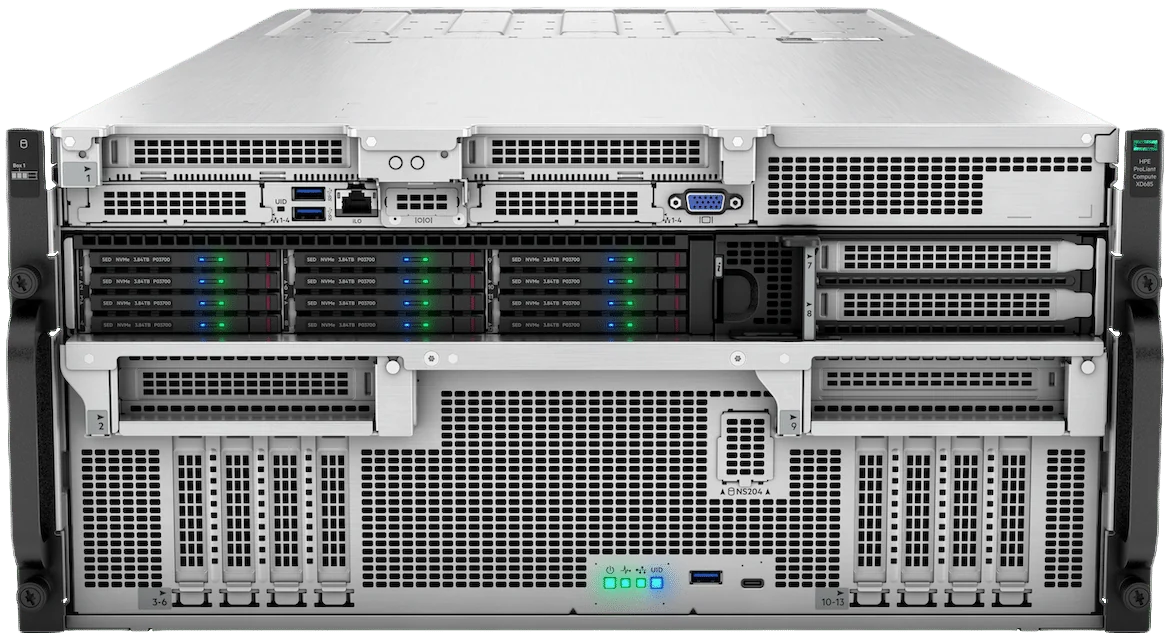
HPE today announced that Lux, the AI cluster it built with AMD for Oak Ridge National Laboratory (ORNL), has debuted at No. 14 on the TOP500 list with 220.79 petaflops of measured HPL performance. HPE says the system, which was designed for AI training and inference, placed ahead of machines built for traditional supercomputing workloads. Lux gives researchers across the U.S. multi-tenant, cloud-style access, and it is the first dedicated AI system to come online for the Department of Energy’s (DOE) Genesis Mission.
Liquid-Cooled Compute and 800G Networking
Lux runs on direct liquid-cooled HPE ProLiant Compute XD685 systems with AMD Instinct MI355X GPUs, AMD EPYC CPUs, and AMD Pensando DPUs. HPE says the configuration suits large-model AI training and deep learning, and that it carries the integrated management and Silicon Root of Trust protection found across HPE ProLiant servers. AMD adds that the cluster runs its ROCm software stack. Neither company has published a node or GPU count for the system.
The network uses HPE Juniper Networking QFX switches running 800G Ethernet, with load balancing and congestion management that HPE says reduce bottlenecks and improve GPU utilization. HPE Networking Data Center Director handles intent-based deployment, management, and lifecycle automation. HPE describes Lux as the first deployment of HPE Networking products at a DOE national laboratory.
Research Access and Genesis Mission
The Genesis Mission is a DOE program that applies AI to energy research, scientific discovery, and national security on a platform combining AI, supercomputing, quantum systems, and scientific instruments. Half of Lux’s 3.5 million annual node-hours are dedicated to the mission, and the other half is available for proprietary use. That annual total is equivalent to about 400 nodes running around the clock for a year.
AMD says Lux is now open to scientific users. Georgia Tourassi, associate director of computing and computational sciences at the Oak Ridge Leadership Computing Facility, said the system adds capacity and flexibility for work in Earth system prediction, materials development, biology, and fusion energy. Thomas Zacharia, AMD’s senior vice president of global public sector and strategic partnerships, tied Lux to an open, sovereign AI stack with tools that researchers across the country can use.
HPE has also made a $37 million in-kind investment in the program to support research projects. Trish Damkroger, senior vice president and general manager of HPC and AI Infrastructure Solutions at HPE, said the debut furthers “what we can accomplish as a proven public-private partnership.”
HPE announced Lux about a year ago alongside Discovery, the next-generation Oak Ridge supercomputer planned as the successor to Frontier. ORNL has said Discovery will pair AMD EPYC Venice CPUs with AMD Instinct MI430X GPUs on an HPE Cray Supercomputing platform, with delivery expected in 2028.
HPE ProLiant Compute XD685
The post HPE Lux AI Cluster Debuts at No. 14 on the TOP500 With 220.79 Petaflops on AMD Instinct MI355X GPUs appeared first on StorageReview.com.