Podcast #157: Quantum’s Skip Levens on the Scalar i7 RAPTOR and 80PB of Tape in One Rack
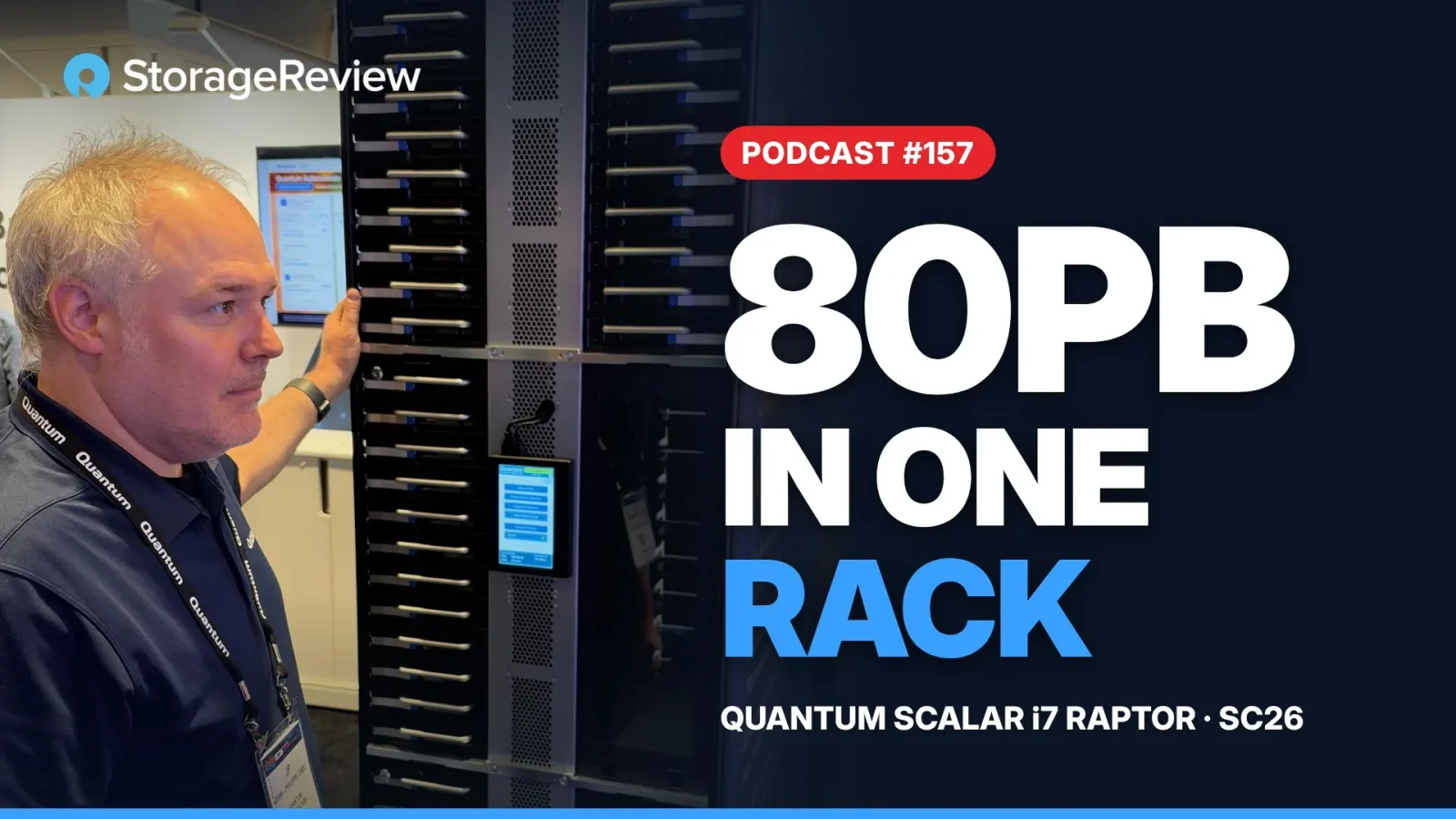
Brian caught up with Skip Levens, Head of Product Marketing at Quantum, at the company’s SC26 booth in Chicago for a short episode recorded in front of the Scalar i7 RAPTOR tape library. The subject was why tape demand is climbing again as AI and HPC sites pile up data, and the answer ran through LTO-10 capacity, a rack that holds 2,000 cartridges, and a robot built to be swapped in minutes.
We covered the Scalar i7 RAPTOR at its launch, the 40TB LTO-10 cartridge when the LTO Program announced it, and the 57 percent jump in LTO tape shipments reported for the first quarter of 2026.
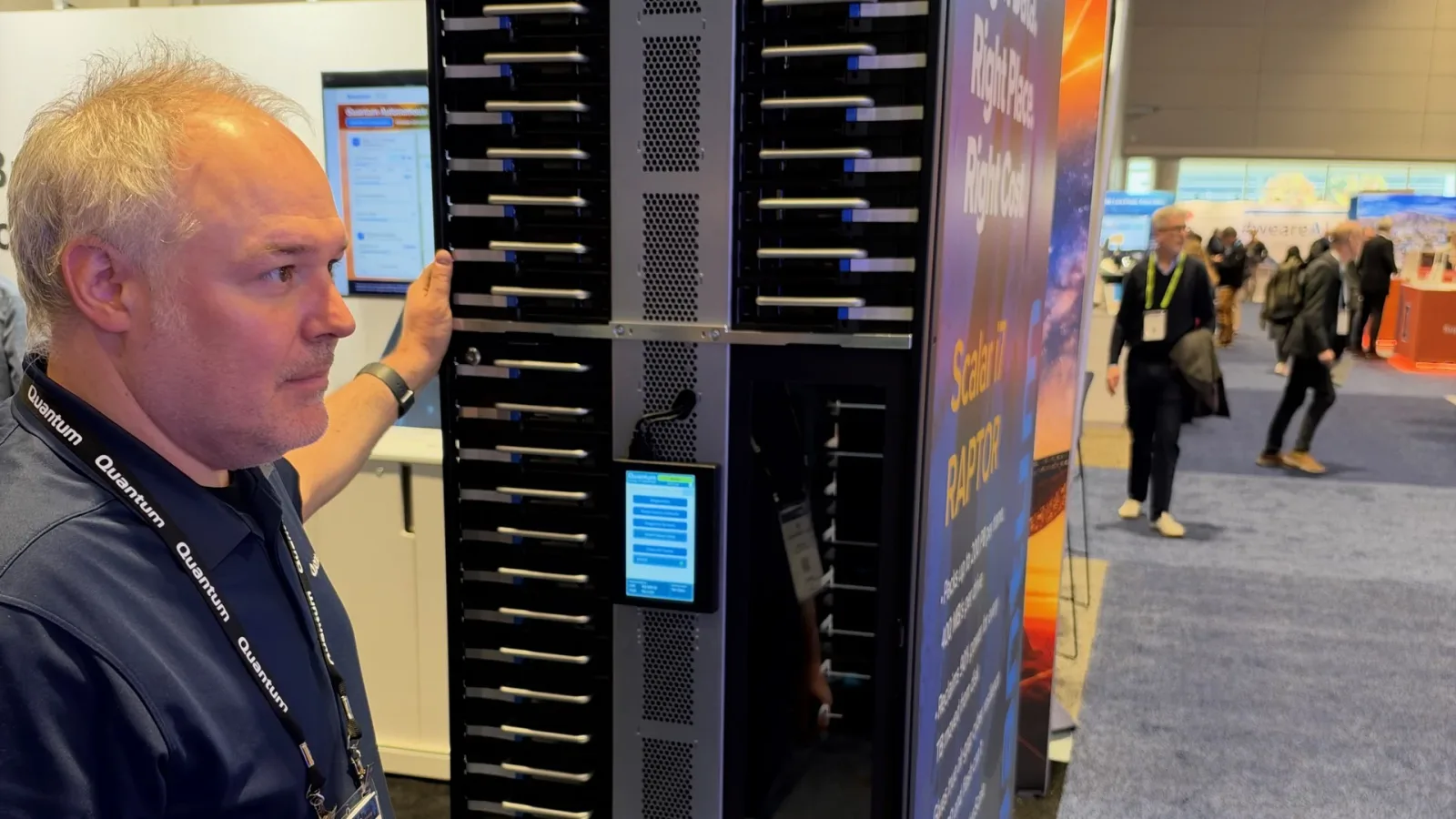
Skip leads product marketing at Quantum, where he works on positioning and go-to-market for enterprise and media data infrastructure. His background includes time at Apple, service in the U.S. Marine Corps, and a run of startups.
Quantum has been in our lab before, starting with Myriad, its software-defined all-flash platform, which we reviewed in 2023 and again in 2024, and we looked at Scalar Ransom Block as a physical barrier against ransomware in 2022.
The episode runs about seven minutes. The numbers that stuck with us, all from Skip: LTO-10 cartridges hold up to 40TB raw, one Scalar i7 RAPTOR rack fits 2,000 of them for up to 80PB raw or about 200PB when the data compresses, and a single system takes up to 20 drives at up to 400MB/s each.
[00:00] Why Tape Is Back
Brian opens on tape returning to the conversation with AI, and Skip agrees that the market has rediscovered it.
- Skip does not think sites want to keep petabytes and exabytes at scale on flash right now.
- Brian adds that cloud is a hard fit as well, because moving that much data in and out is difficult and regulated industries need chain of custody.
- Skip says LTO-10 media shipments are doubling, and he reads the forecast as a prime signal that buyers have moved back to tape.
[01:10] 40TB Cartridges and 2,000 Slots per Rack
The capacity math for a single rack starts with the LTO-10 cartridge.
- LTO-10 media reaches 40TB raw in a single cartridge.
- Skip says Quantum designed the Scalar i7 side by side with hyperscalers that wanted maximum density and the ability to swap any component in minutes.
- The result is a modular system that fits 2,000 cartridges in one rack, which Skip puts at up to 80PB raw and about 200PB if the data is compressible.
[02:00] Start Small and Keep the Media You Have
A full rack is the ceiling, and Brian asks where customers can begin.
- Customers choose how many drives to install, up to 20 in a single system, and scale out by adding more.
- A library can start with 12 or 24 tapes and grow from there.
- Earlier LTO generations are supported, and Skip says some customers will stay on LTO-9 for a while as part of their migration strategy.
[02:51] A Robot One Move From Any Cartridge
The robot gets the most attention at any tape booth, and this segment covers how it reaches media and how it is serviced.
- Cartridges sit two deep, so the robot pulls the front one, rotates, takes the one behind it, and returns the first without the library having to re-index.
- Skip says that leaves the robot one movement away from any piece of media, an efficiency that adds up across millions of operations.
- With the robot homed, Skip brings it out to show the head, which has two bays so it can hold one cartridge while it handles a second.
- Brian notes that customers can keep a spare robot on hand and swap it in if something fails.
[04:04] Up to 20 Drives at 400MB/s
Brian turns to the drives, the part of the library that sets how quickly data comes back.
- The system takes LTO-9 and LTO-10 drives, up to 20 of them.
- Skip says each drive delivers up to 400MB/s.
- Brian makes the case that tape is performant when reads are scheduled well, since 20 drives at that rate can move a lot of data back to primary systems.
[04:36] Tape as a Warm Tier
Skip argues that designers who think of tape as slow or offline are picturing a cloud archive service.
- He describes the Glacier experience as waiting weeks for data unless the customer pays to get it back fast.
- Owning the library changes that, and Skip says tape can almost be treated as a warm tier.
- Quantum uses tape to deliver a cold tier inside its object storage, and Skip says it all presents as one object storage pool.
[05:10] Research Data and What Comes Next
The show floor is full of universities and labs sharing large data sets, and the last segment ties tape to that work.
- Brian says scheduled data movement between institutions, such as sending a petabyte from one university to another, is a job tape can be part of.
- Skip says research and higher education sites feeding AI and HPC need to keep storing more data, and that tape is how they do it at scale without breaking a budget.
- Brian plans a visit to Quantum in Denver to go deeper on tiering and tape for large AI and HPC data sets.
You can read our Scalar i7 RAPTOR launch coverage, the LTO-10 40TB cartridge news, and the Quantum Myriad review for more background on the hardware discussed in the episode.
The post Podcast #157: Quantum’s Skip Levens on the Scalar i7 RAPTOR and 80PB of Tape in One Rack appeared first on StorageReview.com.