← Technology, Science & Infrastructure
▣ Distilled locally
Give Your Halloween Decorations an AI Brain
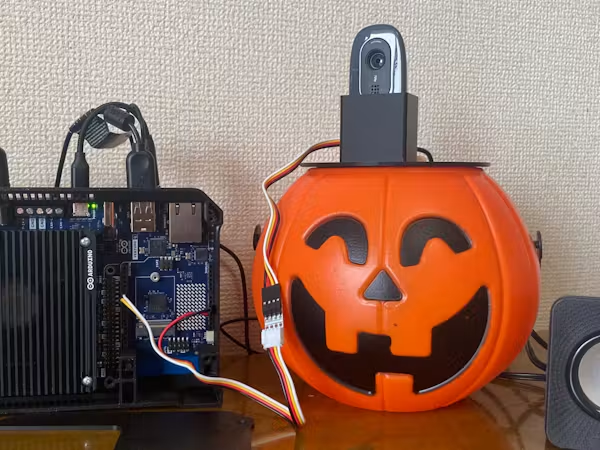
It's that time of year when scary jack-o'-lanterns with glowing faces are a common sight on people's front porches once again. But what if your Halloween decorations could do more than just look spooky? What if they could actually see people approaching, listen to their questions, and respond with creepy comments of their own? That's exactly what maker Naveen Kumar has accomplished with a project called Spooky Sassy Pumpkin , which uses an Arduino board to turn an ordinary plastic pumpkin into an interactive AI-powered Halloween decoration. Unlike traditional talking Halloween decorations that rely on simple motion sensors and prerecorded audio clips, this pumpkin can generate original responses based on what visitors say and what it sees through a camera. All of the AI processing happens locally, so it doesn't require an internet connection or cloud services that may give you a real fright with how they handle data privacy. The project is built around an Arduino VENTUNO Q, which combines a Qualcomm Dragonwing IQ8 processor with an STM32H5 microcontroller. The board provides 40 TOPS of neural processing acceleration and 16 GB of RAM, giving it enough computing power to run several smaller AI models simultaneously. A Logitech C270 webcam provides both video and audio input through its integrated microphone, while a small 3-watt speaker allows the pumpkin to talk. An M5Stack FlashLight Unit illuminates the pumpkin from within, producing lighting effects that change depending on what the AI is doing. Kumar used a plastic pumpkin decoration instead of a real one, then designed and 3D-printed a mounting bracket to hold the webcam and flashlight. The speaker and associated wiring are tucked inside the pumpkin, while the VENTUNO Q handles the processing. The software was developed using Arduino App Lab and includes four different AI models. A Qualcomm face detection model watches for approaching visitors, while a quantized Whisper Small model converts spoken questions into text. A Qwen3-VL-4B vision-language model analyzes the question alongside an image captured by the camera, then generates a response. Finally, a Melo text-to-speech model gives the pumpkin its voice. Kumar configured the vision-language model to behave like a spooky, sarcastic jack-o'-lantern, with responses limited to fewer than ten words. This keeps conversations entertaining while reducing the time required to generate speech. The pumpkin's internal lighting flickers like a candle while idle, glows steadily when listening, slowly pulses while thinking, and flashes rapidly when speaking. These effects are controlled independently by the STM32 microcontroller. When a visitor approaches, the pumpkin automatically greets them and begins listening. It can continue answering questions as long as someone remains nearby, then says goodbye when they leave. The project still has some limitations, particularly delays when initializing speech recognition that can cause it to miss the beginning of a question. Nevertheless, this project is a good example of how multiple AI models can work together on a single embedded platform to create interactive characters without relying on cloud computing. And with Halloween approaching, it's a fun way to give your decorations a little more personality.The Spooky Sassy Pumpkin is powered by local AI (📷: Naveen Kumar) The Arduino VENTUNO Q development board (📷: Naveen Kumar) The wiring diagram (📷: Naveen Kumar)
↑ Back to top
Originally published by Hackster News ↗
· rebuilt here from its own full-text RSS feed · all rights
remain with the publisher, please read and support them there.