← Technology, Science & Infrastructure
▣ Distilled locally
MIT's AI-Powered Bass Guitar Plays Along With You
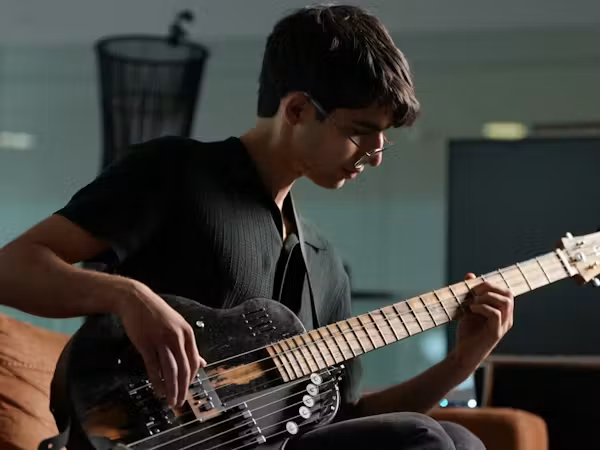
Artificial intelligence is getting pretty good at generating music, but most AI music tools work by producing digital audio from text prompts. That's a very different experience from actually playing an instrument. MIT Media Lab researcher Antonis Christou has taken another approach with Automatar , a custom-built bass guitar that uses AI to accompany a human musician in real time. Instead of generating synthetic audio, it physically vibrates its own strings to produce music. Automatar looks and plays much like a normal bass guitar, but it has some unusual hardware hidden inside. Alongside its four standard strings are five additional sympathetic strings that are controlled by an onboard AI system. As a musician plays, the instrument analyzes the notes and generates complementary harmonies by vibrating those extra strings electromagnetically. The intelligence comes from an NVIDIA Jetson Orin NX embedded inside the instrument. This compact computer runs small, MIDI-based AI models locally, eliminating the need to send audio to a cloud service for processing. A separate Bela Mini handles audio processing using SuperCollider, a programming environment designed for real-time audio synthesis and algorithmic composition. The system continuously monitors the instrument's strings, using pitch detection to identify the notes being played. These are converted into MIDI data and fed into the AI model, which determines how the additional strings should respond. But rather than simply playing the resulting notes through speakers, Automatar produces sound mechanically. The Bela Mini generates sine waves based on commands from the AI model, which are amplified using high-current operational amplifiers. These electrical signals drive electromagnetic actuators that cause the five sympathetic strings to vibrate at the desired frequencies. To build the instrument, Christou combined traditional woodworking techniques with modern fabrication tools, including CNC routers, milling machines, and 3D printers. The body and neck are made from Pale Moon Ebony, while the back is solid mahogany. The headstock features a mother-of-pearl inlay displaying the MIT Opera of the Future group's logo. Christou developed Automatar to explore how artificial intelligence might enhance traditional musical performance rather than replace it. The musician remains in control, while the AI acts as a responsive accompaniment that contributes to the performance. To see this unusual instrument in action, be sure to check out the video below. Automatar is an intelligent AI guitar (📷: MIT Media Lab) A closer look at the hardware (📷: MIT Media Lab) The instrument was built by hand (📷: MIT Media Lab)
↑ Back to top
Originally published by Hackster News ↗
· rebuilt here from its own full-text RSS feed · all rights
remain with the publisher, please read and support them there.