← Technology, Science & Infrastructure
▣ Distilled locally
A Touchscreen You Can Wear
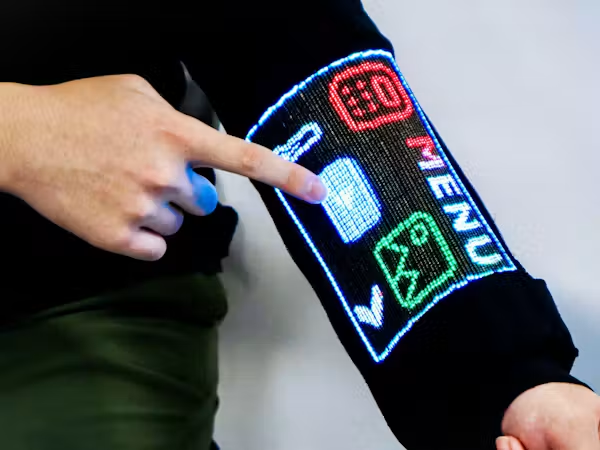
Touchscreens have found their way into just about everything, from phones and watches to refrigerators and cars. Clothing, however, has remained screen-free. That's not for a lack of interest in wearable electronics, but because conventional displays don't translate particularly well to something that needs to bend, breathe, and survive a trip through the washing machine. Researchers at the National University of Singapore (NUS) may have found a way around those limitations by building a touchscreen from electronic fibers that can be incorporated directly into fabric. The technology, developed by a team led by Assistant Professor Tural Khudiyev at NUS's College of Design and Engineering, combines individually addressable LEDs and touch sensing inside fibers that can be incorporated into textiles like yarn. To demonstrate the concept, the researchers wove 54 of the fibers into a sleeve, creating what they say is the world's first touchscreen integrated directly into a garment. Packing all of the electronics into a fiber required solving a problem that doesn't exist with conventional circuit boards. A fiber is essentially one-dimensional, leaving little room to arrange and connect electronic components. To deal with that problem, the researchers developed a manufacturing process that uses a laser to expose specific points along tiny insulated wires. Controlled surface wetting then causes molten solder to form connections only at those locations. This technique allowed more than 5,000 chips to be joined with over 20,000 electrical connections. The interconnected LEDs are subsequently incorporated into a multilayer fiber using a thermal drawing process. The resulting fiber is only one millimeter thick and can be up to 10 meters long. A separate layer beneath the LEDs provides touch sensing. Pressing the fiber completes a circuit, allowing the system to determine the location of the touch and illuminate the corresponding pixel. For the prototype sleeve, NUS researchers used 54 fibers containing 96 LEDs each to create a 168×105 mm display with a resolution of 96×54 pixels. It supports 8-bit color and runs at 30 frames per second. Multiple touches can be detected simultaneously, and each fiber has its own control channel, so the failure of one doesn't take down the rest of the display. The researchers also added specialized fibers containing a microphone, speaker, motion sensors, magnetometer, ambient light sensor, and temperature sensor. Together, the hardware lets the sleeve run a calculator, display photos, play video, act as a compass, respond to voice commands, receive images over Bluetooth, and automatically adjust its orientation and brightness. A temperature-sensing fiber positioned under the arm can also measure and display the wearer's body temperature. Testing showed that the fabric's light output and touch response remained nearly unchanged after 50 machine washes and 1,000 bends around a five-millimeter radius. The display also remains comparable in breathability to common fabrics such as cotton, polyester, and denim. The researchers are now working toward higher-resolution displays, additional sensing capabilities, and on-device AI. Eventually, the same approach could produce clothing that monitors the wearer and their surroundings while putting the interface for all of that information right on their sleeve.This touchscreen is built into clothing (📷: NUS) An individual fiber (📷: NUS)
↑ Back to top
Originally published by Hackster News ↗
· rebuilt here from its own full-text RSS feed · all rights
remain with the publisher, please read and support them there.