MinIO AIStor Memory Reaches GA at SC26 as Datadog Certifies AIStor for On-Premises BYOC Logs
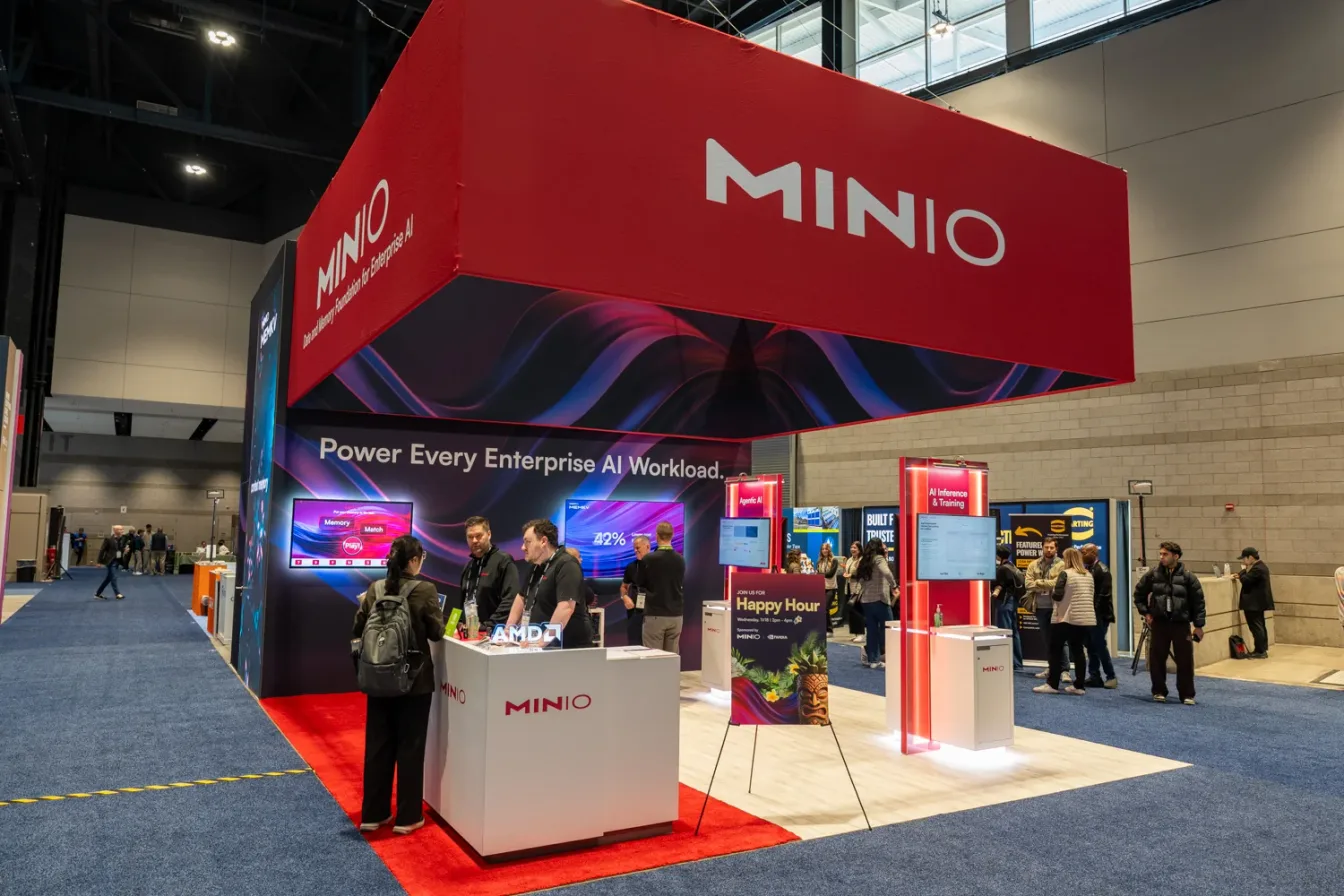
MinIO announced the general availability of AIStor Memory today at SC26, moving its agent memory layer out of the technology preview we covered in July. AIStor Memory keeps long-term memory, persistent workspaces, and secrets for AI agents on infrastructure the enterprise controls. MinIO also announced a partnership with Datadog, which has certified AIStor as an on-premises foundation for Datadog Bring Your Own Cloud (BYOC), so log data can stay in a customer’s AIStor cluster while Datadog’s tools query it. Both are available now, and the announcements mark two years since AIStor launched in November 2024.
Persistent Agent Context, Unified Table Storage
AIStor Memory stores what agents learn as governed organizational knowledge that authorized agents can reuse across sessions. MinIO says that reuse improves response quality while reducing latency and token costs, though it has not published figures for either. The GA release keeps the three components from the preview in one system: long-term memory, workspaces that persist between runs, and secrets management. MinIO has not said whether AIStor Memory is licensed separately, and its availability statement covers AIStor as a whole, including AIStor Tables and AIStor Memory.
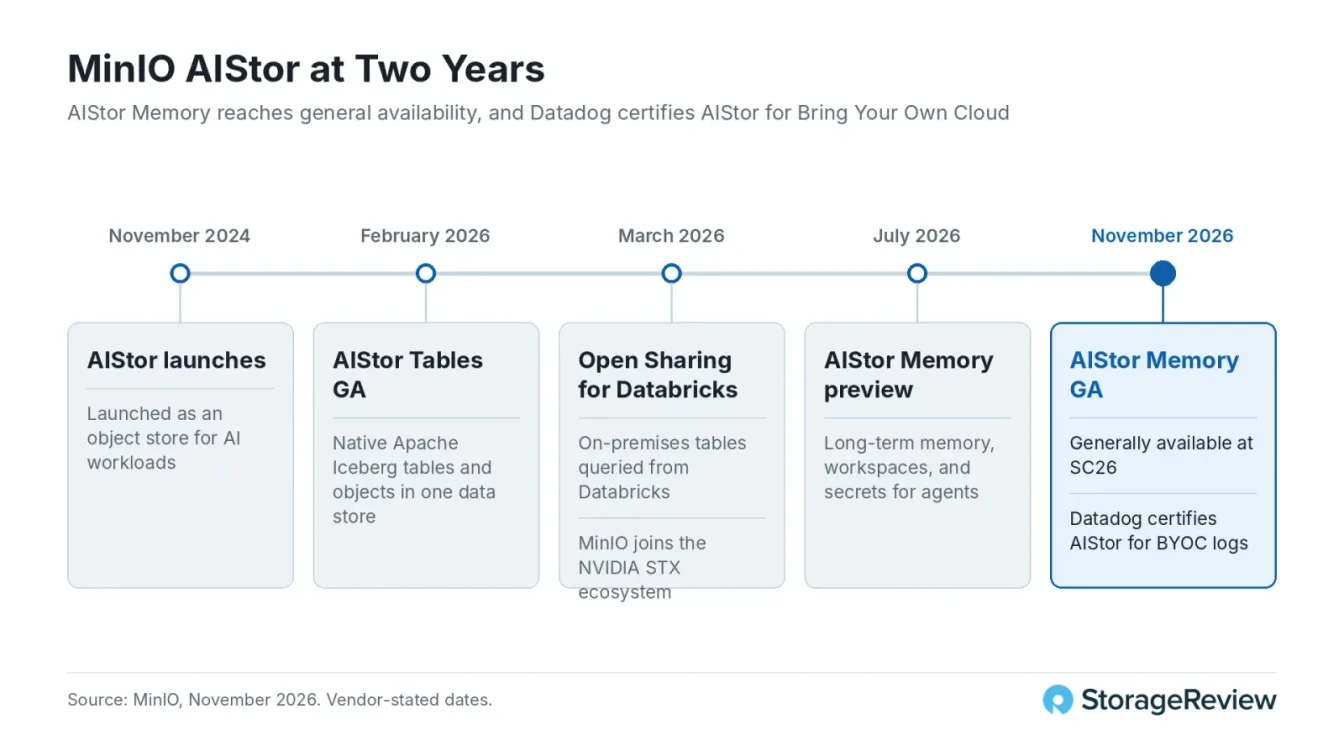
AIStor Tables, generally available since February, puts native Apache Iceberg tables and objects in the same data store. MinIO describes the result as a lakehouse in which Iceberg tables index logs, telemetry, financial transactions, machine-generated events, and vector embeddings alongside information from documents, audio, and video. A common catalog makes that data discoverable to analytics tools and authorized agents. AIStor Memory sits on the same store, so enterprises keep both the data agents read and the knowledge they generate on infrastructure they control.
Since launch, AIStor has added S3 Express API support, S3 over RDMA, and ExaPOD, a reference architecture developed with Intel, Solidigm, and Supermicro for exabyte-scale deployments. AIStor Open Sharing for Databricks, introduced in March, connects on-premises tables to Databricks without duplicate cloud datasets or replication pipelines, and Databricks named MinIO its 2026 ISV Storage Partner of the Year. Stephen Orban, SVP of product ecosystem and partnerships at Databricks, said teams can query on-premises Iceberg and Delta tables through OpenSharing and govern them in Unity Catalog.
Datadog BYOC Certification
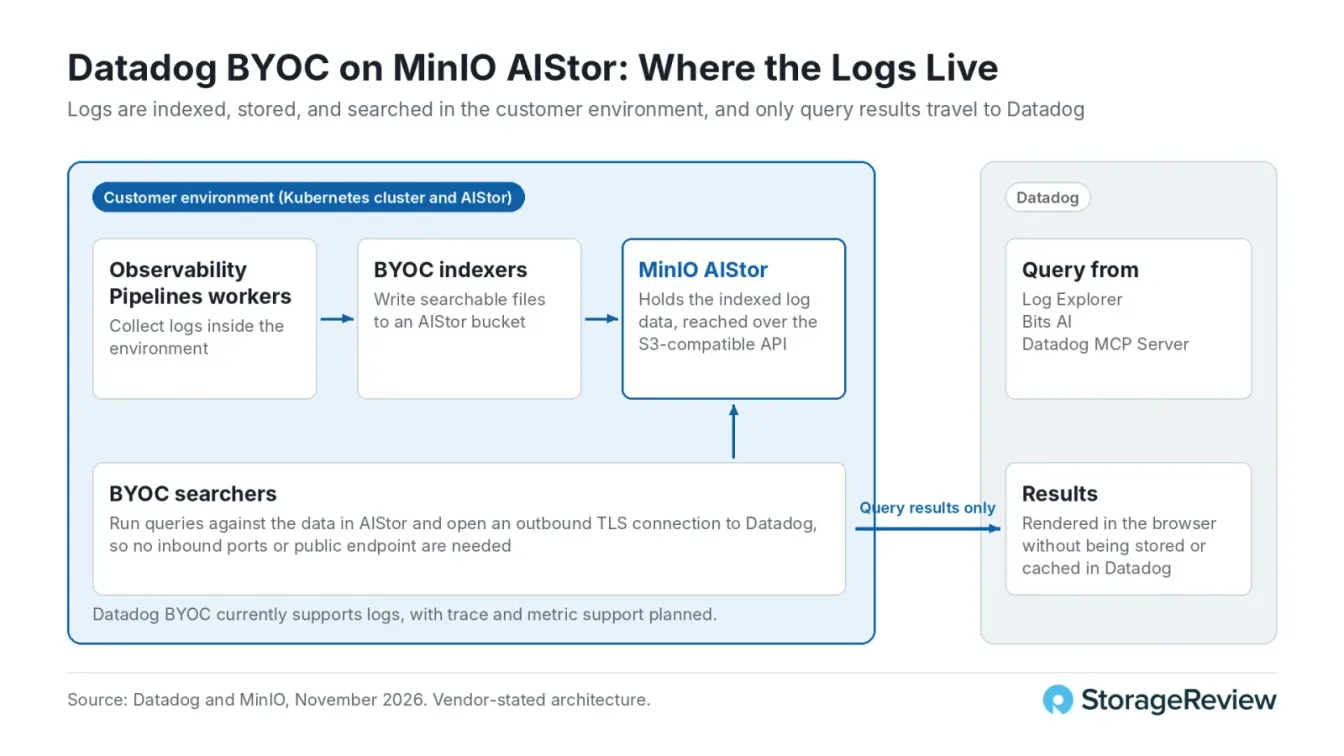
Datadog BYOC lets a customer ingest, retain, and search logs inside its environment while querying and correlating them with metrics and traces in Datadog. With AIStor as the storage layer, logs are written to the customer’s AIStor cluster, the BYOC engine runs in that environment, and only query results travel to Datadog. Datadog describes the pieces as Observability Pipelines workers that collect logs, BYOC indexers that write searchable files to an AIStor bucket, and searchers that connect to Datadog over an outbound TLS connection, with indexing and search running in the customer’s Kubernetes cluster.
MinIO pitches the arrangement at regulated industries such as financial services, healthcare, and telecom, and at teams that sample traffic, drop fields, or shorten retention to hold down log costs. Keeping every log on AIStor also means an investigation that reaches back months does not wait on a restore from a cold tier. Michael Whetten, SVP of Product at Datadog, said AIStor lets on-premises customers “keep every log locally without compromising on visibility.” Built-in key management supports encryption requirements, and AIStor Tables lets the same system hold Iceberg data beside the logs.
Datadog says BYOC currently supports logs, with trace and metric support coming, so the API-call and Model Context Protocol telemetry MinIO cites as a driver of log growth is covered to the extent it arrives as logs. Neither company defines what the certification tested, and neither has published sizing guidance, ingest rates, or query performance for the combination. MinIO says AIStor is priced on usable capacity with no per-operation or egress charges, and the store exposes native Prometheus metrics and OpenTelemetry tracing for monitoring AIStor itself.
NVIDIA and Micron Partner Work
MinIO joined the NVIDIA STX ecosystem in March and announced further work in May to support the NVIDIA Vera BlueField-4 STX storage architecture. On the flash side, Larry Hart, senior director of solutions marketing for Micron’s Core Data Center Business Unit, said testing of AIStor with Micron 6600 ION SSDs showed greater performance with lower demands on power and compute, and no figures from that testing were published. MemKV, which MinIO positions for inference context, remains a separate product from AIStor Memory.
MinIO AIStor
The post MinIO AIStor Memory Reaches GA at SC26 as Datadog Certifies AIStor for On-Premises BYOC Logs appeared first on StorageReview.com.