← Technology, Science & Infrastructure
▣ Distilled locally
Building a Smartwatch From Scratch
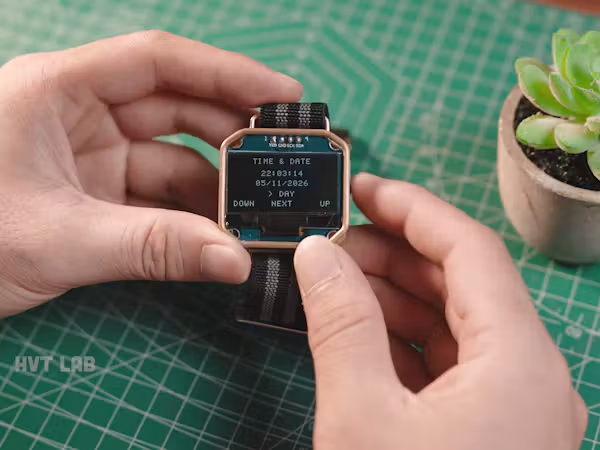
Building your own smartwatch might sound like a complicated project, especially when you consider how much technology manufacturers squeeze into such tiny devices. But you don't necessarily need custom circuit boards, specialized manufacturing equipment, or even a 3D printer to make one. YouTuber Huy Vector demonstrated this by building a fully functional smartwatch from scratch using an ESP32 microcontroller, a handful of inexpensive electronic modules, and some brass tubing. Vector constructed the watch's frame from 2 mm brass tubing, bending it into shape and soldering the pieces together. This exposed metal skeleton holds all the electronics in place while giving the watch a distinctive industrial appearance. The electronics include a 1.3-inch OLED display, which serves as the watch's primary interface. To make it fit within the compact frame, Vector carefully trimmed the corners of the display's circuit board. He also removed the pin headers, replacing them with connections made from rigid 1 mm brass wire. At the core of the watch is an ESP32-C3 microcontroller, which provides the processing power and wireless connectivity needed for its more advanced features. A separate real-time clock (RTC) module keeps track of the time even when the main system is powered down. Both the RTC and OLED display communicate with the ESP32 over a shared I2C bus, helping to minimize the number of connections required. Rather than running separate ground wires between every component, Vector soldered their ground connections directly to the metal structure. This effectively turns the frame into a common ground rail, reducing wiring clutter and making the finished assembly quite a lot neater. Power comes from a small 3.7 V lithium battery, paired with a miniature USB-C charging module. A slide switch controls the main power supply, and a three-way toggle switch provides a way to navigate menus and interact with the interface. Once the electronics were assembled, Vector attached a wrist strap and loaded custom open source firmware onto the microcontroller. The finished watch can connect to a smartphone over Bluetooth to synchronize the time, display notifications from apps, and alert the wearer to incoming calls. It also supports multiple watch faces, allowing the appearance of the display to be customized. To make the exposed electronics more practical for everyday use, Vector applied a protective water-resistant coating. This helps shield the components from sweat, rain, and accidental exposure to water, although it shouldn't be mistaken for the waterproofing found in commercial watches. Vector's smartwatch isn't as polished or feature-packed as a commercial model, but it's still quite capable. Aside from that, it's hackable and has a unique design. Check out the video below for more details about the build process. A DIY smartwatch (📷: HVT Lab) The required components (📷: HVT Lab) Assembling the hardware (📷: HVT Lab)
↑ Back to top
Originally published by Hackster News ↗
· rebuilt here from its own full-text RSS feed · all rights
remain with the publisher, please read and support them there.