← Technology, Science & Infrastructure
▣ Distilled locally
Giving a Robot Dog Some Muscle
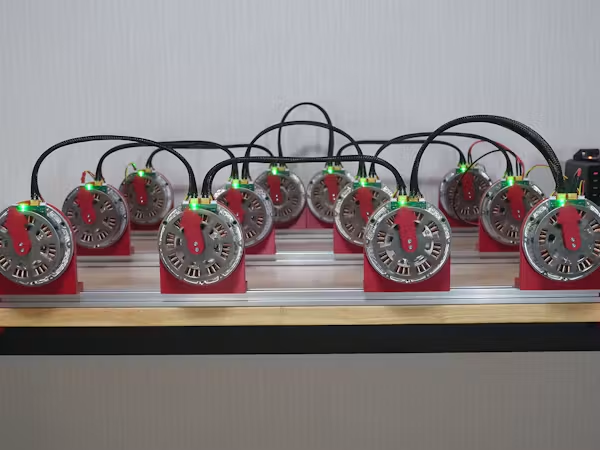
Building a robot dog from scratch is a major undertaking. There are plenty of mechanical, electrical, and software challenges to sort out along the way. One of the most important tasks is finding suitable actuators for the legs. They need to be powerful enough to move the robot, yet responsive and compliant enough to handle the impacts of walking and running. And since a typical quadruped needs 12 of them, the cost can add up quickly. Rather than spending a fortune on commercial actuators, YouTuber Koshiro Robot Creator decided to design and build his own. Koshiro's custom actuators use a quasi-direct drive design that combines a brushless DC motor with a low-ratio gearbox. The goal wasn't to make the smallest or most powerful actuator possible, but to develop something affordable, durable, and relatively easy to manufacture. With 12 identical units to build, keeping the design simple was especially important. Each actuator is built around a pancake-style brushless motor sandwiched between two custom CNC-machined aluminum plates. A large bearing supports the rotating assembly, while a custom PCB handles field-oriented control. The board also includes a magnetic encoder for position feedback, along with connectors that allow power and communication signals to be daisy-chained between actuators. Unlike some commercial designs that integrate the gearbox and electronics inside the motor's stator, Koshiro mounted these components externally. This makes the actuator a bit bulkier but simplifies assembly and wiring. It also keeps the 3D-printed gearbox away from the motor's heat, which could otherwise cause the plastic components to deform. For the gearbox, Koshiro chose a 9:1 cycloidal reduction drive rather than a planetary gearbox. The mechanism uses two offset cycloidal disks that move eccentrically within a ring of pins. This arrangement distributes loads across multiple contact points, reducing the likelihood of stripping or breaking the 3D-printed components when the robot's feet hit the ground. Before installing the gearbox, the bare motor was tested at speeds of up to 600 RPM. The custom controller supports impedance control, allowing the motor to behave like a virtual spring-damper. This is particularly useful for a walking robot, where compliant joints help absorb impacts and maintain stability. Adding the gearbox reduced the maximum output speed to approximately 67 RPM while significantly increasing torque. At peak load, the actuator produced around 10.5 N·m, compared with a theoretical 17.64 N·m. The difference is largely attributed to friction in the sleeve bearings and deformation of the printed parts. Despite these losses, the actuator remained backdrivable and demonstrated smooth position and impedance control. With the design working as intended, Koshiro manufactured all 24 aluminum plates, assembled 12 custom driver boards, and 3D-printed the gearbox components needed to complete the full set of actuators. The next step is to put three of these actuators together into a working robot leg before moving on to the complete quadruped. Koshiro has also released the CAD and PCB design files as open source, giving other makers a chance to build their own. There's still plenty of work to do before this robot dog takes its first steps, but at least it now has the muscles to make it happen. A set of 12 DIY actuators (📷: Koshiro Robot Creator) The primary components (📷: Koshiro Robot Creator) Assembling a motor (📷: Koshiro Robot Creator)
↑ Back to top
Originally published by Hackster News ↗
· rebuilt here from its own full-text RSS feed · all rights
remain with the publisher, please read and support them there.