← Technology, Science & Infrastructure
▣ Distilled locally
HD Graphics for Microcontrollers
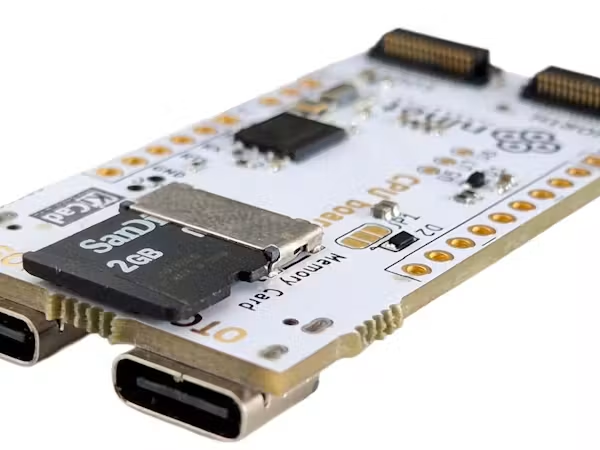
Adding a graphical interface to a microcontroller-based project may be more trouble than it's worth when a large, high-resolution display is involved. Most microcontrollers don't have the processing power or memory bandwidth needed to drive such displays. A single-board computer like a Raspberry Pi can solve that problem, but it also introduces the complexity of an operating system and additional hardware that may not be necessary. CuprumFlow Graphics aims to offer an alternative with a pair of small controller boards designed specifically for driving high-resolution graphical interfaces. The CuprumFlow Graphics platform consists of two boards, one built around a CPU and another that uses an FPGA. Both measure just 50×26 mm and work without an operating system. The CPU-based version supports resolutions up to 1920×1080, while the current FPGA model tops out at 1366×768. Both support 24-bit color and alpha transparency, making them suitable for applications ranging from industrial control panels and vehicle dashboards to interactive art installations and custom gaming systems. The platform offers support for several types of displays. Swappable adapters allow the boards to connect directly to laptop LCD panels through LVDS or eDP interfaces, conventional HDMI monitors using DVI, or older VGA monitors. This makes it possible to repurpose inexpensive laptop screens instead of purchasing specialized displays for embedded applications. Depending on the model, the boards include 64 MB, 128 MB, or 256 MB of DDR memory, along with a microSD card slot for storing images, fonts, and other graphical assets. USB host functionality supports peripherals such as keyboards, mice, and touchscreens, allowing developers to create complete human-machine interfaces. The development environment was designed to be easy to use, with an Arduino-style C++ API and MicroPython support. Using these tools, developers can draw graphics, display images, and create interactive interfaces, all in a bare-metal environment. The FPGA version has a useful tool for those unaccustomed to working with programmable logic. Normally, developers who want to accelerate graphics operations in FPGA hardware need to describe those operations using a hardware description language such as Verilog or VHDL. CuprumFlow Graphics instead uses a custom transpiler that converts ordinary C-compatible graphics code into FPGA hardware accelerators. This means the same code used to draw lines, rectangles, and alpha-blended images can run as software on a PC or the CPU-based board, or be converted into dedicated hardware on the FPGA. According to the developers, testing has shown performance to be several times faster compared to pure software implementations. CuprumFlow Graphics is an open source project supported by funding from the NLnet Foundation. Its GitHub repository currently provides schematics and previews of the software, with additional code scheduled for release following testing. A crowdfunding campaign is also being prepared, although pricing and availability have not yet been announced.CuprumFlow Graphics makes it easy to add a UI to a microcontroller project (📷: CuprumFlow) A high-resolution display being driven by the device (📷: CuprumFlow) The board comes in two varieties (📷: CuprumFlow)
↑ Back to top
Originally published by Hackster News ↗
· rebuilt here from its own full-text RSS feed · all rights
remain with the publisher, please read and support them there.