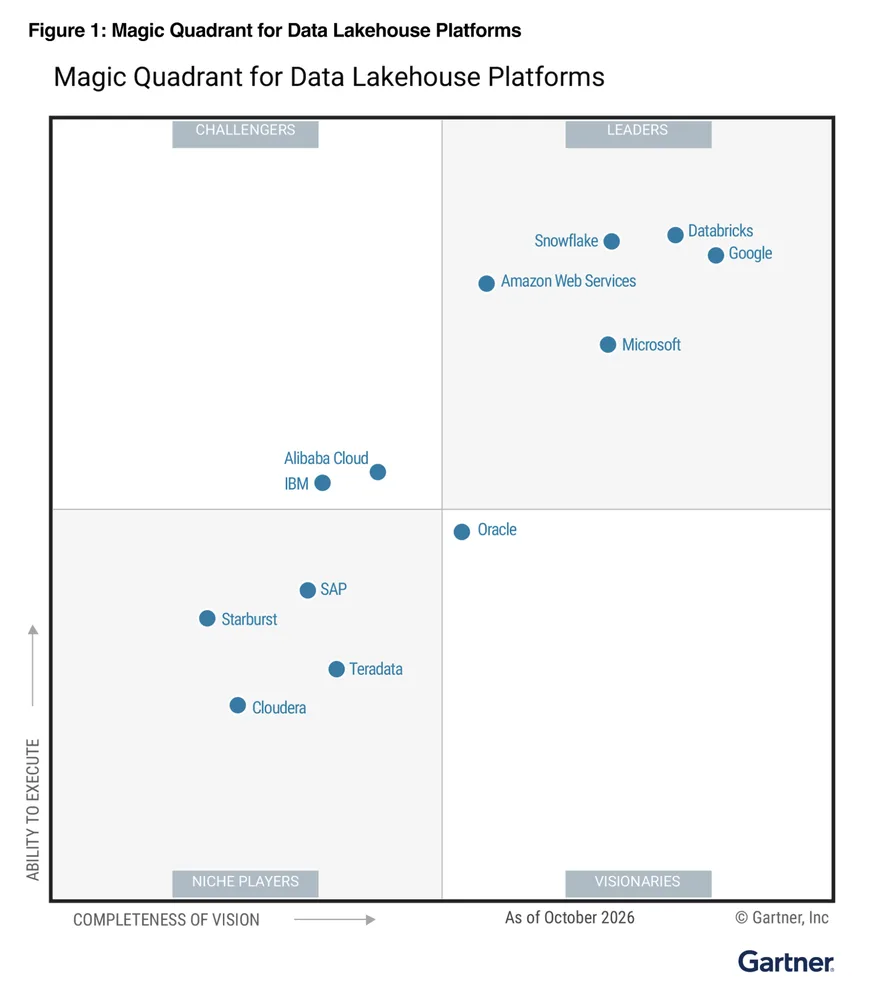
Google named the furthest in vision for the Gartner Magic Quadrant for Data Lakehouse Platforms
Gartner has named Google a Leader, positioned furthest in vision, in its first-ever Magic Quadrant for Data Lakehouse Platforms. In our opinion, this recognition validates a fundamental shift our customers are experiencing every day: In the agentic era, the enterprise lakehouse is no longer a passive data repository, but a foundation where agents reason and act across all your data.
The lakehouse originally emerged to bring data warehouse reliability to open, low-cost storage, but the benchmark defining the category is now shifting. Leading enterprises are moving rapidly from static reporting to autonomous AI agents that monitor operations, flag anomalies, and execute business workflows in real time. To support that shift, organizations need a platform where thousands of agents can read, reason, and act continuously across enterprise data without having to move that data first. Traditional, fragmented data stacks burdened by brittle pipelines, duplicated storage, and disjointed governance simply were not designed for the scale, performance, and latency required for agentic-scale workloads.
We engineered our borderless Lakehouse at every layer of the stack to eliminate this complexity and hidden cost. Specifically designed for agents to reason across petabyte-scale data, the borderless Lakehouse unifies your data estate across clouds, data platforms, and SaaS applications so you can ground agents in governed business context and bring Gemini directly to your data. This allows your teams to move from managing infrastructure to orchestrating business outcomes.
Activate your global data footprint in place
For most organizations, the biggest barrier to scaling AI is that enterprise data lives everywhere, spanning multiple clouds, operational databases, and SaaS platforms. Moving all of that data into a single physical location is slow, expensive, and introduces governance risk.
Our borderless Lakehouse acts as the bridge across your distributed environment to activate your data. Built on open Apache Iceberg, it connects your multi-cloud, SaaS, and operational data into a single governed fabric. Organizations can start analyzing datasets across AWS, Azure, and Google Cloud immediately without costly data copies or complex migrations, benefitting from:
- Openness without performance trade-offs: Run analytics and AI across BigQuery and Managed Service for Apache Spark directly on open Iceberg tables with similar price-performance as native storage.
- High-speed cross-cloud economics: Establishing private, high-speed paths to AWS and Azure is simple and cost-effective through Cross-Cloud Interconnect and intelligent caching. By caching only the active data blocks your queries touch, the lakehouse serves repeated lookups locally, protecting data residency and eliminating variable egress fees.
- Vertically integrated security and governance: Keeping data protected wherever it resides is non-negotiable. Credential vending in Lakehouse runtime catalog helps ensure security policies travel directly with your agents wherever your data resides.
German banking leader Commerzbank built its AI strategy on our borderless Lakehouse and Apache Iceberg to deploy AI agents across contact centers and marketing while satisfying strict European banking regulations. A unified foundation now powers AI across the bank. The marketing team reduced campaign production times from weeks to days and empowered contact center agents with verified next steps in seconds.
Agents need business context, not just access
An autonomous agent is only as accurate as the business context it understands. The lakehouse bridges the gap between agents and enterprise data, automatically harvesting metadata directly from your storage layers and passing it to your context engines. The Lakehouse runtime catalog integrates directly with Knowledge Catalog, which acts as your universal context engine for your enterprise data. It autonomously aggregates and curates metadata and semantic context from all your sources, within and outside Google, enriches them to extract meaning, and serves this unified context to all the agents that you build and use. Key Knowledge Catalog capabilities include:
- Unified aggregation across the enterprise: A single, governed semantic layer prevents metric drift across multi-cloud assets. With the general availability of expanded aggregation in Knowledge Catalog, organizations can unify metadata, metrics, and business logic across Looker, dbt, and BigQuery in one plane.
- Turnkey agent grounding: Anchoring agents in verified business logic accelerates development and builds trust. Gemini grounded with Knowledge Catalog and context sets, both in preview, let teams package curated metrics and instructions into token-efficient bundles that agents consume via standard APIs and Model Context Protocol.
- No-code context optimization: Delivering only the most relevant context reduces latency, lowers token costs, and prevents expensive reasoning loops. With a new studio experience in Knowledge Catalog, in preview, data stewards get an agentic-first, no-code environment to resolve definition gaps and securely govern the exact context that agents are authorized to access.
Bloomberg Media grounded their conversational queries directly in the Knowledge Catalog semantic layer, achieving a 63% improvement in query accuracy and eliminating hallucinations across their business teams.
Business context is only half the equation. Because agents act rather than just analyze, your analytical lakehouse and operational databases have to behave as one system. That is why BigQuery, Managed Service for Apache Spark, Spanner, and AlloyDB are built to work together, making the borderless Lakehouse the data foundation for the entire Agentic Data Cloud.
Empowering practitioners with an agentic lakehouse
Unlocking the full potential of your lakehouse requires transforming how people work with data. Historically, data engineers, data scientists, and business users operated in disconnected silos. The lakehouse acts as the collaborative connective tissue by integrating directly with Gemini, allowing you to build, test, and operate AI agents directly on top of your unified lakehouse data.
- Intent-driven workflows for technical teams: With the Data Agent Kit, data practitioners can write code, build notebooks, and run ML models directly from their preferred IDEs and CLIs using simple text prompts. Instead of writing boilerplate code from scratch, teams can use pre-built agentic skills and MCP tools to build complex data pipelines and work seamlessly across 15+ Google Cloud data services
- Proactive and personalized insights for business users: Conversational analytics gives business users trusted answers in plain language, without waiting on data teams to build custom reports. One-click publishing extends this, instantly turning approved technical models into conversational tools, allowing employees to ask plain-language questions, run accurate reports, and safely ground custom agents in daily workflows without any coding experience.
PayPal connected their Looker semantic models directly to AI agents using these capabilities, allowing business intelligence teams to define metric models once so that 5,000 employees could query live data with near 100% accuracy, accelerating insights by 50%.
Bringing AI-powered engines to the Lakehouse
To make decisions that impact your business in real time, AI agents need to run complex reasoning loops directly where your data lives. We bring Google's leading artificial intelligence and high-performance processing engines directly into open table formats, enabling you to extract massive value without the complexity of duplicating data. Consider the following use cases:
- Running analytics at unprecedented scale: Driving real-time actions over petabytes of open data requires highly optimized compute. In BigQuery we've made queries over 40% faster while cutting query processing cost by more than 50% through intelligent optimizations like fluid scaling and built-in workload acceleration, while our Lightning Engine for Apache Spark runs open-format Spark workloads with an over 3x price-performance advantage over the leading alternative.
- In-place AI and machine learning: With TabFM in preview, business teams can generate instant predictive insights on tabular data through simple SQL queries, while TimesFM 3.0 in BigQuery provides advanced multivariate forecasting over existing data.
- Cost-effective agent-scale data processing: Agents query data continuously and in short bursts, so paying for idle compute quickly adds up. BigQuery fluid scaling introduces per-second billing with no minimum duration, removing the costly one-minute minimum to deliver up to 34% in compute cost savings.
Maximize efficiency at scale without cost spirals
Google Cloud's borderless Lakehouse redefines enterprise AI economics by delivering compounding savings across compute, AI processing, and token consumption. As agents apply AI across millions of rows, token spend can quickly become a very large line item. Knowledge Catalog prevents expensive token consumption by filtering and delivering only the precise metadata and metrics required for each prompt, avoiding the need to send massive, unorganized datasets to your LLMs, significantly reducing token consumption. BigQuery AI adds built-in token controls that let teams estimate usage before a query runs, set firm limits, and automatically switch to smaller, more efficient models through an optimized mode. The result is BigQuery's cost-optimized AI functions use 230x fewer tokens compared to row by row gen AI processing.
What’s next?
To learn more about our placement and how we think we can accelerate your data journey, download the complimentary 2026 Gartner Magic Quadrant for Data Lakehouse Platforms report.
Gartner, Magic Quadrant for Data Lakehouse Platforms, Aaron Rosenbaum, Michael Gonzales, Masud Miraz, Ramke Ramakrishnan, Xingyu Gu, Robin Schumacher, Prasad Pore November 4, 2026
Gartner and Magic Quadrant are trademarks of Gartner, Inc. and/or its affiliates.
Gartner does not endorse any company, vendor, product or service depicted in its publications, and does not advise technology users to select only those vendors with the highest ratings or other designation. Gartner publications consist of the opinions of Gartner’s business and technology insights organization and should not be construed as statements of fact. Gartner disclaims all warranties, expressed or implied, with respect to this publication, including any warranties of merchantability or fitness for a particular purpose.
This graphic was published by Gartner, Inc. as part of a larger research document and should be evaluated in the context of the entire document. The Gartner document is available upon request from Google.