← Technology, Science & Infrastructure
▣ Distilled locally
The Omnibot Finally Got the Brains It Deserves
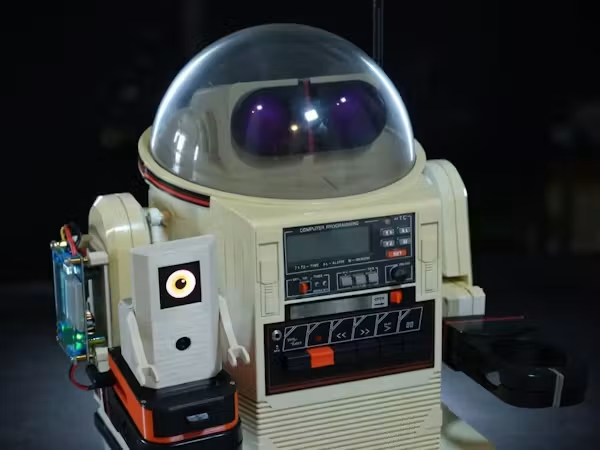
In 1984, Tomy released the Omnibot, a toy robot that promised to bring a little bit of the future into people's homes. It could drive around, play cassette tapes, and carry drinks on a built-in serving tray. But despite its futuristic appearance, the Omnibot wasn't particularly intelligent. It relied on remote control and prerecorded commands to get anything done. More than four decades later, maker Mario Cruz has given one of these vintage robots the brains it always deserved, using a Raspberry Pi, an AI camera, and a 3D-printed companion named Ring-O. The project began when Cruz received a donated Omnibot at Moonlighter FabLab in Miami. Unfortunately, decades of neglect had taken their toll. Leaking batteries had damaged the circuit board, and the rubber wheels had deteriorated. With some cleaning and soldering work, Cruz was able to bring the robot roaring back to life — but that was only the beginning of the project. The Omnibot's original cassette deck used audio tones to control its movements. Different frequencies corresponded to commands such as moving forward or turning left. Cruz realized that he could exploit this functionality to control the robot wirelessly, without replacing its original electronics. By installing a Bluetooth cassette adapter and writing a Raspberry Pi script to generate the appropriate tones, he was able to send movement commands directly from a computer. Cruz still wanted to take things further, so he teamed up with maker Placitech to develop Ring-O, a small 3D-printed companion that rides along with the Omnibot. Inside is a Raspberry Pi 5 with 8 GB of RAM, a Sony IMX500 AI Camera, a cooling fan, a battery, and a 128×128-pixel OLED display that serves as an animated eye. The camera runs a YOLO11-nano object detection model directly on its own hardware, recognizing 80 classes of everyday objects. This allows the robot to identify people, animals, and other objects without burdening the Raspberry Pi with the inference workload. Initially, Cruz used a cloud-hosted large language model to decide how the robot should move. After finding that this approach not only took 15 seconds to respond but was also doing a terrible job, he hardcoded some simple rules to govern movement. It may not be cutting-edge tech, but it works well and it's fast. Ring-O's animated eye blinks, follows movement, and reacts to detected objects. A web-based interface lets users give the robot commands such as finding a person, locating a shoe, or performing a dance routine. An LLM is available to generate spoken descriptions of what the camera sees. The project's source code is available on GitHub under an MIT license. Perhaps the most impressive part of the project is that the robot's original motor control electronics are still doing their job more than 40 years later. With a little modern hardware and some clever software, Cruz has finally made good on the futuristic promises Tomy made back in 1984.An Omnibot with some modern upgrades (📷: Placitech) Bringing new and old together (📷: Mario Cruz) Looking good, Omnibot! (📷: Mario Cruz)
↑ Back to top
Originally published by Hackster News ↗
· rebuilt here from its own full-text RSS feed · all rights
remain with the publisher, please read and support them there.